
Eric Sepanek
SBC Founder
Eric Sepanek is the founder of Scottsdale Bullion & Coin, established in 2011. With extensive experience in the precious metals industry, he is dedicated to educating Americans on the wealth preservation power of gold and silver.

Add SBC on Google as a preferred source to see more market related news like this when you search.


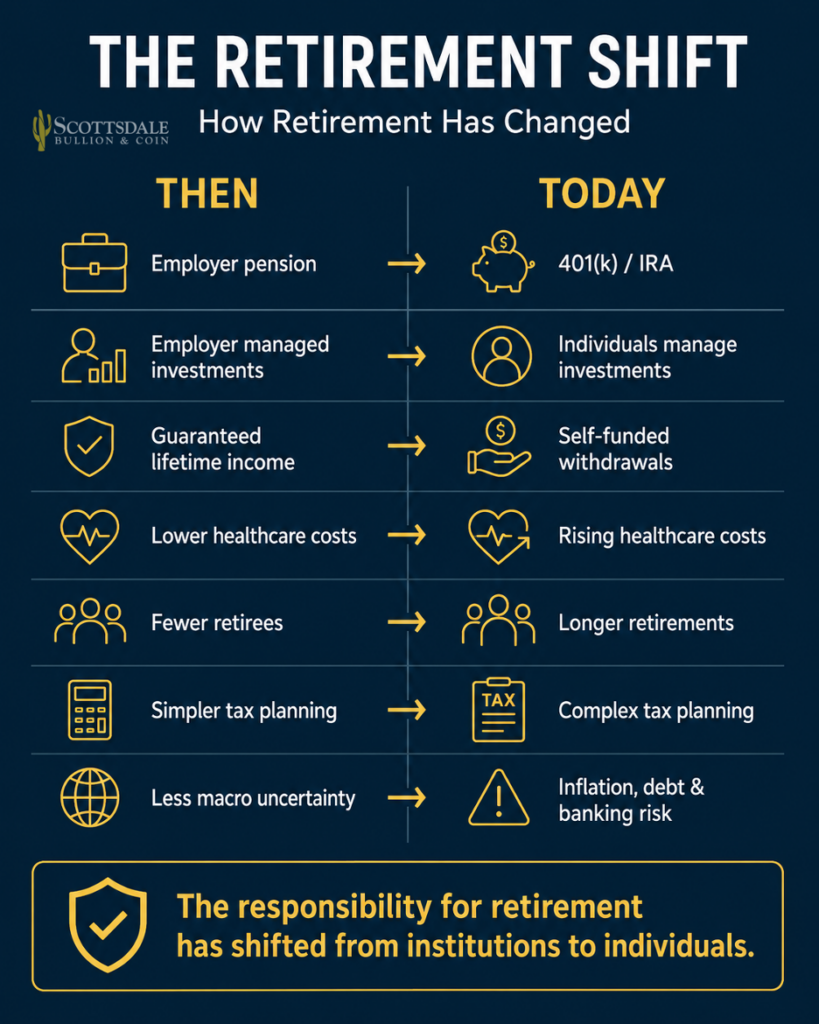
Long gone are the days when workers could simply set aside a portion of each paycheck, remain with one employer for decades, and retire on a dependable pension. Longer lifespans, declining access to guaranteed retirement income, rising healthcare costs, inflation, and greater market uncertainty have placed far more responsibility on individual investors.
These changes have prompted many investors to rethink not only how much they save for retirement, but also what they hold inside their retirement accounts. As traditional retirement strategies become more difficult to rely on alone, gold IRAs have emerged as one way investors seek to diversify their retirement savings with physical precious metals while preserving the tax advantages of an IRA.
To understand why gold IRAs have gained traction, it’s first important to understand how retirement itself has changed.
Key Takeaways
- Longer lifespans, declining pension coverage, rising costs, and greater individual responsibility have fundamentally changed retirement planning.
- Retirees today face a broader mix of risks, including inflation, market volatility, healthcare costs, banking instability, and fiscal uncertainty.
- Gold IRAs allow investors to hold eligible physical precious metals within a tax-advantaged retirement account.
- Physical gold can add diversification beyond traditional stocks, bonds, funds, and other financial assets.
- Gold IRAs may help investors preserve purchasing power and reduce exposure to certain forms of counterparty risk.
- A Gold IRA is generally best viewed as a long-term wealth-preservation allocation rather than a short-term trade.
How Retirement Planning Has Changed

People Are Living Longer
One of the biggest, and completely uncontrollable, reasons retirement planning has changed is the steady rise in life expectancy. Thanks to advances in medicine, healthcare, and overall living standards, Americans are living significantly longer.
Someone who reaches age 65 today can expect to live approximately 20 more years, up from 15 years in 1970, according to the Social Security Administration. That means retirement savings need to last far longer than they once did, increasing the risk of retirees outliving their assets.
The Decline of Traditional Pensions
For much of the 20th century, retirement income was built around employer-funded pensions that delivered predictable, lifetime payments. That system has largely disappeared from the private sector. The Congressional Research Service reveals that private-sector workers with access to a traditional defined benefit pension fell from 38% in 1980 to 22% in 1998. Today, that figure has collapsed to 14%, according to the Bureau of Labor Statistics (BLS).
In its place, defined contribution plans such as 401(k)s have become the dominant employer-sponsored retirement model. This shift transfers investment risk, longevity risk, and the responsibility of generating sustainable retirement income directly onto individuals, fundamentally changing how retirement security is built and maintained.
Social Security is Fiscally Unsustainable
Social Security has long served as a financial backstop for retirees, but its future is far less certain than it once was. Ongoing demographic pressures and funding shortfalls have put the program on a fiscally unsustainable path.
The 2026 Social Security Trustees Report reveals that the program can only make full scheduled benefits until 2034. After that, recipients would only receive 83% of scheduled benefits if no reforms are enacted.
That funding gap will likely require lawmakers to consider difficult policy choices, such as higher taxes, changes to eligibility, or adjustments to future benefits. This adds another layer of uncertainty for retirees who already shoulder more responsibility for their retirement income than previous generations.
The Cost of Living & Healthcare Are Rising
Rising living expenses have become one of the most persistent pressures on modern retirement plans, with healthcare costs standing out as a major driver. Housing, food, and other essentials consume a substantial portion of retirees’ budgets, while healthcare costs have historically risen faster than overall inflation.
Fidelity estimates that a 65-year-old retiring in 2026 can expect to spend an average of $185,500 on healthcare and medical expenses over the course of retirement. Crucially, this stat doesn’t take into account long-term care expenses.
Over time, rising costs steadily eat away at purchasing power, forcing retirees to rely more heavily on their savings. The result is a higher financial hurdle, as retirees must accumulate significantly more just to preserve the standard of living their savings once provided.
Individuals Now Manage Their Own Risk
Unlike past generations who received automatic, lifetime income through employer pensions, today’s retirees rely largely on account balances rather than guaranteed payments. That shift forces individuals to actively decide how much to withdraw, how to invest remaining assets, and how to respond to market downturns, all while managing the risk of outliving their savings.
Market declines early in retirement can permanently reduce income, a challenge pension recipients rarely faced. Unsurprisingly, the Employee Benefit Research Institute reports that 43% of workers aren’t sure where to look for reliable financial or retirement-planning advice, underscoring how much responsibility has shifted from institutions to individuals.
Retirement Tax Planning Is More Important Than Ever
A huge difference between the pension era and today is how much tax uncertainty retirees now face. Traditional pensions were typically taxed as ordinary income, but the payments were fixed and predictable, giving retirees a relatively clear picture of their annual tax burden.
Modern retirees, however, often rely on a mix of 401(k)s, traditional IRAs, Roth accounts, and taxable investments, where the taxes they owe can depend on withdrawal timing, investment performance, and future tax policy. As a result, tax strategy has become a far more important part of retirement planning than it was for earlier generations.
Retirees Face a New Generation of Economic Risks
The retirement system has changed dramatically over the past several decades. Employer-sponsored pensions have largely disappeared from the private sector, and Social Security faces growing long-term fiscal challenges.
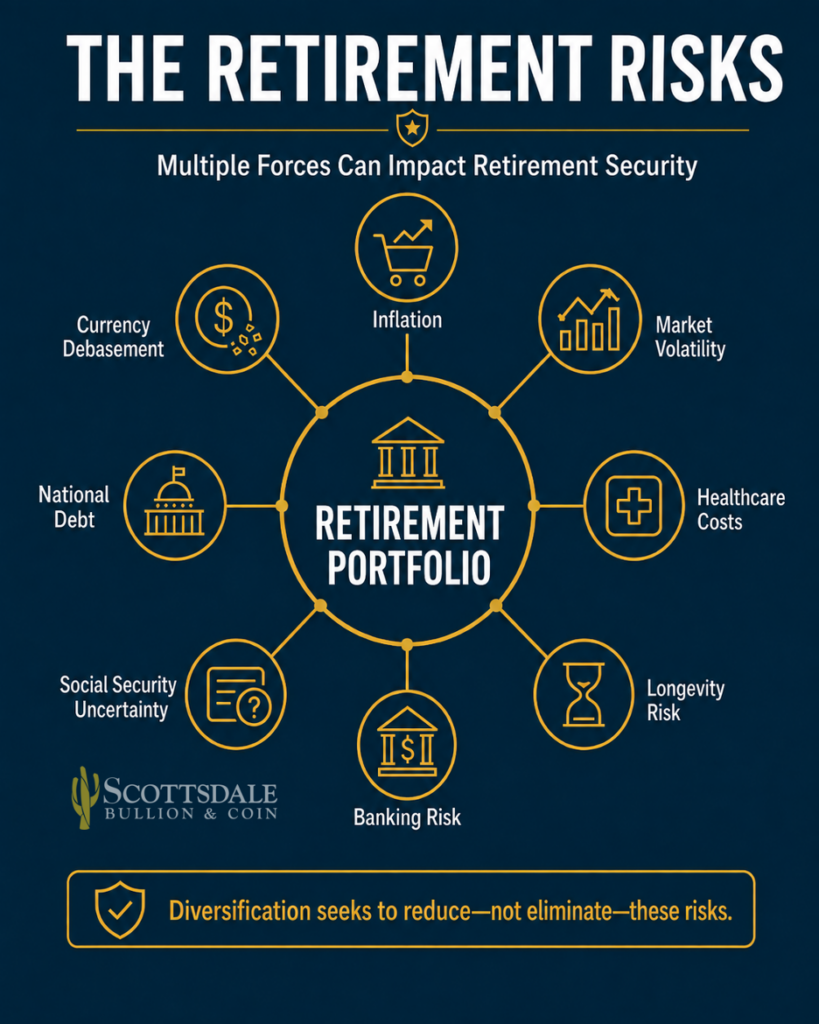
Yet the retirement system itself is only part of the equation. Today’s retirees must also navigate an increasingly complex landscape of macroeconomic, political, and geopolitical risks that can directly affect the value of their savings and their long-term financial security.
Market Volatility & Timing Risk
Market cycles have become sharper and more disruptive, exposing retirees to risks that were far less pronounced in earlier decades. Instead of steady growth punctuated by occasional downturns, investors now face faster boom-bust cycles that can derail retirement plans at the worst possible moment. The S&P 500 has suffered three declines of 20% or more in just the past 20 years, underscoring how frequently severe drawdowns now occur.
For retirees, the timing of these declines matters enormously. Morningstar research shows that retirees who experience the weakest investment returns during their first five years face a substantially greater risk of exhausting their savings over a 30-year retirement. In this environment, retirement planning increasingly requires built-in volatility buffers to avoid locking in losses during the withdrawal phase.
Inflation & Federal Reserve Policy Cycles
Since the 2008 financial crisis, the Federal Reserve has relied more heavily on aggressive interest-rate adjustments and periods of large-scale monetary stimulus to support the economy. While these policies can help stabilize financial markets and support economic growth, they can also contribute to long-term inflationary pressures that erode purchasing power. Inflation steadily chips away at the real value of savings, leaving retirees with less savings over time.
BLS data shows that $1.00 in January 2000 requires $1.98 in mid-2026 to purchase the same basket of goods and services. Put another way, the dollar’s buying power has been slashed in half over the past quarter century. In this environment, retirement portfolios must be built to preserve real, inflation-adjusted purchasing power, not just nominal account balances.
Banking System & Liquidity Risks
The regional banking turmoil of 2023 reminded investors that even FDIC-insured banks can fail when rising interest rates, unrealized investment losses, and rapid deposit withdrawals collide. Three of the largest bank failures in U.S. history occurred that year, highlighting how quickly confidence and liquidity can unravel. While the FDIC insures eligible deposits up to $250,000 per depositor, its Deposit Insurance Fund remains only a fraction of the trillions held in insured bank accounts.
Banking stress can also spread beyond deposits, pressuring stocks, bonds, money market funds, and other paper assets connected to the broader financial system. As a result, even a diversified retirement portfolio may remain heavily exposed to systemic and counterparty risks. These concerns have renewed attention on bank bail-ins and other resolution mechanisms that can impose losses on shareholders and certain creditors when major financial institutions fail.
Weakening Dollar & Global Reserve Shifts
The U.S. dollar remains the world’s reserve currency, but central banks have gradually reduced their reliance on it as they diversify across currencies and hard assets. According to the International Monetary Fund, the dollar accounted for 57% of global foreign exchange reserves in the first quarter of 2026, down from roughly 71% in 1999.
This shift away from the USD has significantly benefited gold, as central banks pour into the physical metal to the tune of 1,000 tonnes per year on average between 2022 and 2025. In fact, gold overtook the dollar and euro in foreign reserves in total value. With the dollar undergirding the entire financial structure upon which retirees build their nest egg, the global trend of de-dollarization further complicates long-term financial planning.
Rising U.S. National Debt
The accelerating national debt has gone from a niche issue on Capitol Hill to an active concern for investors and retirees alike. The Congressional Budget Office recently reported that debt held by the public is 100% of gross domestic product (GDP) and is expected to hit 118% by 2035. Meanwhile, rapidly rising interest costs already exceed $1 trillion annually, creating a snowball effect.
The more tax dollars put toward servicing the national debt and making up for persistent federal deficits, the more likely policymakers will be forced to cut spending, raise taxes, or inflate the currency. These long-term fiscal challenges highlight the importance of maintaining buying power and building a diversified portfolio to withstand an uncertain fiscal policy climate.
Why More Investors Are Turning to Gold IRAs
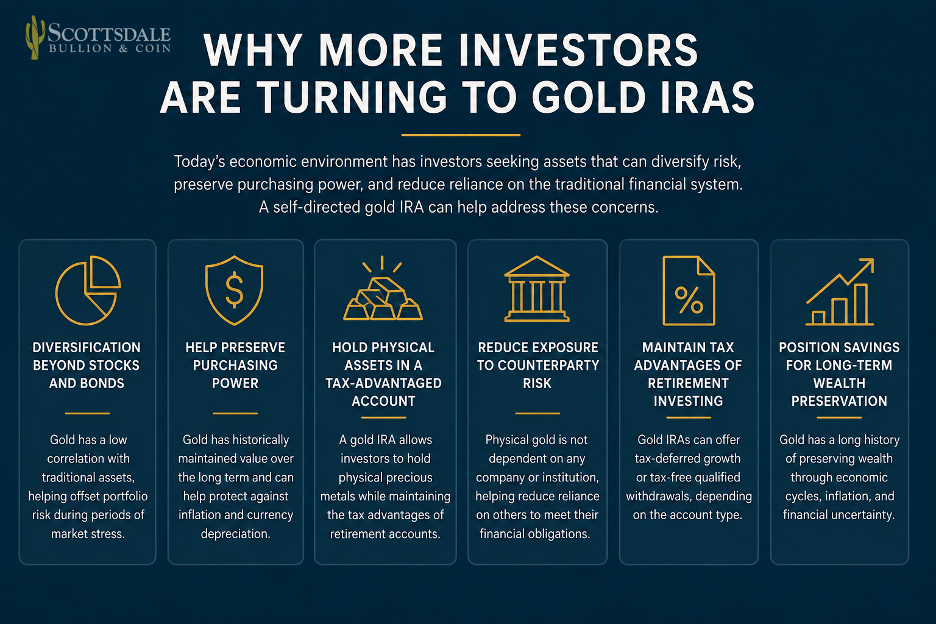
These changes have led many investors to question whether portfolios built primarily around stocks, bonds, and cash are sufficiently prepared for the decades ahead. Increasingly, they are seeking assets that can diversify risk, preserve purchasing power, and reduce reliance on the traditional financial system.
A self-directed gold IRA addresses several of these concerns by allowing investors to hold eligible physical precious metals within a tax-advantaged retirement account. While it cannot eliminate every retirement risk, it can add the wealth-preservation qualities of physical gold to a broader long-term strategy.
Diversification Beyond Stocks and Bonds
Many retirement portfolios appear diversified because they contain numerous funds, companies, industries, and bond maturities. Yet, most of those holdings remain tied to the broader financial markets. During widespread selloffs, assets that normally behave differently can decline together, limiting the protection investors expected from diversification.
A gold IRA introduces a materially different asset into the retirement mix. Physical gold is not a share of a company, a debt obligation, or a promise of future payment. Gold has also frequently demonstrated a lower correlation with traditional financial assets, giving it the potential to offset some portfolio risk during periods of market stress.
Help Preserve Purchasing Power
Inflation poses an especially serious threat in retirement because retirees must fund rising living expenses with a finite pool of savings. Even modest annual price increases compound over time, gradually reducing how much food, housing, healthcare, and other necessities each dollar can purchase.
Gold has historically been used as a long-term store of value because its supply cannot be expanded as easily as fiat currency. A gold IRA gives investors a way to position part of their retirement savings against persistent inflation and currency depreciation without moving those assets entirely outside the retirement system.
Hold Physical Assets in a Tax-Advantaged Account
Most retirement accounts limit investors to paper or digitally recorded assets, such as stocks, bonds, mutual funds, and exchange-traded funds. A gold IRA expands those options by permitting eligible products, such as gold, silver, platinum, and palladium in both coins and bar form.
There’s a crucial distinction between merely holding physical bullion and investing through a precious metals IRA. The former offers exposure to the gold or silver market, but only the latter comes with the tax advantages associated with conventional retirement accounts.
Reduce Exposure to Counterparty Risk
Most traditional assets rely heavily on a separate entity apart from the investor meeting their financial obligations. Stocks depend on the success of the issuing company. Bonds depend on the borrower’s ability to repay. Bank deposits, funds, and other financial products also involve institutions responsible for holding, managing, or honoring the asset.
Physical gold, on the other hand, is largely free of this counterparty risk. Of course, these plans require an approved custodian and security depository, but they provide a considerable buffer between your investments and third-party behavior. Physical precious metals are inherently valuable, directly owned, and less responsive to immediate market forces.
Maintain the Tax Advantages of Retirement Investing
Investors don’t have to choose between owning physical precious metals and maintaining the tax benefits of conventional retirement plans. A traditional gold IRA can generally offer tax-deferred growth, while an eligible Roth structure may allow qualified withdrawals to be made tax-free. The specific treatment depends on the account type and the investor’s circumstances.
Instead of starting from scratch, you can transfer or roll over an existing 401(k), IRA, or other retirement account into a gold IRA. This structure allows investors to reposition a portion of an existing nest egg rather than building an entirely separate gold allocation with after-tax savings. Taxes, contribution limits, distributions, and rollover requirements still apply, making proper setup essential.
Position Savings for Long-Term Wealth Preservation
Gold tends to perform best in the long run, which positions the metal as an ideal addition to retirement portfolios. Throughout history, the yellow metal has a proven track record of keeping pace with inflation, maintaining purchasing power, protecting wealth, and even increasing in value during some phases.
A gold IRA allows investors to position physical precious metals as a long-term wealth-preservation asset rather than a short-term trade. Gold prices will fluctuate from year to year, but the metal has maintained its role as a store of value through changing currencies, political regimes, banking crises, inflationary periods, and repeated economic cycles.