

Eric Sepanek
SBC Founder
Eric Sepanek is the founder of Scottsdale Bullion & Coin, established in 2011. With extensive experience in the precious metals industry, he is dedicated to educating Americans on the wealth preservation power of gold and silver.

Add SBC on Google as a preferred source to see more market related news like this when you search.

 Gold’s impressive record-setting performance over the past few years has left many investors with questions regarding how it plays into the economy and where it should fit in their portfolios. The yellow metal’s historic ability to keep pace with inflation and counter market losses hasn’t gone anywhere. However, the unparalleled rise of gold prices, often outpacing the stock market, has made experts rethink how the commodity responds to high-growth cycles.
What WGC Data Says About Gold and Stocks
In a recent report, the World Gold Council (WGC) analyzed the recent relationship between gold and the stock market, with a particular focus on the past five years. The findings reinforced the long-maintained correlation of these two distinct assets, while acknowledging some critical nuances. Traditional investment wisdom often says that gold tends to rise during periods of economic uncertainty, while easing when markets perform strongly.
WGC research reinforces the first part of this widely held assumption, but questions the latter. More specifically, experts highlight how gold has shown a tendency to rise alongside the broader stock market in bullish environments, without breaking its tendency to counter market downturns. Gold’s shifting correlation with the stock market is a product of the recent spate of unprecedented market activity. Both gold and the S&P 500 have reached several all-time highs in the past year.
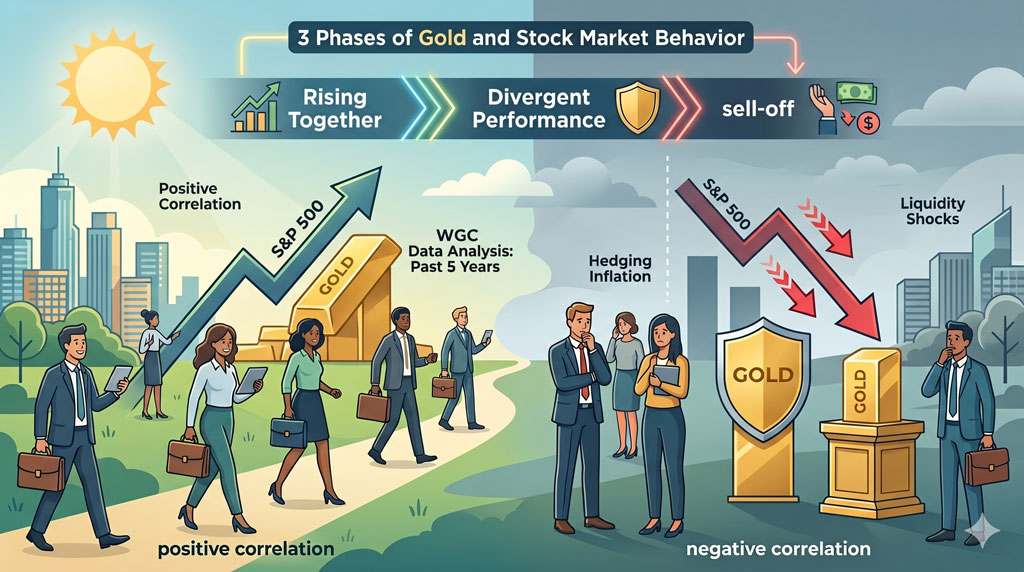
The 3 Phases of Gold and Stock Market Behavior
The connection between gold and equities is well established but not static. While they often move in relation to one another, the direction and strength of that relation are shaped by the broader market environment.
1. Rising Together During Market Uptrends
Generally speaking, the economy tends to maintain an upward trend. In this risk-on environment, where economic growth is steady and liquidity is high, equities and gold tend to maintain a positive correlation as both rise together.
2. Divergent Performance in Sustained Downturns
When the economy takes a turn for the worse, the connection between gold and the stock market remains, but turns into a negative correlation. Instead of rising together, the yellow metal often maintains its value or even gradually increases while equities fall sharply. This is where gold’s reputation as a hedge against inflation is proven.
3. Falling Together During Liquidity Shocks
The third scenario sees gold and stocks dropping simultaneously during severe economic shocks. When major events rapidly dry up liquidity and spike risk-aversion, people often sell both equities and commodities to raise cash.
How This Connection Looks in Real Life
Understanding how gold and stocks perform in relation to each other within different economic scenarios is helpful, but looking at real-world examples offers a more realistic and tangible touchpoint.
2008 Financial Crisis
In the immediate aftermath of the 2008 global financial crisis, the S&P 500 shed 50% of its value, and gold dropped 30% as investors immediately dove into cash. This classic liquidity shock tied the short-term performance of the yellow metal and equities together. As the crisis deepened, the aggressive easing of monetary policies of central banks reduced the opportunity cost of owning non-yielding assets. The 30% drop in gold prices during 2008 was a temporary peak-to-trough movement within a single year. This emphasizes that gold’s role as a “hedge” often requires a slightly longer timeframe to manifest during a liquidity crisis, as shown by its subsequent rise to $1,800 by 2011.
2020 COVID Crash
The COVID-19 pandemic and the economic crackdown that followed resulted in a rapid sell-off that hit both equities and commodities. Stocks slumped by 34%, and gold lost about 10%. Similar to the GFC, investors were eager to offload assets for liquid cash. The macroeconomic backdrop shifted dramatically as massive stimulus spending was pumped into the market, and interest rates fell. During this time, the stock market and gold rose simultaneously as a broad bull market ensued.
2022 Market Downturn
The 2022 market downturn looked very different. The S&P 500 fell more than 20%, while bonds had one of their worst years on record. Meanwhile, gold stayed relatively stagnant, finishing the year roughly flat as interest rates rose and the U.S. dollar gained strength. Eventually, gold entered a historic breakout, rallying from 2023 and continuing into early 2026. The stock market caught up to post records of its own but remains behind.
Don’t Wait for a Liquidity Shock to Secure Your Savings
History shows that during severe economic events, even the strongest assets can be hit by rapid sell-offs. By understanding how gold has historically countered market losses, you can better prepare your portfolio for whatever comes next.
Learn how to add a proven hedge to your retirement strategy today, by requesting our free Precious Metals Investing Guide.