

Steve Rand
General Manager / Sr. Precious Metals Advisor
Steve Rand is the General Manager and a Sr. Precious Metals Advisor at Scottsdale Bullion & Coin. He brings over 20 years of experience in the physical precious metals markets.

Add SBC on Google as a preferred source to see more market related news like this when you search.


 Traditionally, gold has been held by investors for its role as a safe-haven asset, boasting inherent value and an ability to keep pace with inflation. Beyond mere convention, the metal has a proven track record of maintaining worth and preserving wealth during periods of broad economic downturn.
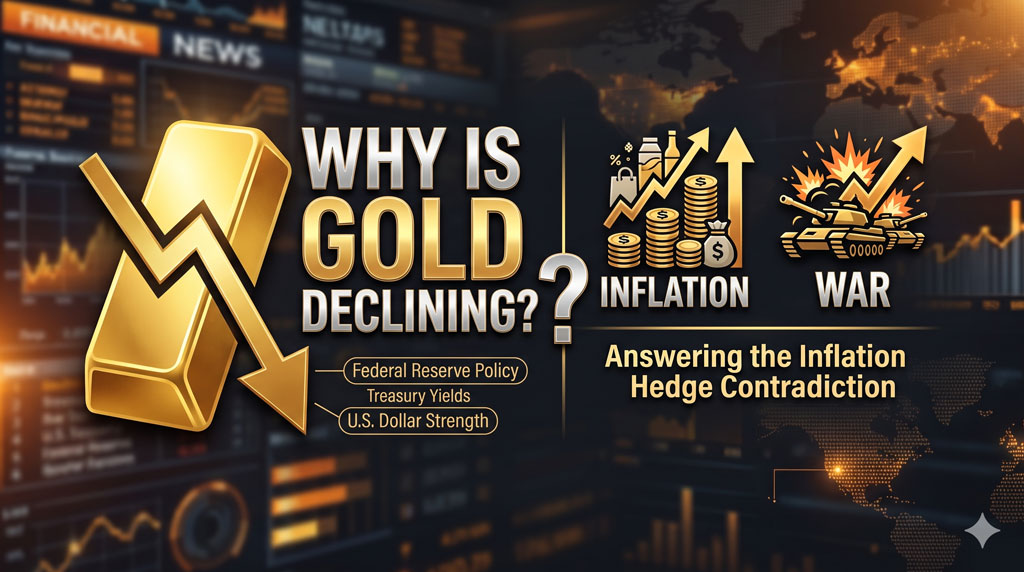
Yet, gold has pulled back more than 25% from an all-time high in January 2026, in the midst of a fiscal climate characterized by persistent inflation, the U.S.-Iran war, and heightened geopolitical volatility. At first glance, this discrepancy appears to contradict gold’s widely accepted investment role and even the metal’s historical performance.
In reality, gold’s current correction is not occurring in direct response to broad-scale inflation or outright war. Instead, the market is caught up in a macroeconomic whirlwind of Federal Reserve policy, Treasury yields, U.S. dollar positioning, and investor behavior.
The key distinction lies between short-term gold pricing and long-term gold fundamentals, which are often driven by different forces. As J.P. Morgan’s Head of Base and Precious Metals Research, Greg Shearer, succinctly explains: “Gold is stuck in a bit of a technical no-man’s land.”
The Inflation Hedge Contradiction
Gold Has Historically Protected Purchasing Power
The idea of precious metals as an inflation hedge isn’t the product of popular belief. It’s deeply rooted in the historical analysis of gold’s comparative performance to inflation and the U.S. dollar. According to the World Gold Council’s Senior Market Analyst, Louise Street, gold has outperformed U.S.-based and global consumer price indices (CPI)—the most commonly cited metric for inflation—since the end of the gold standard in 1971.
More specifically, Charles Schwab shows that gold prices rose by more than 3,000% from 1975 through 2025, while consumer prices increased roughly 500% within the same period. This demonstrates the metal’s long-term ability to preserve purchasing power and outpace inflation despite significant periods of market volatility. Additionally, the U.S. dollar has lost 99% of its value when measured against gold since the 1930s, reinforcing gold’s long-term role.
As many analysts note, gold tends to deliver its strongest results across years and economic cycles, not necessarily in response to every inflation report or geopolitical headline. In fact, gold’s tendency to steadily appreciate against inflation over time is precisely what makes it a dependable store of value. If gold spiked every time inflation fears surfaced, it would behave more like a speculative trade than a long-term hedge.
Why Inflation Is Pressuring Gold…For Now
The answer has less to do with inflation itself and more to do with the market’s expectations for monetary policy. Rather than focusing on today’s inflation rate, investors are increasingly focused on how the Fed may respond if inflation remains stubbornly elevated.
The shift has been dramatic. At the end of 2025 and into early 2026, many analysts expected the Fed to begin a meaningful rate-cutting cycle as inflation cooled. Instead, hotter-than-expected price pressures and rising energy costs have forced policymakers into a more cautious stance. Now, 9 of 19 officials expect at least one rate hike this year, while futures markets see a 70% probability of a September increase.
According to Deutsche Bank analyst Michael Hsueh, “Fed repricing, together with resilient U.S. macro data, has played the primary role in pushing gold lower.” Similarly, Bank of America recently stated that shifting expectations around monetary policy remain “the biggest obstacle for gold in the near term.”
What the Market Is Currently Pricing
The following sequence illustrates why gold’s long-term inflation-hedging role can temporarily take a back seat to changing expectations for interest rates and monetary policy.
1. Stubborn Inflation
In May 2026, inflation rates hit 4.2% year over year—the highest point in three years. Simultaneously, energy prices have surged 23.5% over the past 12 months, according to the Bureau of Labor Statistics.
More specifically, gas climbed by a staggering 40%. Ongoing tensions in the Middle East, especially around the Strait of Hormuz, which supplies 20% of the world’s petroleum, has only heightened concern that inflationary pressures will remain. In fact, CNBC reports that a growing number of investors believe inflation will hit 4.5% and even 5% in the latter half of 2026.
2. Shifting Fed Rate Policy
Earlier this year, and late into 2025, the market anticipated the Fed to implement a long-running easing policy after an extended period of elevated rates. In the face of rising inflation, these expectations have largely evaporated. Under the new management of Chair Kevin Warsh, the Fed opted to leave its benchmark rate unchanged at 3.50% to 3.75%.
As mentioned before, nearly half of policymakers now anticipate a rate hike in 2026, turning earlier expectations on their head. Now, market optimism has fallen under a cloud of persistent inflation, bringing in a higher-for-long interest-rate climate.
3. Higher U.S. Treasury Yields
As the anticipation for higher interest rates permeates the market, investors become more unwilling to buy older U.S. Treasuries that pay out comparatively lower interest rates. As investors anticipate higher interest rates, existing bonds with lower coupons become less attractive. Their prices fall, causing yields to rise.
Recently, the two-year Treasury note, which closely tracks Fed policy expectations, stretched over 4.2%—the highest level since early 2025. The benchmark 10-year Treasury is hovering around 4.5%. As Treasury yields climb, investors can earn increasingly attractive returns from government bonds and other income-producing assets. That raises the opportunity cost of holding gold and other non-interest-bearing safe-haven assets.
4. Strengthening U.S. Dollar
The U.S. Dollar Index, which tracks the USD value against a basket of major currencies, fell 10% in early 2026, and the decades-long process of de-dollarization has made a meaningful dent in the greenback’s global influence. However, the dollar still has enough influence in global markets to benefit from the recent U.S.-Iran War and subsequent oil crisis. As the core of the petrodollar system, the USD directly benefitted from soaring fuel prices.
At the same time, higher Treasury yields make dollar-denominated assets more appealing to global investors, further boosting demand for the U.S. currency. Generally, a stronger dollar, even if the upward swing is temporary, creates another headwind for gold by encouraging capital flow to dollar-based investments and by making the metal more expensive to foreign buyers.
Together, these macroeconomic forces have made the investment landscape considerably less favorable for gold, at least in the short run. However, these variables alone don’t tell the whole story. Short-term gold prices are also heavily influenced by investor positioning and financial flows, factors that have recently amplified the metal’s decline.
ETF Outflows and Weak Investor Demand
Financial Markets Drive Short-Term Gold Prices
While the macro backdrop explains why sentiment toward gold has temporarily weakened, it doesn’t fully explain how prices have fallen so quickly. The answer lies in the distinction between physical and paper gold.
Although gold bars, coins, jewelry, and central bank purchases remain critical sources of long-term demand, they are only one part of the gold market. Paper gold, in the form of gold exchange-traded funds, futures contracts, and other derivatives, represents the financial side of the gold market
These financial instruments often experience more trading activity and higher liquidity because they merely track the spot price, rather than involving physical ownership. Thus, these widely-held instruments exert a disproportionate influence on short-term price activity.
Institutional Investors Have Been Pulling Back
Recent ETF flow data reinforces what many large financial institutions have been observing for months. The World Gold Council reported modest ETF outflows in May as investors largely “moved to the sidelines while awaiting a clearer catalyst.”
At the same time, Deutsche Bank described traditional investor support as “notably absent,” Goldman Sachs cited weaker ETF inflows when lowering its gold forecast, and Morgan Stanley argued that renewed ETF demand remains the “missing piece” for a sustained recovery.
Market Positioning Amplified the Selloff
Weak investor demand alone doesn’t fully explain gold’s sharp correction. According to Barclays, part of the recent selloff also stemmed from the unwinding of crowded and leveraged positions following gold’s record-setting rally. The bank estimated that the stronger U.S. dollar and the S&P 500’s roughly 10% gain together implied about a 10% decline in gold prices.
The remainder of the correction largely reflected investors taking profits and reducing leveraged positions. As those trades unraveled, selling pressure accelerated, causing gold to underperform despite persistent geopolitical tensions and an inflationary backdrop, even though the broader long-term fundamentals remain largely intact.
Central Banks Keep Buying, Wall Street Remains Bullish
Despite gold’s recent correction, a challenging Fed policy backdrop, and cooling ETF demand, many of the metal’s long-term fundamentals remain intact.
The most recent World Gold Council Central Bank Gold Reserves Survey found that 45% of reserve managers plan to increase their physical gold holdings over the next 12 months—the highest level on record since the survey began. At the same time, 84% believe gold will account for a larger share of global reserves over the next five years, reinforcing the broader trend toward reserve diversification.
Wall Street’s outlook also remains constructive. While several major financial institutions have trimmed their near-term price targets in response to shifting interest rate expectations, virtually all continue to forecast gold prices above current levels through 2026.
- Bank of America: Still sees a longer-term path to $6,000 per ounce.
- P. Morgan: Forecasts $6,000 per ounce by the end of 2026, with $6,300 possible in 2027.
- Goldman Sachs: Trimmed its forecast but still targets approximately $4,900 per ounce by year-end.
- Deutsche Bank: Lowered its outlook but still expects $4,800 per ounce in Q4 2026 under a stable Fed scenario.
- Societe Generale: Increased its commodities allocation from 5% to 20% and continues to identify gold as a buy-on-dips opportunity.
In other words, many analysts view the recent pullback as a correction within a longer-term bull market rather than the end of gold’s investment thesis.
Gold’s Long-Term Role Remains Intact
Gold’s recent correction does not necessarily invalidate its long-standing role as an inflation hedge or safe-haven asset. Rather, it reflects a market that is currently placing greater weight on Fed policy, Treasury yields, U.S. dollar strength, and investment flows than on gold’s long-term fundamentals.
If the investment case for gold had truly broken down, it would be difficult to explain why central banks continue accumulating bullion at historically elevated levels, why reserve managers expect gold to claim a larger share of global reserves, or why many of Wall Street’s largest financial institutions still forecast higher prices ahead.
While the market may be questioning gold’s next move, central banks and many of Wall Street’s largest institutions remain bullish on gold’s long-term trajectory and increasingly central role in global finances.