

Eric Sepanek
SBC Founder
Eric Sepanek is the founder of Scottsdale Bullion & Coin, established in 2011. With extensive experience in the precious metals industry, he is dedicated to educating Americans on the wealth preservation power of gold and silver.

John Karow
Precious Metals Advisor
John Karow is an experienced lawyer and Precious Metals Advisor at Scottsdale Bullion & Coin. He holds degrees from Lehigh University, the University of Missouri, Cornell University, and St. John’s University School of Law. John is a knowledgeable authority in precious metals, dedicated to helping clients navigate economic cycles and gold and silver investments.

Add SBC on Google as a preferred source to see more market related news like this when you search.

As gold prices remain rangebound, three major shifts are quietly reshaping the outlook for investors. Taken together, they point to a changing environment that could have lasting implications for how and where you hold your wealth.
In this week’s The Gold Spot, Scottsdale Bullion & Coin Founder Eric Sepanek and Precious Metals Advisor John Karow break down rising tax pressure on U.S. investors, China’s aggressive and sustained gold accumulation, and new policy risks that could impact precious metals ownership.
Your “Fair Share” Keeps Growing
With another tax year successfully in the rearview mirror, you may be left feeling like Uncle Sam is gradually increasing his claim on your wealth. You’re not alone. Pew Research suggests that 60% of Americans feel that their taxes account for more than their “fair share,” which is up from 49% in 2021. Thus, over the past five years, 11% more U.S. taxpayers report feeling unduly burdened by the federal government.
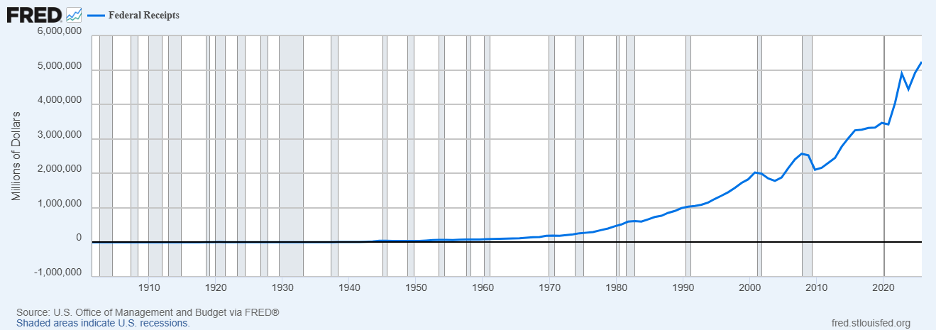
Everyone wishes they could pay less in taxes, but the data actually reinforces the growing feeling of overtaxation. For instance, federal tax receipts have surged over the past five years. Total collections climbed from roughly $3.4 trillion in 2020 to more than $5.2 trillion in 2025, according to the Federal Reserve Bank of St. Louis.
Source: https://fred.stlouisfed.org/series/FYFR
Furthermore, USAFacts points out that federal tax inflows have grown by 2.5 times since 1980, yet the U.S. population has only risen by 1.5 times during the same period. This means the rising government revenues cannot be explained away entirely by population growth. No matter how the numbers are sliced, the government is taking more out of the pockets of the average American. U.S. taxpayers will only have to hand over more of their hard-earned money as the national debt is projected to hit $50 trillion by 2030.
“The problem is the same...every year. 'Fair share' is redefined every year to be more and more and more from the people who produce wealth.”
John Karow
Precious Metals Advisor

How to Privatize Your Wealth
It’s tempting to move on from anything related to financial planning once your taxes are filed, but this is actually the moment to act. Now that you know exactly what you have left, the question becomes how to put it to work in the smartest way possible.
For many investors frustrated with rising tax burdens and the volatility of traditional markets, the conversation is shifting toward the privatization of wealth. In simple terms, that means moving a portion of your assets outside the conventional financial system and into something you directly control.
This is where precious metals investing comes into play. For centuries, gold and silver have offered investors a tangible, independent, and inherently valuable alternative to the traditional paper market. Some of the advantages of precious metals include:
- No counterparty risk – Gold and silver are not dependent on any bank, institution, or third party to maintain their value.
- Outside the paper system – Unlike stocks, bonds, or funds, physical metals are not just another trackable financial asset within the traditional system.
- Private and not inherently reported – Holding physical metals does not automatically generate tax documents or ongoing reporting like brokerage accounts do.
- Highly liquid and divisible – Precious metals can be easily bought, sold, or split into smaller portions without liquidating the entire position.
- Proven hedge across conditions – Gold has historically maintained its role as a store of value through inflation, deflation, and currency devaluation.
“Physical precious metals…hedge against inflation, deflation, and currency devaluation all at once. They always have, and they always will.”
John Karow
Precious Metals Advisor
Get more out of your gold & silver investments. Read our free, data-backed investment report now.
Get Free ReportChina’s Quiet Gold Accumulation
As private investors in the West increasingly look to gold for wealth privatization, protection, and even growth, China has been quietly leading the charge in country-level gold demand. Over the past several years, Beijing has steadily accumulated vast amounts of physical metal to gain independence and distance from the faltering dollar-led global economy. This is part of a rising worldwide trend, as total gold consumption reached a record of 5,000 metric tons in 2025.
What stands out most is the consistency of China’s central bank activity:
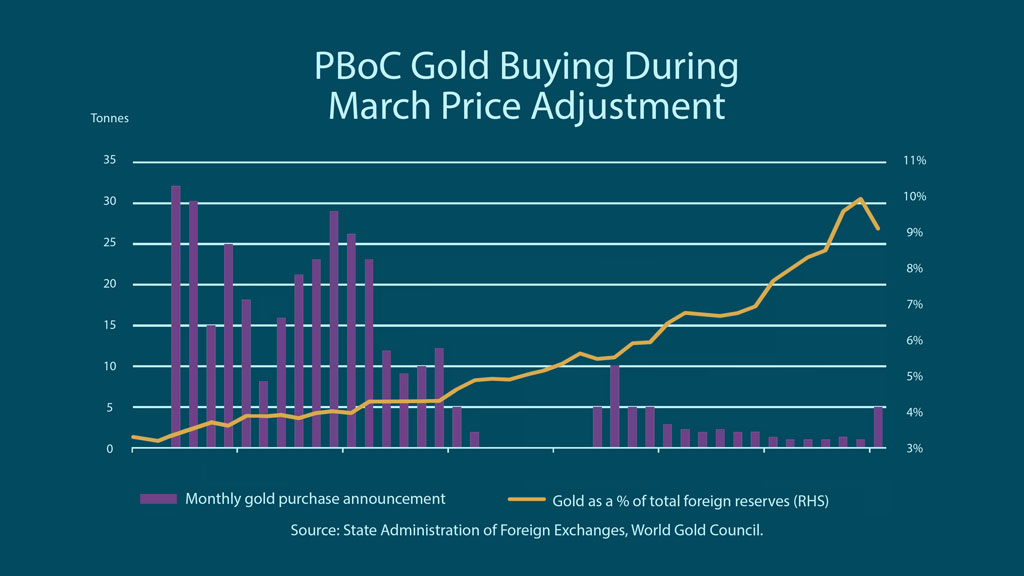
- The People’s Bank of China has increased its gold reserves for 17 consecutive months, steadily adding to its holdings since late 2024.
- China now holds 2,313 metric tons of gold in official reserves, placing it among the largest gold holders in the world.
- Gold now accounts for roughly 9% of China’s foreign exchange reserves, reflecting a growing shift away from traditional currency holdings.
Taken together, these moves point to a methodical reallocation of national wealth into an asset that exists outside the control of any single government or financial system.
“17 straight months of central bank buying is not simply trading; that’s policy. China is systematically reallocating its national wealth out of U.S. dollars and into gold.” — Scottsdale Bullion & Coin Founder Eric Sepanek
Chinese Retail Demand Meets Western Outflows
China’s shift into gold is not limited to its central bank. Retail investors are moving in the same direction, reinforcing what appears to be a coordinated, top-down and bottom-up trend. As gold prices fell over the latter half of the past quarter, Chinese investors took the opportunity to buy the dip:
- Chinese gold ETFs recorded $8.5 billion in inflows during Q1 2026, the strongest quarter on record.
- Total assets under management climbed to $44 billion.
- ETF holdings increased to 298 metric tons.
At the same time, Western investors are dumping their gold investments. North American investors pulled $13 billion from gold ETFs in March alone. This marked the largest monthly outflow on record. This wave of selling came as inflation remained stubborn and economic uncertainty rose.
The contrast between Chinese gold demand and North American selling is difficult to ignore. On one side, a global power is steadily building its gold position at both the institutional and retail levels. On the other hand, Western investors are stepping away from the same asset during a time when volatility and risks remain elevated.
New York Targets Gold
While global powers are accumulating gold, policy pressure is beginning to build closer to home. Led by self-described democratic socialist Mayor Zohran Mamdani, New York lawmakers are exploring the removal of sales tax exemptions on gold and silver bullion. This move would effectively reintroduce taxes on precious metals purchases, marking a momentous reversal in the treatment of these tangible assets.
To be sure, gold ownership in the U.S. has not always been guaranteed. Private ownership was effectively banned in 1933, and it was not fully restored until 1974. It wasn’t until 1986 that the U.S. government began producing modern bullion coins like the Gold American Eagle, reinforcing gold’s role as a legitimate, citizen-held store of value.
Reintroducing taxes on bullion transactions would challenge that framework, potentially discouraging ownership of an asset specifically designed to provide individuals with financial independence outside the traditional system.
The Decision Facing Investors Right Now
Rising tax pressure at home, China buying at a steady pace, and new policy risks all indicate that where you hold your wealth matters now more than ever.
If you are thinking about moving outside the traditional system, it is important to understand the difference between bullion and investment-grade coins, especially right now, when premiums on rare coins have come down and created a strong buying opportunity.
“The prices of coins right now are really good because the premiums have been overtaken by the bullion surge that we've seen in the last few years. So it's a really good buying opportunity.”
Eric Sepanek
Scottsdale Bullion & Coin Founder

To get a clearer picture, download the free Investment-Grade Coins Report and see how to position your portfolio for privacy, protection, and long-term value.