

Eric Sepanek
SBC Founder
Eric Sepanek is the founder of Scottsdale Bullion & Coin, established in 2011. With extensive experience in the precious metals industry, he is dedicated to educating Americans on the wealth preservation power of gold and silver.

Add SBC on Google as a preferred source to see more market related news like this when you search.


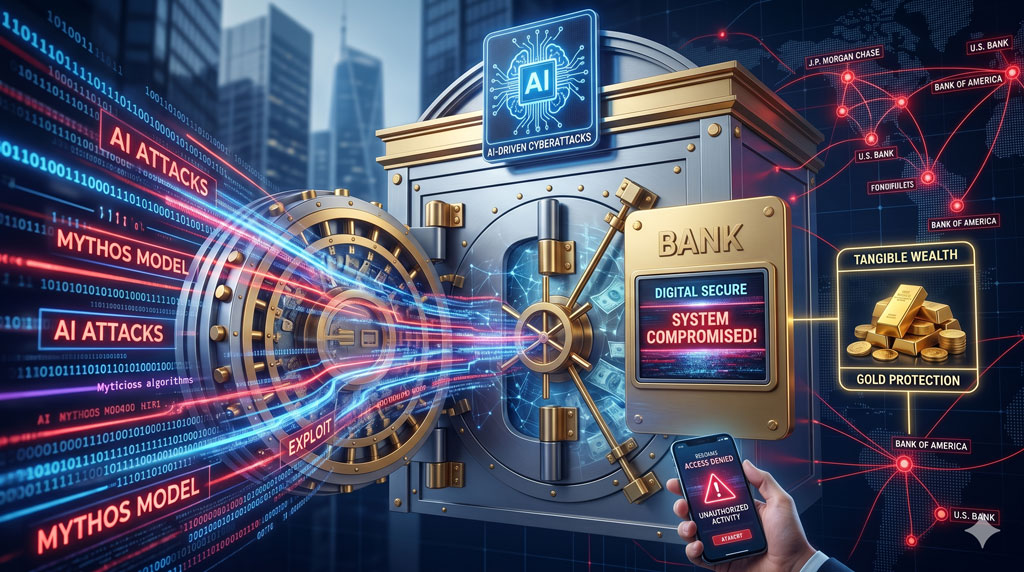 Cybersecurity has always been a major concern among investors and account holders in a banking sector built on fragile digital infrastructure. With artificial intelligence (AI) advancing at a rapid pace and financial institutions scrambling to remain at the cutting edge of the technological wave, many experts have shifted their attention to the next generation of risk.
Anthropic’s recent unveiling of its frontier Mythos model has propelled these concerns to the forefront, with federal regulators, international banking organizations, and heads of the world’s largest banks raising alarm bells. Now, investors are left wondering if their money is safe with sophisticated AI unleashed onto a hyper-connected and antiquated banking system.
What Is Anthropic’s Mythos?
On April 7, 2026, Anthropic — a prominent AI research organization — launched its Mythos project. This AI model is designed to uncover and exploit software vulnerabilities faster and more reliably than the most capable human hackers. The practice of detecting weaknesses from within an organization is a common cybersecurity practice, but Mythos leverages the power of AI to identify issues at a scale and speed impossible for humans.
Beyond mere identification, this model figures out how to manipulate shortcomings in software and increase unauthorized accessibility. While designed to operate from within organizations to strengthen cybersecurity, it’s impossible to overstate the risks Mythos poses if the technology, or even a poor replica, falls into the wrong hands.
Project Glasswing Explained
On the same day of Mythos’ release, Anthropic announced the creation of Project Glasswing, an initiative in tandem with some of the most recognizable companies to ensure Mythos is used defensively and enhance systemic protection across the U.S. tech ecosystem. Currently, this group of insiders includes:
- Amazon Web Services
- Apple
- J.P. Morgan Chase
- Microsoft
- NVIDIA
- Cisco
- CrowdStrike
- Palo Alto Networks
- Linux Foundation
Notably, Anthropic’s model isn’t yet available for public use, with the creators acknowledging the existential risk it would pose to cybersecurity. The AI company explains: “The fallout—for economies, public safety, and national security—could be severe.”
Mythos May Already Be Compromised
It didn’t take long for these public and high-stakes warnings to come to fruition. Within 24 hours of Mythos launching, a group of authorized users was able to hack the model, even with restricted access in place. Nearly more alarming than the immediate breach were the relatively basic strategies and tools used to gain access, underscoring the AI model’s own security shortcomings.
Although the hackers only shared screenshots with journalists and demonstrated use of the model, they were able to avoid triggering cybersecurity tripwires for extended periods.
The U.S. Banking System’s Rapid Adoption
Despite only being a few weeks old, Mythos has made surprisingly swift inroads into the U.S. banking system. J.P. Morgan Chase is the only bank officially included in Project Glasswing, but reports suggest that Bank of America and U.S. Bank, among other leading financial institutions, have been testing the AI internally.
Already, banks in the United Kingdom and European Union are clamoring for access, with Anthropic seemingly more than willing to offer its model. Experts suggest it won’t be long until this controversial and extremely advanced technology is unleashed into the entire banking system.
The Fraught Landscape of Financial Risk
Tellingly, the U.S. banking sector is no stranger to massive security breaches. By the same token, Americans are used to reading headlines about cyberattacks, identity theft, impersonation scams, and other forms of financial fraud. The numbers paint a grim image of the current financial risks:
Financial Institutions
- 45% of institutions face AI-driven cyberattacks.
- Over 50% of financial professionals encountered deepfake scam attempts.
- Nearly 60% of companies report rising fraud losses tied to AI.
- Humans detect high-quality deepfakes only about 24% of the time.
Individuals
- Americans lost over $12.5 billion to fraud in a single year.
- Up to one million cybercrime complaints are filed annually.
- Deepfakes and AI scams are already costing hundreds of millions annually.
- AI-driven fraud could reach $40 billion by 2027.
How AI Augments Cyber Attacks
AI is a loaded topic, which can make it difficult for investors and account holders to get a grasp on how this technology enhances financial risks. Broadly speaking, AI is creating three major shifts in cyberattacks:
- Speed: Advanced models, such as Anthropic’s Mythos, dramatically reduce the time it takes to detect and exploit vulnerabilities. What used to take a team of top-tier hackers months to accomplish can be completed within minutes or less by a single software developer.
- Accessibility: The low-barrier-to-entry, widespread availability, and affordable cost of even the most capable AI models expand the pool of potential hackers, no longer requiring advanced skills or expert knowledge.
- Scale: With rapid deployment and ease of use, AI models allow hackers to accomplish more in a shorter period of time. Mythos can scan entire systems instantly, scaling the threat level.
Why Large Banking Systems Are Especially Vulnerable
Legacy, Outdated Systems
The foundation of the U.S. banking system has remained largely unchanged since the 1970s and 1980s. Instead of uprooting legacy platforms, institutions have opted to simply layer newer infrastructure onto outdated software, legacy coding, and other outdated tech. In 2025, the Government Accountability Office advised Congress to encourage “major agencies to make modernization plans for their critical legacy systems.”
Centralized, Digital Access
The banking system may rely on outdated infrastructure behind the scenes, but customer access is almost entirely digital. Today, most transactions take place online, through apps, or via electronic payment networks. That shift has effectively centralized how depositors access their money. When issues arise on the backend, whether from outages, technical failures, or security incidents, customers often have few alternative ways to reach their funds. This strict access is designed to protect institutions from bank runs, not for the convenience or benefit of consumers.
An Interconnected System
In its 2024 annual report, the Financial Stability Oversight Council warned that “financial institutions and systems are highly interconnected,” creating a built-in force-multiplier effect on cyberattacks. This hyperconnectivity makes it challenging to contain financial threats, allowing them to spread quickly across institutions. The rapid consolidation of major banks — which have more than halved from 2000 to 2024, according to Statista — represents a concentration of risk.
AI Arms Race
Despite a steady trend of consolidation, the U.S. banking system remains highly rivalrous and has fewer guardrails than its European counterparts. This combination of cutthroat competition and limited regulation has sparked an AI arms race, with about 70% of banks leveraging AI. As Mythos reveals, these technologies often pose the high risk they promise to protect against.
Limited Government Protection
The Federal Deposit Insurance Corporation (FDIC) backs up every American for up to $250,000 across bank accounts at regulated institutions. This may seem like a solid bulwark against cyberattacks, but the agency doesn’t have sufficient funds to make good on its promises. The FDIC fund only has $153.9 billion on hand. In reality, the FDIC only targets maintaining sufficient funds to cover 2% of American depositors.
The Real Risk: Losing Access
The worst-case scenario most Americans fear is a total wipeout of their savings accounts, investment portfolios, or retirement plans. While AI undoubtedly heightens those risks, a more likely — and equally disruptive — outcome is a loss of access.
Banks are designed to prioritize security and stability, which often means restricting account access, either digitally or in person, when threats arise. As AI-driven risks collide with legacy banking infrastructure, the likelihood of account freezes, system outages, fraud-triggered lockouts, and even bail-ins continues to increase.
Rethinking Where You Hold Your Wealth
As the digital risk landscape intensifies, investors are reconsidering where they hold their money. As it has for centuries, physical gold offers a completely tangible, inflation-resistant, and entirely private way to store wealth. Here are some ways gold can offer protection against the AI threats to the banking system:
- Entirely Physical: Gold’s value is not represented on an account balance or a line item on an app. Gold bullion is 100% tangible, free of connection to digital systems or financial networks.
- Financial Privacy: Physical gold isn’t tethered to any centralized records, offering a heightened level of privacy not found in mainstream investments. Some gold assets don’t even have to be reported to the government.
- Hedge Against Inflation: While the dollar, at best, loses 2% of value each year, gold has consistently kept pace with inflation. This offers wealth protection against currency devaluation inherent in savings accounts.
- Direct Ownership: When you own physical gold, you don’t rely on a third-party financial institution to grant access or protect your investments. You have full custody of a tangible asset. A Gold IRA is one powerful way to hold physical gold within your retirement portfolio.
If you’d like to learn more about how gold can protect your wealth from the threat of AI and the systemic vulnerabilities of the banking system, grab a FREE copy of our Precious Metals Investment Guide. It covers everything you need to know about how physical gold can shore up your assets.