

Joe Elkjer
Sr. Precious Metals Advisor
Joe Elkjer, a Precious Metals Advisor at Scottsdale Bullion & Coin since 2019, specializes in helping clients protect their assets through tangible investments. With a strong background in business and finance, he emphasizes stellar customer service and stays dedicated to informing clients about market impacts through frequent appearances on The Gold Spot.

Todd Graf
Precious Metals Advisor
Todd Graf is a seasoned Precious Metals Advisor at Scottsdale Bullion & Coin. He has a decade-long career in finance, previously at Morgan Stanley and Vanguard. He is Series 7 licensed and has extensive experience in traditional and defensive assets, providing clients with solid investment strategies.

Add SBC on Google as a preferred source to see more market related news like this when you search.

Hackers have turned supermarket freezers into heaters, attempted to boil life-saving blood supplies, and stolen billions from a major cryptocurrency exchange. As artificial intelligence threatens to make cyberattacks faster and more convincing, investors face a pressing question. How much of your wealth depends on digital systems you don’t personally control?
In this week’s The Gold Spot, Scottsdale Bullion & Coin’s Sr. Precious Metals Advisor Joe Elkjer and Precious Metals Advisor Todd Graf examine how cyberattacks are disrupting essential services and financial accounts, why government agencies are warning about AI, and how physical gold and silver can reduce dependence on digital systems.
Cyberattacks Disrupt Food Supplies, Healthcare, and Utilities

In 2026 alone, countries worldwide have seen an alarming rise in cyberattacks that affect some of the most basic functions of daily life, including food supplies, blood banks, hospitals, and utilities.
European Supermarkets: Food Supplies Become Targets
On November 2, 2026, hackers manipulated connected supermarket cooling systems across at least seven European countries. One Swedish store reported settings raised to 122°F, forcing retailers to discard unsafe food. An October attack hit hundreds of French supermarkets, costing tens of millions of euros.
French Blood Storage: Healthcare Faces Similar Risks
That same day, a cyberattack disrupted cold-storage monitoring and controls at three French Blood Establishment sites. Timely alerts helped staff secure products or transfer them to unaffected refrigeration, but the incident exposed similar risks in remotely managed healthcare equipment.
New Mexico Hospitals: Patient Care Interrupted
A late-October cybersecurity incident at UNM Health diverted ambulances for several hours and suspended outpatient surgeries and appointments for the rest of the day. Clinical operations later resumed, but patients faced disruptions even though security teams kept the threat out of core systems and servers.
U.S. Water Utilities: Essential Systems Disrupted
At the end of July, FBI/EPA advisory documented attacks on water and wastewater utilities in at least seven states. Attackers remotely changed internet-connected controllers’ IP addresses and passwords, disrupting monitoring and control. Some incidents degraded water operations, showing how digital vulnerabilities can interfere with basic services.
Banking Outages and Crypto Theft Expose Digital Wealth Risks

These risks, especially AI-powered cyberattacks, extend directly to people’s money, with banking outages blocking access to funds and cybercriminals stealing digital assets.
Banking Services: Account Access Interrupted
In late October, vulnerabilities in PHP, software widely used to run websites, prompted emergency fixes and protective shutdowns. Approximately 1.5 million internet hosts were running versions without available fixes at the time. By October 22, Cloudflare had observed millions of exploitation attempts.
At least six Japanese banks temporarily restricted services as a precaution. MUFG halted some online transactions, while other lenders suspended applications and services, including access to account balances. Separately, the European Banking Authority reports that 22% of banks reported cyberattacks resulting in an actual major IT-related incident.
“We've grown accustomed to having instant access to our money, but that convenience depends on technology functioning properly, and increasingly those systems are being targeted.”
Todd Graf
Precious Metals Advisor

Binance: A Record Crypto Theft
On October 29, Binance suffered a breach involving approximately $6.3 billion in digital assets, more than four times the previous record of approximately $1.46 billion stolen from Bybit in February 2025. According to Binance, attackers combined stolen credentials, malicious software, social engineering, and compromised internal AI tools to gain unauthorized access to its wallet infrastructure.
The exchange temporarily suspended withdrawals while containing the incident. As of November 3, $2.85 billion in affected assets had been frozen or intercepted. Despite being advertised as a decentralized and “safe” asset, cryptocurrency is still widely traded and held on highly centralized and interconnected systems.
U.S. and UK Agencies Warn AI Could Intensify Cyberattacks
Some of the world’s leading security agencies and financial authorities are warning that AI could make cyberattacks faster, more sophisticated, and more damaging to essential services and personal wealth.
- UK National Cyber Security Centre warns that AI-powered malware is “highly likely” to be used in a ransomware attack against UK critical infrastructure by 2028, with AI expected to increase the scale and efficiency of attacks.
- Federal Reserve says AI can help criminals “capture sensitive information, including user credentials” through phishing and text scams, potentially bypass voice verification with cloned voices, and write malware.
- S. Treasury cautions that deepfakes can help criminals “bypass customer identification checks at U.S. financial institutions,” with fraudulent accounts already opened using identities suspected of being generated with AI.
- National Security Agency says adversaries are already using AI to “automate the intrusion lifecycle” and exploit unpatched software, weak authentication, and configuration errors.
- FBI reports nearly $893 million in losses from AI-related crime complaints in 2025, involving tactics such as “fake social profiles, voice clones, identification documents, and believable videos.”
AI can reduce the time, cost, and expertise needed for attacks. It also helps defenders detect threats. The concern is whether some organizations can fix vulnerabilities as quickly as criminals exploit them.
A Diverse Portfolio Can Still Share Digital Risks
The rapid rise and increasing sophistication of cyberattacks have put many investors on edge. A common misconception is that portfolio diversity automatically means security diversity. While mainstream assets offer exposure to different markets, many share the same underlying infrastructure.
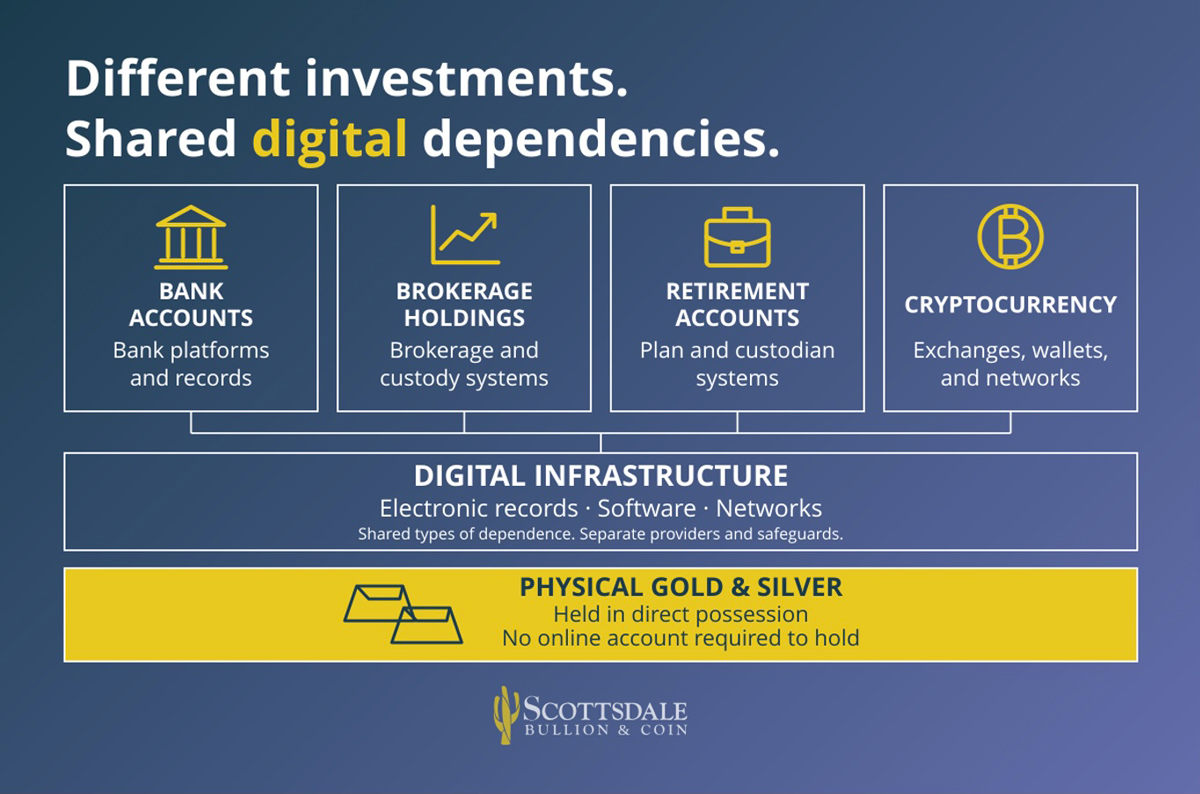
Savings sit in bank accounts, stocks and bonds in brokerage accounts, retirement assets with plan administrators and custodians, and cryptocurrency in exchanges or digital wallets. Different investments can still share dependence on electronic records, software, and network access.
“You could have a portfolio spread across stocks, bonds, cash, and even cryptocurrency, yet nearly all those assets will still depend on interconnected digital systems. While you've diversified your investments, have you really diversified your exposure to technological disruption?”
Joe Elkjer
Sr. Precious Metals Advisor
The Depository Trust & Clearing Corporation says it safeguards roughly 90% of all U.S. securities and serves 5,600 client firms across 95 countries. That means investments held with different brokers can still rely on the same infrastructure to complete trades and transfer securities.
These arrangements provide enormous convenience and substantial security protections, but spreading your money across different investments doesn’t automatically diversify how you access and control that wealth. Diversification also means understanding how you hold your assets, what risks they share, and how dependent your wealth is on digital systems.
Physical Gold and Silver Reduce Digital Dependence
Unlike traditional investments, physical gold and silver in your possession put part of your wealth outside the digital financial system. You don’t need a bank login, brokerage account, or internet connection to hold them. Continued possession doesn’t depend on a financial institution keeping its platform online.
The three P’s of precious metals investing help clarify their purpose, with privacy and protection particularly relevant to cybersecurity concerns.
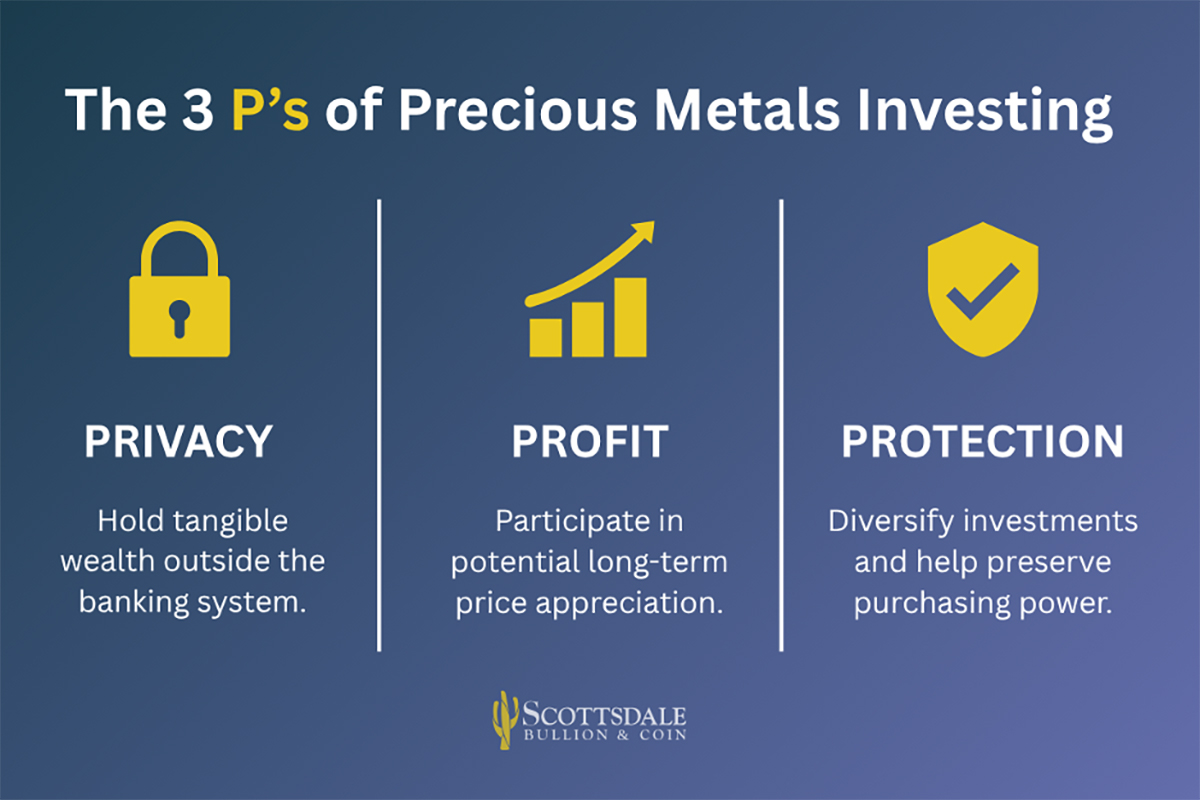
Prices still fluctuate, secure storage matters, and selling metals or accessing custodial holdings can involve financial institutions. However, the real advantage is reduced digital dependence through direct possession.
“Physical gold and silver held in your direct possession doesn't require a bank login, a brokerage account, or an internet connection to exist. Their value isn't dependent on a particular financial institution maintaining access to its digital platform.”
Todd Graf
Precious Metals Advisor
Gold and silver have recently undergone a significant price correction, even as major Wall Street institutions recommend buying the dip, given their constructive long-term outlook. Rather than focusing exclusively on finding the exact bottom, think about what you own, how and where you hold it, and which risks those holdings share.
Consider Physical Assets Before the Next Financial Disruption

Recent cyberattacks have disrupted everyday businesses, restricted banking access, and compromised cryptocurrency assets. Government warnings about AI reinforce why these risks matter to anyone relying on digital systems to access their savings and investments.
“Diversification isn't just about owning different investments; it's also about understanding how you own them, where they're held, and what risks they share.”
Todd Graf
Precious Metals Advisor
No one knows when or where the next major disruption will occur, but preparation is key. Unlike traditional investments, which rely on a hyperconnected digital framework, physical gold and silver offer direct ownership, no counterparty risk, and added privacy.
If you’d like to learn more about how physical precious metals can reduce your dependence on digital systems and preserve your wealth, grab a FREE copy of our Gold and Silver Investor Guide. It covers everything you need to know about buying gold and silver and can help you avoid common mistakes and make more informed investment decisions.
To speak directly with a Precious Metals Advisor, call toll-free at Call Us: 1 (888) 812-9892 or use our live chat function. As always, it costs nothing to consult!
Important Notice:

We’re excited to finally move into our new permanent home office in North Scottsdale, Arizona! After a long construction process, we’re looking forward to welcoming you into a space designed to help us better serve your precious metals needs for years to come.
Company CLOSED Thanksgiving Week: November 23rd-27th, 2026
We’ll be moving during Thanksgiving week, November 23–27. Our company will be closed, with no in-person meetings or product pickups, and shipping may experience delays. Our Precious Metals Advisors will remain available by direct phone and email.
We’ll officially reopen on Monday, November 30th, 2026, at our new location.
Thank you for following our journey and supporting Scottsdale Bullion & Coin along the way. We look forward to seeing you at our new home!
Question or Comments?
If you have any questions about today’s topics or want to see us discuss something specific in a future The Gold Spot episode, please add them here.
Comment
Questions or Comments?
"*" indicates required fields