

Steve Rand
General Manager / Sr. Precious Metals Advisor
Steve Rand is the General Manager and a Sr. Precious Metals Advisor at Scottsdale Bullion & Coin. He brings over 20 years of experience in the physical precious metals markets.

John Karow
Sr. Precious Metals Advisor
John Karow is an experienced lawyer and Precious Metals Advisor at Scottsdale Bullion & Coin. He holds degrees from Lehigh University, the University of Missouri, Cornell University, and St. John’s University School of Law. John is a knowledgeable authority in precious metals, dedicated to helping clients navigate economic cycles and gold and silver investments.

Add SBC on Google as a preferred source to see more market related news like this when you search.

With gold dipping below $4,000/oz, many investors are wondering whether to pull the trigger or wait for potentially lower prices. While American gold demand remains below recent levels, Chinese buyers are taking the opportunity to scoop up more bullion at a discount.
Could waiting for another decline become a costly investment decision?
In this week’s The Gold Spot, Scottsdale Bullion & Coin’s Sr. Precious Metals Advisor Steve Rand and John Karow discuss the challenge of timing gold purchases, why Chinese buyers are embracing lower gold prices, and how the upcoming midterms could influence the gold market.
Gold Retreats After a Volatile Year
2026 has been a turbulent year for gold prices. After reaching an all-time high above $5,500/oz in January, prices retreated sharply before recovering during the summer. A roughly 13% August rebound lifted gold to $4,563/oz at month-end, but the recovery faltered as rising Treasury yields and a stronger dollar renewed pressure.
Gold fell 8.5% in September, then closed below $4,000/oz on October 23. Investors around the world have had different reactions to the most recent pullback, with Chinese investors jumping at lower prices and Americans remaining cautious.
Chinese Buyers Move In as Gold Pulls Back

Bloomberg reports that trading volume in the Shanghai Gold Exchange’s Au99.99 reached approximately 430 tonnes in a single week, the highest since April. Some reports even compared crowded jewelry sectors to bustling street markets.
“The Chinese aren't waiting for an absolute bottom. They see an opportunity to accumulate, and they're taking it now. While some American investors are waiting for the perfect bottom, Chinese buyers are using lower prices as an opportunity to accumulate.”
Steve Rand
General Manager / Sr. Precious Metals Advisor

The discrepancy between Chinese and American demand extends back even further. According to the World Gold Council (WGC), mainland Chinese investors bought roughly ten times as much gold in bullion bars and coins as U.S. investors during the first half of 2026:
| Period | Mainland China | United States | China/U.S. Ratio |
|---|---|---|---|
| Q1 2026 | 206.9 tonnes | 17.4 tonnes | 11.9× |
| Q2 2026 | 107.2 tonnes | 13.8 tonnes | 7.8× |
| H1 2026 | 314.1 tonnes | 31.2 tonnes | 10.1× |
Americans are even falling behind their historical demand. U.S. purchases remain approximately 57% below the 32.2 tonnes bought in Q2 2023. During the same period, Chinese demand more than doubled from 49 tonnes. Although American purchases increased 28% from Q2 2025, U.S. demand remains far below its earlier strength.
The Problem With Trying to Time Gold & Silver’s Bottom

Every investor feels the urge to time the bottom of a market downturn perfectly. While the desire for a lower entry point is understandable, no reliable strategy can predict the lowest point of a correction.
Absolute bottoms can only be confirmed in hindsight. Furthermore, waiting for lower gold and silver prices often comes at the expense of a previously planned investment strategy. Eventually, prices inevitably rebound, and the cautious investor is looking at higher prices again, hoping for another correction.
“The problem is nobody rings a bell when gold's about to hit the bottom. It's never the “right” time to buy. In my experience, investors who spend too much time trying to find the perfect entry point often end up paying more.”
Steve Rand
General Manager / Sr. Precious Metals Advisor
Think in Years Rather Than Daily Price Moves
For investors building a long-term precious metals position, the focus should center on how gold and silver serve their portfolio in the long run, rather than getting distracted with short-term spot price fluctuations. Generally, investors seek out precious metals for their:
- Wealth preservation: Maintaining purchasing power over an extended term.
- Inflation protection: Using gold as a potential long-term hedge against monetary erosion.
- Diversification: Adding assets with different demand drivers from stocks and bonds.
- Direct ownership: Holding tangible metal without depending on an issuer’s promise to repay.
- Privacy and control: Choosing how to purchase, hold, and access physical wealth.
“Remember, buying physical gold and silver isn't supposed to be about making a quick trade. It's about building a long-term position that fits your financial goals. And if that's your objective, market corrections can present opportunities worth considering.”
Steve Rand
General Manager / Sr. Precious Metals Advisor
Buying in Stages Can Reduce Timing Pressure
Instead of trying to time the bottom of a correction, investment experts recommend making regular purchases. This strategy, known as dollar-cost averaging, involves buying a set dollar amount of gold at predetermined intervals regardless of market conditions.
The main goal is to average out the cost per ounce over time through routine purchases, smoothing out the metal’s trading volatility. Of course, investors can increase their allotment during notable pullbacks, but the idea is to maintain consistent purchases to build a larger allocation over the long run.
Institutions Are Looking Beyond the Next Pullback
As investors wonder where prices might be headed, Wall Street is already cementing bullish gold price forecasts for 2027 and beyond. For example, RBC Capital Markets has outlined a 2027 high scenario of $5,296 an ounce. State Street’s Aakash Doshi has discussed a longer-term $10,000 gold outlook, describing that milestone as a matter of “if, not when.”
“While investors focus on whether gold might fall another $100 or so next week, major institutions are looking at a much bigger picture and a much longer timeline.”
John Karow
Sr. Precious Metals Advisor
It’s worth noting that many of the underlying tailwinds cited by these institutions are long-term factors affecting gold over a broader timeframe than short-term fluctuations. Some of the recurringly cited reasons for an upbeat gold outlook include:
- Government borrowing: Large debts and rising servicing costs raise concerns about fiscal sustainability.
- Central-bank demand: Continued accumulation supports gold’s role as a reserve asset.
- Currency and inflation risks: Investors seek protection against debasement and declining purchasing power.
- Global uncertainty: Geopolitical tensions encourage diversification and demand for financial protection.
How the Midterm Elections Could Influence Gold Prices
Investors closely tracking the political calendar may be wondering how the upcoming November 3 midterm election could influence gold prices. Although this contentious election could result in political gridlock over the next few years, history suggests that both political parties have a penchant for spending and borrowing.
The WGC recently performed a midterm election analysis to see how these political events affect the gold market specifically. The report found that U.S. election outcomes have not historically had a consistent or significant effect on gold’s performance. However, the subsequent economic, fiscal, and monetary policies could be more consequential.
In the U.S., the debt warnings are getting louder as institutional leaders and even policy officials caution about the ramifications of the rising national debt, spiking debt-servicing costs, and ongoing federal deficits. For investors, waiting for political certainty can become another extension of waiting for the perfect price.
Buy Gold & Wait, Don’t Wait to Buy Gold
As gold prices trade around $4,000/oz and investors weigh their timing, one of the gold industry’s oldest adages rings true: Don’t wait to buy gold; buy gold and wait.
Nobody can perfectly time the market, but the metal’s real value shines brightest in the long run. Although gold and silver prices are down from their highs, institutional gold price forecasts and economic conditions still support the case for gold.
If you’re interested in learning more about investing in precious metals, grab your FREE copy of our popular Precious Metals Investment Guide. It covers everything you need to know about buying gold and silver while avoiding 22 common pitfalls.
Also, Scottsdale Bullion & Coin’s Precious Metals Advisors can help you develop an approach that fits your long-term priorities. Call toll-free at 1-888-812-9892 or use our live chat.
Special Announcement:
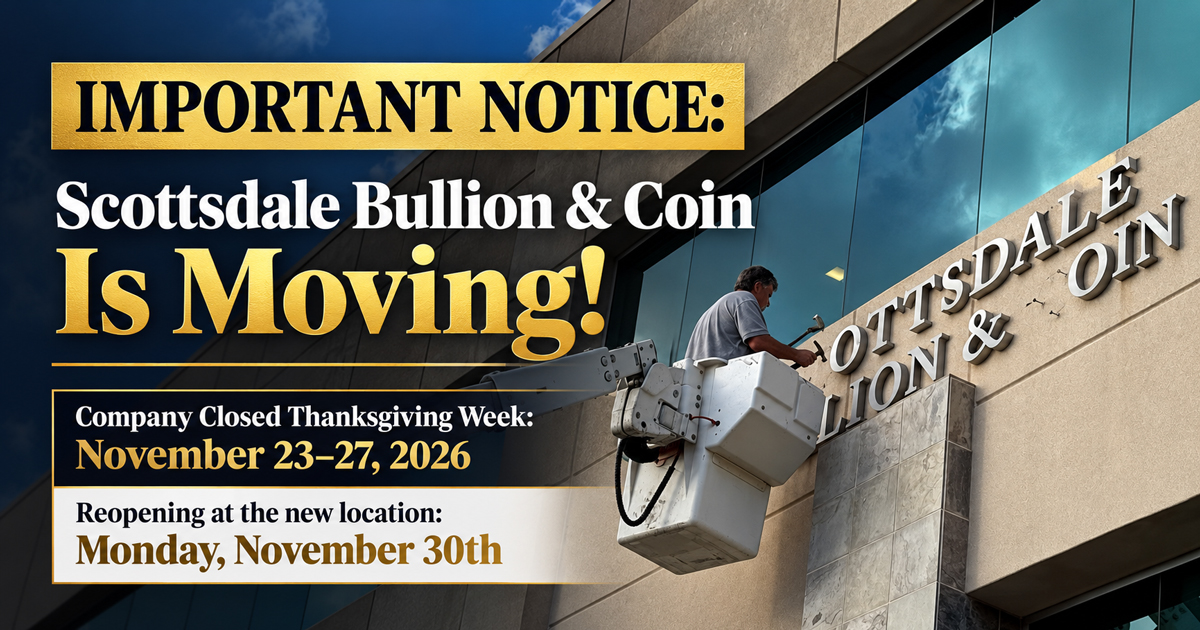
We’re excited to finally move into our new permanent home office in North Scottsdale, Arizona! After a long construction process, we’re looking forward to welcoming you into a space designed to help us better serve your precious metals needs for years to come.
Company CLOSED Thanksgiving Week: November 23rd-27th, 2026
We’ll be moving during Thanksgiving week, November 23–27. Our company will be closed, with no in-person meetings or product pickups, and shipping may experience delays. Our Precious Metals Advisors will remain available by direct phone and email.
We’ll officially reopen on Monday, November 30th, 2026, at our new location.
Thank you for following our journey and supporting Scottsdale Bullion & Coin along the way. We look forward to seeing you at our new home!
Question or Comments?
If you have any questions about today’s topics or want to see us discuss something specific in a future The Gold Spot episode, please add them here.
Comment
Questions or Comments?
"*" indicates required fields