

Eric Sepanek
SBC Founder
Eric Sepanek is the founder of Scottsdale Bullion & Coin, established in 2011. With extensive experience in the precious metals industry, he is dedicated to educating Americans on the wealth preservation power of gold and silver.

John Karow
Sr. Precious Metals Advisor
John Karow is an experienced lawyer and Precious Metals Advisor at Scottsdale Bullion & Coin. He holds degrees from Lehigh University, the University of Missouri, Cornell University, and St. John’s University School of Law. John is a knowledgeable authority in precious metals, dedicated to helping clients navigate economic cycles and gold and silver investments.

Add SBC on Google as a preferred source to see more market related news like this when you search.

As the United States celebrates its momentous 250th birthday, Americans are reflecting on the ideals that gave rise to a new nation. Yet America’s founders sought more than political independence. They also set out to build a financially independent nation. 250 years later, that conversation is far from over.
In this week’s The Gold Spot, Scottsdale Bullion & Coin Founder Eric Sepanek and Precious Metals Advisor John Karow trace the origins of America’s monetary system, examine why the Founding Fathers strongly favored physical gold and silver over paper currency, and why the battle over sound money is far from over.
The Financial Battle Behind the Revolution
When Americans reflect upon the American Revolution, images of steaming muskets, foggy battlefields, tattered flags, and an ink-drenched Declaration of Independence usually come to mind. Less remembered, yet equally foundational, are the financial origins of the young nation.
In 1776, the U.S. had no official currency. Instead, commerce was ruled by an international patchwork of specie, including British pounds, Spanish silver dollars, and other foreign coins. That fragmented, unofficial system got the job done until the U.S. needed to fund its costly war against the mighty British Empire.
With no taxing authority and little access to credit, the Continental Congress turned to the now-time-tested practice of printing money. Continentals, as the currency became known, spurred rapid inflation, a deterioration in purchasing power, and a loss of public confidence.
By the end of 1779, one Continental dollar was reportedly worth just two cents in silver. The phrase “not worth a Continental” was coined as soldiers, merchants, and the earliest American entrepreneurs witnessed their savings evaporate. This early experimentation with paper currency served as a vital economic lesson for the Founding Fathers.

“The Founders had lived through the collapse of paper money firsthand. They had watched inflation eat the army's pay. They had watched merchants get ruined. They had watched currency printed into worthlessness while men died in the field. And when the war was over, they were not going to let it happen again.”
Eric Sepanek
SBC Founder

America’s First Coin Was Forged in Crisis
Faced with a fledgling paper means of exchange, the Continental Congress quickly turned its attention to building an economic foundation on inherent value rather than paper promises. This renewed focus gave rise to one of the most fascinating numismatic coins in American history: the 1776 Continental Dollar.
Designed by Benjamin Franklin, the coin carried powerful symbolism. One side featured a sundial illuminated by the sun with the Latin word Fugio, meaning “I fly,” reminding Americans that time is fleeting. The reverse displayed thirteen interlocking rings representing the original colonies surrounding the words “We Are One,” reflecting the unity that held the Revolution together.
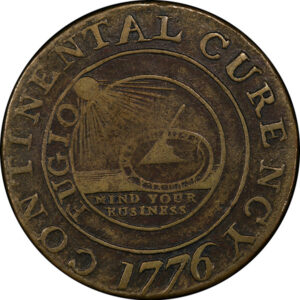
1776 Continental Dollar Obverse Design
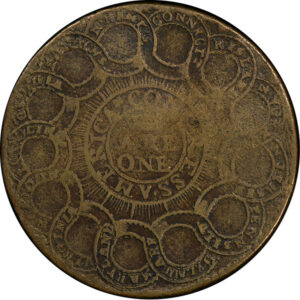
1776 Continental Dollar Reverse Design
Although the original intention was to strike the coin in silver using bullion from France, the shipment never arrived. Instead of abandoning the project, a handful of Continental Dollars were struck in silver, and larger quantities in pewter, a far less valuable metal.
However, this legendary coin has gone on to command a value far beyond its metal content. Today, they’re among the rarest numismatic coins. While pewter versions command an impressive evaluation of $100,000 to $300,000, rarer silver iterations can sell for well over $1 million.
Remarkably, one private SBC client owns both a pewter and a brass 1776 Continental Dollar, two exceptionally rare pieces from the earliest chapter of America’s monetary story. The client has expressed a willingness to pass these extraordinary pieces on to the right collector.
They hope to find someone who appreciates not only their exceptional rarity and value, but also their enduring place in America’s monetary history. If these remarkable artifacts are of interest to you, contact Scottsdale Bullion & Coin directly for additional details.
 SUGGESTED VIDEO
Why the Founders Distrusted Paper Money
The rapid collapse of the Continental paper currency left an indelible mark on America’s founding generation, providing a tangible illustration of how an unanchored means of exchange can devastate commerce, undermine confidence, and dramatically lose value. The Founding Fathers made their beliefs about the need for physical currency and their preference for gold and silver abundantly clear.
Thomas Jefferson summarized his views bluntly, writing that “Paper is poverty. It is only the ghost of money, and not money itself.”
George Washington similarly warned that paper money could “ruin commerce, oppress the honest, and open the door to every species of fraud and injustice.”
Meanwhile, James Madison sought constitutional protections limiting the use of paper currency, while John Adams argued that many of America’s financial problems stemmed from misunderstandings about money itself.
The Founding Fathers disagreed passionately on politics, religion, and philosophy. Still, their disparate views converged on the necessity for tangible, inherently valuable precious metals at the heart of the American financial system.
“Sound money is not just about keeping prices stable. Sound money is a check on government power. When a government can print money freely, it can wage unlimited wars. It can run unlimited debt. It can steal wealth through inflation without ever passing a visible tax.”
Eric Sepanek
SBC Founder
How Gold and Silver Became America’s Monetary Foundation
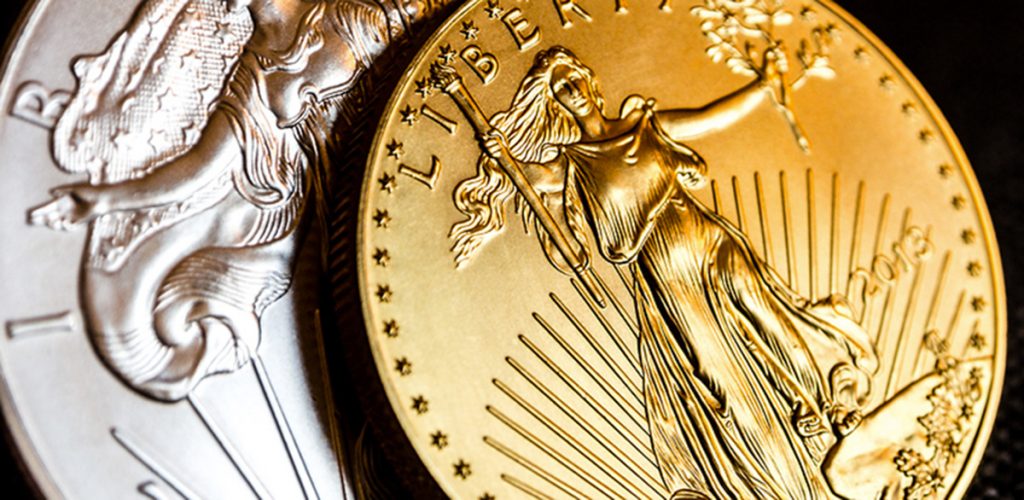
Those convictions soon found their way into law. In 1792, President George Washington signed the Coinage Act, formally establishing the U.S. Mint and creating America’s first standardized monetary system. Guided largely by Treasury Secretary Alexander Hamilton, the dollar was modeled after the widely trusted Spanish milled dollar while adopting a bimetallic standard based on both gold and silver.
Rather than relying solely on paper promises, the nation’s currency was defined by specified amounts of precious metals. Gold and silver became the monetary foundation upon which the young republic built its financial system. For nearly 180 years, America’s monetary framework remained connected to precious metals in one form or another, reflecting the lessons its founders believed history had taught them.
1971 Marked a Turning Point
That long-standing relationship changed dramatically in August 1971. When President Richard Nixon suspended the dollar’s convertibility into gold, the U.S. effectively ended the Bretton Woods system and ushered in the modern era of fiat currency. From that point forward, the dollar’s value would no longer be tied directly to precious metals but would instead rest on confidence in the U.S. government and its economy.
“Tricky Dick closed the gold window in August of 1971. Then the dollar became pure fiat, backed by nothing but government confidence. Every warning Jefferson wrote, every line Washington put into a letter, every protection Madison embedded into the Constitution, all of it, gone, just like that.”
Eric Sepanek
SBC Founder
Few moments have altered America’s monetary history more profoundly than the de facto end of the gold standard. Whether viewed as a necessary evolution or a departure from the nation’s original monetary philosophy, the decision fundamentally transformed how the U.S. creates and manages money. Many of the fiscal ailments plaguing the country today can be traced back to this decision.
The Legacy of Fiat Currency
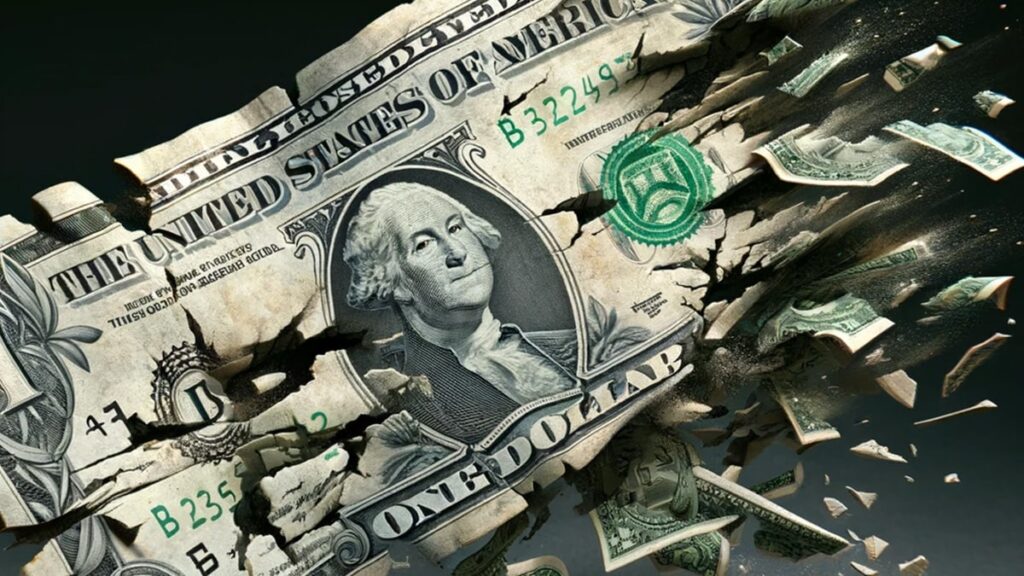
Although America’s monetary system has evolved dramatically over the past 250 years, many of the questions that occupied the nation’s earliest leaders remain remarkably familiar. The U.S. has now operated under a fiat regime for more than five decades, and the sheer amount of red on the balance sheet is impossible to ignore. Currently, the financial system faces:
- A towering $39 trillion national debt that’s projected to hit $50 trillion by 2030.
- Automatic annual $1 trillion interest burden, creating a self-perpetuating debt cycle.
- Ever-expanding federal deficits that routinely top $2 trillion, only digging the debt hole deeper.
- Global de-dollarization trend as countries seek to distance their economies from a struggling and increasingly weaponized USD.
- Declining official demand for the dollar as gold overtakes the USD in central bank reserves.
At the same time, new technologies, such as digital payment systems, stablecoins, and central bank digital currencies (CBDCs), continue to threaten to take the foundation of the U.S. financial system even further away from the Founding Fathers’ shared vision.
America Is Still Having the Same Conversation

History rarely repeats itself verbatim, but it often revisits the same questions. A quarter of a century after the nation’s founding, the American public finds itself voicing the same concerns as the founding generation: What gives money its value? What limits should be placed on the government’s ability to create money? And, perhaps most aptly, what role should precious metals play in preserving wealth and purchasing power in the long run?
If you’d like to learn more about the history, strategy, and investment potential of America’s rarest coins, claim a FREE copy of SBC’s Investment Grade Coin Report. It explores how historically significant coins have preserved wealth across generations and why they continue to play a unique role in many investors’ portfolios.
🇺🇸 Happy Fourth! 🇺🇸
From all of us at Scottsdale Bullion & Coin, we wish you and your family a safe, joyful, and memorable Fourth of July. Happy Independence Day, and happy 250th birthday, America!
Question or Comments?
If you have any questions about today’s topics or want to see us discuss something specific in a future The Gold Spot episode, please add them here.
Comment
Questions or Comments?
"*" indicates required fields