

Eric Sepanek
SBC Founder
Eric Sepanek is the founder of Scottsdale Bullion & Coin, established in 2011. With extensive experience in the precious metals industry, he is dedicated to educating Americans on the wealth preservation power of gold and silver.

Add SBC on Google as a preferred source to see more market related news like this when you search.


When investors think about buying gold, their focus usually revolves around product types, investment amounts, and recurring purchases. However, understanding how you own gold is just as important as these other considerations.
Generally speaking, there are two common arrangements for holding gold through a bank or storage provider: allocated and unallocated gold.
Allocated gold gives investors ownership of identified physical bullion, while unallocated gold gives investors a claim against a provider for an amount of gold.
The difference between these arrangements comes down to ownership, control, access, liquidity, costs, and counterparty risk.
Key Takeaways
- Allocated gold provides ownership of identified bullion, offering greater control and lower counterparty risk.
- Unallocated gold provides an IOU, even when physical bullion fully backs the account.
- Segregated and commingled describe how gold is stored, while pool-allocated gold involves shared ownership of physical bullion.
- Delivery options, conversion requirements, minimum quantities, fees, and waiting times depend on the account agreement.
What is Allocated Gold?
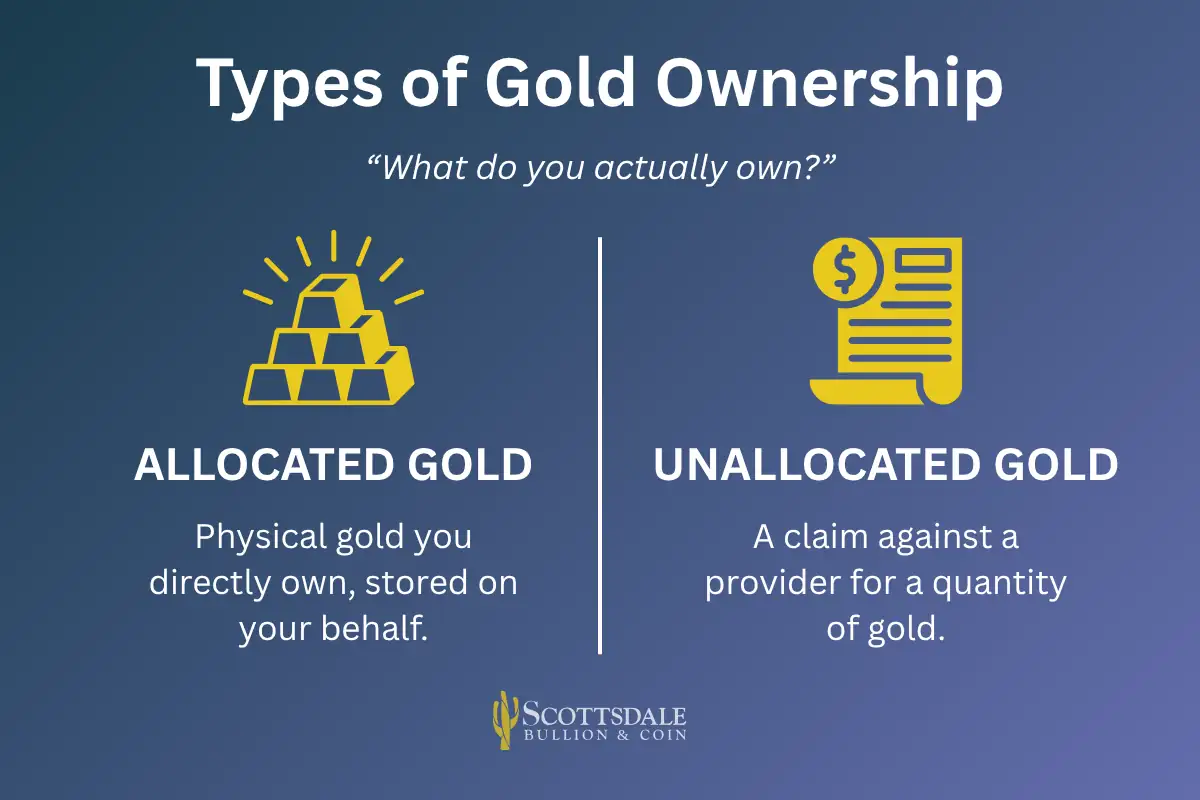
Allocated gold offers direct ownership of specific gold bars and coins and other types of physical bullion. A storage provider, or custodian, safeguards this gold on your behalf.
This arrangement allows investors to own physical gold without handling storage and security themselves. Investors can generally arrange pickup or delivery, with procedures and fees varying by custodian. However, taking delivery of gold held in a precious metals IRA can trigger taxes and potential early-withdrawal penalties.
How is Allocated Gold Identified?
As the legal owner of bullion held in an allocated gold account, you receive records identifying the physical assets that belong to you. While details vary by product and provider, key identifiers often include:
- Refiner or mint: The name of the refinery or mint that produced the bullion, helping identify the manufacturer and its products.
- Product type and quantity: The specific bars or coins, including product names, sizes, and how many of each are held for you.
- Serial number: The unique number marked on an individual bar, where applicable, linking that particular bar to your ownership records.
- Weight and purity: Each product’s weight and percentage of gold, which together determine how much pure gold it contains.
- Storage records: Vault and inventory details linking bullion to your name or account and identifying where it is held.
Buying, Selling, and Exchanging Bullion
With direct control over their physical products, an allocated gold account allows investors to freely buy and sell their gold. You can buy bars and coins, sell some or all of your holdings, or exchange one product for another.
When buying gold, products are subject to dealer premiums, the current gold spot price, and other potential fees. These are the same pricing factors you’d pay when buying gold outside an allocated account.
After selling a product, you can use the proceeds to buy another physical bullion asset or request a cash payout. Some providers also allow the money to remain in the account as a cash balance for future purchases.
If you’re exchanging products, the gold can typically stay in storage throughout the process. For example, an investor may sell a 10 oz gold bar in exchange for ten 1 oz coins, without having to take physical delivery.
What is Unallocated Gold?
Unlike the direct ownership offered by allocated gold, unallocated gold gives investors a claim against a bank or other provider for a specified amount of gold.
Although your holdings are denominated in Troy ounces or grams, no physical bars, coins, or other types of bullion are labeled as your property. Instead, the provider records how much gold it owes you, effectively giving you an IOU for that amount.
Notably, an unallocated gold account doesn’t have to be backed by physical bullion. Some providers explicitly state that their unallocated gold accounts are fully backed with physical bullion, while others have no physical gold backing. This leaves investors dependent on the provider’s broader financial resources to meet its payment obligations.
Depending on the account agreement, investors might sell their balance for cash or request conversion into physical bullion for delivery. However, some accounts only allow cash payouts.
How Is Your Gold Balance Recorded?
An unallocated gold account works much like a bank account balance, except it is measured in ounces or grams instead of dollars. Account statements track how much gold the provider owes you without identifying bars or coins as your property. Generally, these balance records include:
- Gold balance: The total ounces or grams credited to your account, showing how much gold the provider owes you under the agreement.
- Transaction history: A record of purchases, sales, and other account activity, including dates and quantities that explain changes to your gold balance.
- Account charges: Any account maintenance, trading, or other service fees recorded on the statement, whether deducted from your holdings or charged separately.
These records merely document an investor’s claim against the provider for a certain amount of gold, and how the balance changes over time. Crucially, records from an unallocated gold account don’t establish ownership of gold bars or coins.
Buying, Selling, and Exchanging a Gold Balance
An unallocated gold account allows investors to buy and sell amounts of gold without choosing identifiable bars or coins. Purchases add ounces or grams to your account, while sales reduce the balance owed by the provider.
Pricing generally follows gold’s spot price, with the provider’s buying and selling prices and any transaction or account fees affecting costs. Dealer premiums and fabrication charges could apply if you later convert your balance into physical bullion.
After selling, investors can use the proceeds to make another purchase or request a cash payout. As with allocated accounts, some providers let proceeds sit as a cash balance.
Allocated vs. Unallocated Gold: Key Differences
Choosing between allocated and unallocated gold means weighing the costs, flexibility, and protections each arrangement offers. The comparison below brings together the practical differences in buying, holding, and accessing your gold investment.
| Allocated Gold | Unallocated Gold | |
|---|---|---|
| Ownership | Direct ownership of specific gold bars or coins. | A claim against the provider for a stated amount of gold. |
| Proof of Holdings | Records identify the bullion belonging to the investor. | Account statements show a balance in ounces or grams. |
| Physical Backing | Actual bullion held as the investor’s property. | No guaranteed physical backing (depends on provider). |
| Risk | Ownership reduces counterparty risk. | Repayment depends on the provider’s financial health. |
| Costs | Storage and insurance charges generally apply. | Often lower storage costs, but other fees may apply. |
| Buying and Selling | Buy, sell, or exchange specific bullion within provider terms. | Buy or sell a gold balance, rather than specific bullion. |
| Taking Delivery | Have your gold shipped to you or arrange pickup. | Receive cash for your account balance or, in some cases, physical gold. |
| Provider Failure | Gold remains your property, though recovery may take time and money. | Creditors may recover less than their full gold balance. |
Understanding Segregated, Commingled, and Pooled Storage
When researching gold storage options, you may come across the terms “segregated,” “commingled,” and “pooled.” These labels can be confusing because they refer to different, yet sometimes overlapping setups.
Segregated vs. Commingled Storage
As mentioned before, allocated gold describes direct physical ownership of gold stored on an investor’s behalf. Segregated and commingled refer to how that gold is stored:
- Segregated storage: Keeps an investor’s bullion separate from other customers’ holdings.
- Commingled storage: Also called non-segregated storage, multiple customers’ gold is held together.
In either arrangement, allocated holdings remain the investor’s property, with ownership documented in the provider’s records.
Pool-Allocated Gold
Pool-allocated gold involves shared ownership of an identified bar or pool of physical gold. This allows investors to own a portion of a larger bullion asset without purchasing it outright.
For example: You could own 50% of a 100 oz gold bar, with the remaining half owned by other investors.
Why share ownership of a larger gold bar when you could use the same funds to own a smaller one outright?
Larger gold products tend to carry lower premiums per ounce. Pooling lets investors share those potential savings while allowing the buying and selling of smaller amounts.
Pool-allocated gold gives you shared ownership of physical bullion, but taking delivery can involve more steps than receiving a bar or coin that belongs entirely to you. Where delivery is offered, you often need to exchange your ownership share for whole bars or coins containing an equivalent amount of gold.
Related Reading: Gold Vault Demand Soars Among Wealthy Investors in 2026

Why Investors Choose Allocated Gold
Allocated gold can appeal to investors who want to build physical gold holdings over time while leaving storage and security to a professional custodian.
For these buyers, ownership, control, and reducing counterparty risk are central considerations. Some key advantages of allocated gold include:
- Direct physical ownership: Records identify the bullion belonging to the investor, providing a clear connection between the investment and the underlying metal.
- Control over holdings: Individually allocated accounts can offer a choice of specific bars or coins, with options to sell, exchange, or arrange delivery under the provider’s terms.
- Lower counterparty risk: Properly established ownership generally protects customer bullion from being treated as the provider’s property available to repay its debts.
- Faster delivery: Individually allocated bars or coins are already held for the investor, which can avoid the conversion or fabrication delays of an unallocated account.
These advantages come with considerations such as product premiums, storage and insurance charges, and delivery procedures. Investors should still review ownership terms, audits, and insurance coverage.
Why Investors Choose Unallocated Gold
Unallocated gold may appeal to investors who prioritize trading convenience and flexible purchase quantities without selecting specific bullion products. Institutions handling frequent transactions also use these accounts to simplify trading and settlement. Some of the core advantages of unallocated gold include:
- Simple transactions: Purchases and sales change an account balance without requiring particular bars to be assigned to each transaction.
- Flexible quantities: Investors can trade amounts of gold without matching purchases to the weight of whole bars or coins.
- Potentially lower holding costs: Some providers charge less for unallocated holdings, although trading, account, and conversion fees still need to be compared.
The risks involved with unallocated gold stem from the plain fact that investors generally don’t own the bullion. That IOU is a claim against the provider, and it’s only as good as the provider’s ability to follow through.
If the provider fails, you might recover less than you’re owed, plus face the hassle and expense of filing a claim. Even when physical delivery is offered, which isn’t a guarantee, you could still face conversion fees and waiting times, making the bullion less readily accessible.
Allocated vs. Unallocated Gold: Which Is Best for You?
As with many decisions in precious metals investing, there’s no inherently “best” choice between allocated and unallocated gold. The right choice depends on your personal preferences, available capital, portfolio allocation, and overarching investment goals.
If you’re looking for direct ownership of specific gold bars and coins that you can freely buy, sell, and trade, or take physical delivery of, allocated gold is likely the better fit.
Before you invest, it’s critical to understand what you own and how the gold is stored. If you’re interested in learning more about investing in physical gold, our Precious Metals Advisors can answer your questions and offer personalized advice.
You can reach us by calling toll-free at 1-888-812-9892 or using our live chat function.