

Eric Sepanek
SBC Founder
Eric Sepanek is the founder of Scottsdale Bullion & Coin, established in 2011. With extensive experience in the precious metals industry, he is dedicated to educating Americans on the wealth preservation power of gold and silver.

Add SBC on Google as a preferred source to see more market related news like this when you search.


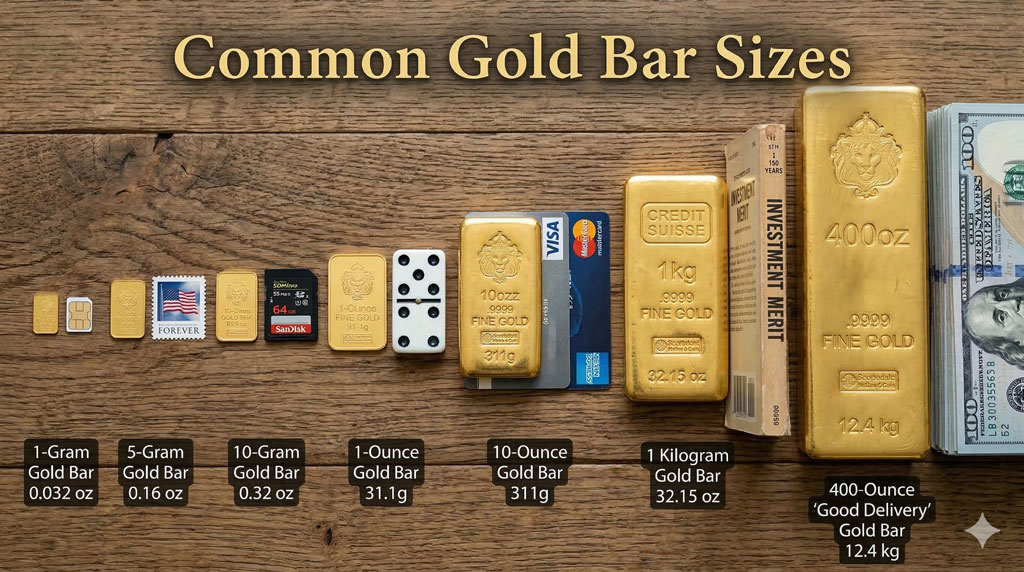
Gold bar sizes vary greatly, offering investors a wide selection to meet diverse investment goals and personal preferences.
In reality, size isn’t the only variable. These size variations also mean different weights and dimensions. Plus, factors such as proportional pricing, storage efficiency, and liquidity shift based on the bar size, making it a crucial consideration for any investor.
Understanding these differences and their investment merits can help you select the gold bar sizes to support your financial objectives.
Understanding Gold Bar Weights
The different weight denominations used for gold bullion bars can be confusing, even for seasoned investors. Across the gold market, bars are typically measured using two systems:
- Grams: Part of the metric system, grams are widely used in countries outside the US, including Latin America, Europe, and Asia. This is the standard unit of mass for industrial and jewelry applications, where precision and global compatibility matter.
- Troy Ounces: Troy ounces are the standard unit of gold bar weights used in the gold market, with the spot price of gold quoted in this system. Unique to precious metals, the troy ounce dates back to the Middle Ages and remains the dominant measurement for bullion worldwide.
Expert Tip: Don’t confuse troy ounces (part of the largely defunct troy weight system) and the more commonly used ounce (part of the widely adopted avoirdupois system).
👉 Suggested Read: Gold Bar Weight Guide: Standard Sizes From 1g to 400 oz
Fractional Gold Bar Sizes: Grams & Smaller Bars
1-Gram Gold Bar (0.032 oz)
One of the smallest gold bar sizes available weighs 1 gram or approximately 0.032 ounces. These bars are about the size of a fingernail or a SIM card. Their relative affordability makes them popular for gifting and collecting, while their high divisibility also makes them practical for bartering or incremental investing.
5-Gram Gold Bar (0.16 oz)
5-gram gold bars are popular for beginner investors or those looking for an affordable entry point into physical gold. They’re still much more affordable than larger bars while still enjoying decent liquidity. The attached dealer premiums are lower than for 1-gram bars but still high in general. A 5-gram product is similar to a postage stamp, one of the smallest gold bar dimensions.
10-Gram Gold Bar (0.32 oz)
As with other pieces of fractional gold bar sizes (assets smaller than one ounce), 10-gram gold bars are ideal for those prioritizing affordability and storage convenience. Premiums are slightly lower than for smaller gold bars, yet still exceed the average. They’re comparable to a standard SD card.
Standard Gold Bar Sizes for Retail Investors
1-Ounce Gold Bar (31.1g)
The 1-ounce gold bar is considered the standard for retail investors, with all of the most popular gold bar companies offering this size. It packs a valuable punch while still maintaining an accessible evaluation. When choosing between gold bullion bars and gold coins, many investors opt for the 1-ounce bar for its pure gold content. They’re slightly larger yet thinner than a common domino tile.
10-Ounce Gold Bar (311g)
The 10-ounce gold bar is a solid mid-range option for investors looking to make a sizeable purchase without overextending themselves. They’re compact enough for easy storage and widely traded enough to ensure simple liquidation when needed. 10-oz bars are similar in size to credit cards but much thicker.
Larger Gold Bar Sizes: Institutional & Good Delivery Bars
1 Kilogram Gold Bar (32.15 oz)
Institutional investors such as banks, mutual funds, and investment companies commonly purchase gold through 1-kilogram bars. These assets offer lower premiums per ounce and offer convenient storage solutions. Yet, they come with hefty price tags, especially when the gold spot price is high. These gold bars are roughly the size of a paperback book.
400 Ounce Gold Bar (12.4 kg)
Commonly known as the “Good Delivery Bar,” the 400-ounce gold bullion bar is the largest widely traded gold bullion asset despite boasting one of the largest gold bar dimensions. Its sheer size makes it unfeasible for retail investors, with current values reaching over $1 million.
However, Good Delivery Bars are one of the most common mediums of gold exchange for central banks as they meet strict standards set by the London Bullion Market Association for global trade. If you’ve ever seen a movie featuring vaults stacked with gold, chances are it was a 400-ounce bar replica.
Common Gold Bar Sizes, Weights & Everyday Comparisons
| Gold Bar Size | Weight (grams) | Weight (oz) | Similar In Size To… |
|---|---|---|---|
| 1 Gram | 1 g | 0.032 oz | SIM card / Fingernail |
| 5 Gram | 5 g | 0.160 oz | Postage stamp |
| 10 Gram | 10 g | 0.321 oz | SD memory card |
| 1 Ounce | 31.1 g | 1 oz | Domino tile |
| 10 Ounce | 311 g | 10 oz | Credit card (thicker) |
| 1 Kilogram | 1000 g | 32.15 oz | Paperback book / Smartphone |
| 400 Ounce (Good Delivery) | 12,400 g | 400 oz | Standard brick |
Considerations of Gold Bar Sizes
As with all precious metals investments, there’s no one-size-fits-all solution. It all depends on your portfolio demands and investment goals. When choosing between different gold bar dimensions, here are some crucial factors to bear in mind:
Cost
One of the pros of gold bars is their value density, allowing investors to pack value into a compact asset. However, this efficiency in storing value also comes at a higher cost than other metals. Determining which gold bar size matches your budget restrictions and investment allocation can prevent overextension and preserve portfolio diversity.
Storage
Gold bars come in uniform shapes for efficient logistics, but storage remains a key factor when choosing the right size. Larger bars, while cost-effective per ounce, can quickly take up space, leading to higher storage or insurance fees. Balancing size and storage requirements is essential for long-term security and investment convenience.
Dealer Premiums
Although gold bullion bars tend to attract lower dealer premiums than investment-grade coins, these add-on costs aren’t proportional. Smaller gold bar sizes typically incur higher premiums per ounce due to higher production costs and elevated demand. In contrast, large bars often have lower premiums per ounce because of more cost-effective manufacturing and common bulk discounts.
Which gold bar sizes are best for you?
The “best” gold bar size depends on your specific investment goals. While some investors stick to fractional bars due to limited budgets or to make incremental investments, others seek to accumulate physical gold faster through larger bars. Still, some investors opt for a mix of different sizes to capitalize on the unique benefits each offers.
In reality, all gold bullion bars have pros and cons. The most effective way to determine which gold bar sizes align with your financial objectives is to speak with a precious metals advisor. The team at Scottsdale Bullion & Coin would be happy to help. Contact us today by calling toll-free at 1-888-812-9892 or using our live chat function.