

Joe Elkjer
Sr. Precious Metals Advisor
Joe Elkjer, a Precious Metals Advisor at Scottsdale Bullion & Coin since 2019, specializes in helping clients protect their assets through tangible investments. With a strong background in business and finance, he emphasizes stellar customer service and stays dedicated to informing clients about market impacts through frequent appearances on The Gold Spot.

Todd Graf
Precious Metals Advisor
Todd Graf is a seasoned Precious Metals Advisor at Scottsdale Bullion & Coin. He has a decade-long career in finance, previously at Morgan Stanley and Vanguard. He is Series 7 licensed and has extensive experience in traditional and defensive assets, providing clients with solid investment strategies.

Add SBC on Google as a preferred source to see more market related news like this when you search.

Silver’s supply crisis is no longer theoretical. As China tightens its grip on refining and exports, the physical market is beginning to crack beneath the surface. Investors with strategically positioned portfolios could stand to benefit enormously if silver’s tightening fundamentals ultimately force a major market repricing.
Watch this week’s The Gold Spot to hear Scottsdale Bullion & Coin’s Precious Metals Advisors, Todd Graf and Joe Elkjer, discuss silver’s sixth consecutive year of supply deficits, China’s tightening grip on global silver refining and exports, and why physical silver premiums may be warning of a much larger market repricing ahead.
Sixth Straight Year of Silver Deficits
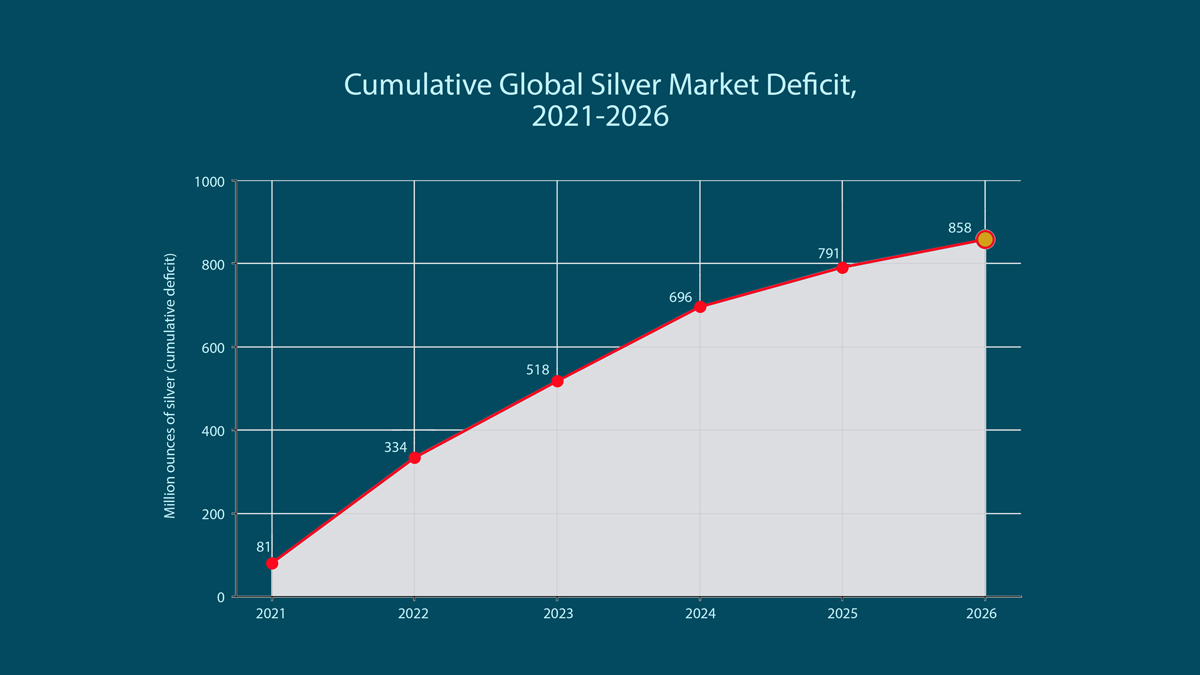
2026 is on pace to become the sixth consecutive year of silver deficits, meaning demand is outpacing available supply. At this point, the silver market is exhibiting structural tightness, not mere cyclical shortages caused by short-term fluctuations with quick resolutions.
What’s more, the silver shortfalls have increased over the years. Since 2021, consecutive annual silver deficits have cumulatively approached 800 million ounces (Moz), with the market expected to surpass that milestone in 2026.
Industrial demand accounts for the majority of silver consumption, comprising roughly 58% of total demand through 2024 and 2025. This primary source of consumption has risen steadily from 2021 to 2024, reaching a record of 680.5 Moz two years ago. In 2025, industrial purchases hit 657.4 Moz, and projections for 2026 sit around 650 Moz.
While manufacturing usage remains the single-largest pillar of demand, it’s not the fastest-growing source. Retail demand for physical silver bars and coins surged 14% year-over-year in 2025, landing at 217.7 Moz. This year, this segment is expected to rise by another 18%, reaching 257.6 Moz.
“What shifted in the narrative is that we're no longer talking about potential imbalance. The strain is on the system right now. With what’s happening on the supply side, the picture gets tighter.”
Todd Graf
Precious Metals Advisor
China Squeezes a Starved Market
China has been an influential player in the silver market for years, but its influence is reaching new extremes. In early 2026, Beijing’s demand reached its highest point in eight years, with the world’s largest population center attracting 1,260 tons in Q1 alone. Simultaneously, China’s physical stockpiles are dwindling rapidly.

Beyond heightened demand, China maintains a stranglehold on the silver market from the supply side. The U.S. Geological Survey estimates that about 11% of the world’s identified silver reserves are concentrated within Chinese borders. This geographical lottery gives Beijing unprecedented leverage, as it controls about 7.6% of global mine production. On top of that, the country plays a central role in silver refining, accounting for about 60% to 70% of global supply.
In late April, significant research from John Rubino indicated that China had begun implementing refining restrictions. China’s disproportionate role in this critical processing stage — converting raw silver into end-use products for both industrial and investment purposes — creates a potentially serious bottleneck in the global silver supply chain.
Chinese leaders have not been transparent about these refining limitations, but they align with recent policy changes aimed at curtailing silver outflows. In 2026, China introduced a new silver export licensing regime that sharply restricted exports to a select group of approved companies. While an outright export ban remains absent, these measures represent a significant shift toward tighter state control over the flow of physical silver from one of the world’s most important refining and processing hubs.
“This may not be a permanent policy shift, but it adds friction to a system that is already under strain.”
Todd Graf
Precious Metals Advisor
Why is the Silver Market Lagging?
With six years and counting of growing deficits and the world’s supply further constrained by China’s demand acceleration and export constriction, investors are rightfully wondering why the silver spot price hasn’t reacted accordingly. After all, these structural shortfalls often lead to spikes in silver prices. So, what gives?
Despite building momentum on the physical side of the equation, paper silver still dominates the market. For context, purchases of global silver exchange-traded product (ETP) holdings totaled 1.13 billion ounces in 2025, while physical demand for silver bars and coins reached only 217.7 Moz.
Several forces continue to weigh on silver prices despite tightening physical fundamentals:
- Futures contracts: Silver prices are still largely driven by paper futures trading, where speculative selling can outweigh physical supply shortages.
- Institutional hesitation: Many major investors remain cautious on silver due to its volatility and industrial exposure, limiting large-scale capital inflows.
- Economic slowdown fears: Since industrial uses account for most silver demand, recession concerns can pressure prices by threatening manufacturing demand.
It’s worth noting that silver prices tend to react with a delay before moving rapidly in response to major catalysts, particularly when surging demand collides with severely constrained supply. That dynamic played out in 2025, when silver prices skyrocketed from around $71/oz to nearly $120/oz in a matter of months.
“Silver has a very well-known pattern in these situations. It tends to lag, and then it moves very quickly. We've seen it before. When the market is finally forced to reprice, it does not do it gradually.”
Joe Elkjer
Sr. Precious Metals Advisor

Premiums Are Starting to Flash Warning Signs
A spike in dealer premiums is one of the clearest signs of stress building beneath the surface of the silver market. Some physical silver products are now seeing rising dealer premiums above spot prices as silver demand increasingly focuses on available supply. This dynamic pierces the illusion of calm reflected by the flat spot price.
Fortunately for investors, not all silver products are priced equally. Many silver products still maintain comparatively modest premiums despite persistent global silver deficits and growing concerns surrounding Chinese export controls and refining restrictions. However, the window of opportunity for these comparatively affordable products is closing fast as the silver market prepares to respond to rising pressure.
Bank of America recently unveiled an aggressive silver forecast ranging between $135/oz and $309/oz, implying massive upside potential from current levels. Furthermore, marketwide 2026 silver price predictions remain optimistic. In a previous episode of The Gold Spot, the Scottsdale Bullion & Coin team outlined a scenario where Chinese control could send silver prices to $300/oz.
If you’re eager to lock in silver products at current levels before prices take off or you have questions about your current strategy, the team at Scottsdale Bullion & Coin is always here to help. Contact us today by calling toll-free at 1-888-812-9892 or using our live chat function.
Investors can also request our all-new silver report, Silver: The Awoken Giant, for a deeper look at the growing supply pressures, rising global demand, silver price potential ahead, and insider strategies for navigating today’s evolving silver market.
Request Your FREE COPY of our New Silver Investor Report Today!

Just Fill Out This Form
"*" indicates required fields
