

Steve Rand
General Manager / Sr. Precious Metals Advisor
Steve Rand is the General Manager and a Sr. Precious Metals Advisor at Scottsdale Bullion & Coin. He brings over 20 years of experience in the physical precious metals markets.

Add SBC on Google as a preferred source to see more market related news like this when you search.

Gold and silver prices can move quickly, making it difficult for investors to know when to buy. Dollar cost averaging offers a simple way to build a precious metals position over time without trying to perfectly time the market.
Instead of making one large purchase at a single price, this strategy spreads purchases across regular intervals. For investors buying physical gold, silver, or other precious metals, dollar cost averaging can help smooth out price swings, encourage consistency, and make long-term accumulation more manageable.
In this guide, we’ll explain how dollar cost averaging works, why investors use it, how it compares with lump sum investing, and how to apply the strategy when buying gold and silver.
Key Takeaways
- Dollar cost averaging means investing a fixed amount at regular intervals.
- For gold and silver investors, DCA can make long-term accumulation more consistent.
- Lump sum investing has often produced stronger returns when all capital is available upfront.
- DCA and lump sum investing are not opposing strategies. Many investors use both at different times.
- Product selection matters because premiums, liquidity, and purchase size affect how many ounces are accumulated.
What is Dollar Cost Averaging?
Dollar cost averaging is an investment strategy in which you invest a fixed amount of money at regular intervals over time, regardless of an asset’s price.
Because the investment amount remains constant, changes in price determine how much of the asset each purchase acquires. As prices fall, the same investment buys more; as prices rise, it buys less. Over time, this approach can smooth out fluctuations in your average purchase price while removing much of the emotional guesswork that often comes with trying to time the market.
Dollar Cost Averaging Precious Metals
For gold and silver investors, dollar cost averaging is especially useful because physical metals are often accumulated over time rather than traded in and out like stocks. The strategy also forces investors to think beyond price alone, since premiums, product selection, liquidity, and purchase size all affect how many ounces are accumulated over time.
How Dollar Cost Averaging Works
Dollar-cost averaging is a rules-based investment strategy built around consistency. Instead of trying to time the market, you only have two decisions to make: how much you’ll invest and how often you’ll invest it.
Whether you invest $100 every month or $500 every quarter, the plan becomes virtually automatic once those rules are set. The only variable that changes is the price of the asset you’re buying, which is entirely outside your control.
By design, dollar-cost averaging turns the variables investors can control into fixed rules while leaving price movements to the market. Over time, your purchases naturally occur across a range of prices, helping smooth your average purchase price without having to stare at charts or hold your breath.
Dollar-cost averaging typically follows five simple steps:
- Decide how much money you want to invest.
- Pick a recurring investment schedule (e.g., weekly, monthly, or quarterly).
- Invest the same dollar amount each time.
- Continue making purchases regardless of short-term price fluctuations.
- Periodically review your average purchase price and overall investment progress.
The process itself is remarkably straightforward. Seeing the numbers in action, however, makes it much easier to understand how dollar-cost averaging affects your average purchase price over time.
Why Investors Use Dollar Cost Averaging
At its core, dollar cost averaging helps investors overcome three of the biggest challenges in investing: deciding when to invest, staying consistent over time, and preventing emotion from driving decisions.
Every investor has experienced the frustration of trying to find the “perfect” time to invest, only to watch the market move in the opposite direction. Dollar cost averaging removes much of that pressure by replacing market predictions with a systematic investing process.
Once you’ve decided how much you’ll invest and how often you’ll invest it, the process stays the same regardless of short-term price movements. Instead of reacting to headlines or daily price swings, you’re simply following the plan you established from the beginning.
Following a predetermined investment schedule also helps investors sidestep the FOMO of market highs and the fear of market lows, reducing the likelihood of costly knee-jerk decisions.
Dollar Cost Averaging Example
The mechanics of dollar cost averaging become much easier to understand when viewed over a series of recurring investments. The example below shows how investing the same dollar amount at regular intervals naturally changes the amount of gold purchased as prices rise and fall.
| Month | Monthly Investment | Gold Price (per oz.) | Gold Purchased (oz.) |
|---|---|---|---|
| January | $500 | $3,000 | 0.1667 |
| February | $500 | $3,400 | 0.1471 |
| March | $500 | $2,900 | 0.1724 |
| April | $500 | $3,300 | 0.1515 |
| May | $500 | $3,100 | 0.1613 |
| June | $500 | $3,600 | 0.1389 |
| Total | $3,000 | — | 0.9378 |
| Average Cost per Ounce | — | $3,198.42 | — |
Notice three patterns that emerge from the example:
The investment amount never changes.
The investor contributes $500 each month regardless of what happens to the price of gold. Every purchase follows the same predetermined schedule.
Lower prices result in larger purchases.
When gold becomes less expensive, the same $500 purchases more gold. When prices rise, it purchases fewer ounces. The investment amount never changes—only the quantity purchased does.
The plan never changes.
Rather than trying to predict where prices will move next, the investor simply continues making the same recurring investment. There is no guessing, no waiting for a better entry point, and no attempt to time the market. The strategy is simply to follow the plan consistently.
While this simplified example illustrates the mechanics of dollar cost averaging, many investors eventually ask a bigger question: How does the strategy compare to investing all of your money at once?
Dollar Cost Averaging vs. Lump Sum Investing
Once investors understand how dollar cost averaging works, the next logical comparison is lump sum investing. Instead of spreading purchases out over fixed increments, lump sum investing means putting all available capital to work immediately.
Rather than competing investment philosophies, dollar cost averaging and lump sum investing are simply two different approaches to investing available capital. Many investors use both at different points in their investing journey.
Dollar cost averaging is commonly used when investors build a position gradually as new capital becomes available. Lump sum investing is more relevant when a larger amount of capital is ready to deploy, such as a year-end bonus, inheritance, business sale, or retirement rollover.
Both strategies share the same objective of building long-term wealth. They simply approach that goal differently.
What the Research Says
When researchers have compared lump sum investing and dollar cost averaging head to head, investing immediately has generally produced higher long-term returns. Over the past several decades, researchers have repeatedly reached that same conclusion for different reasons.
The Case Against Waiting
George Constantinides’ landmark 1979 paper helped establish the mathematical foundation of the debate. His conclusion was straightforward. If an investment has a positive expected return, delaying investment generally reduces expected wealth because part of the portfolio remains in cash instead of participating in market growth. In other words, waiting comes with an opportunity cost.
Time in the Market Matters
Michael Rozeff’s 1994 research moved the discussion from theory into historical market evidence. Using real market data, he found that lump sum investing generally produced stronger long-term results.
More money invested earlier simply has more time to participate in the market’s long-term growth. Dollar cost averaging can reduce the pain of unfortunate timing, but that benefit often comes at the expense of expected return.
Why Dollar Cost Averaging Still Appeals to Investors
Brennan, Li, and Torous added an important behavioral perspective in 2005. Instead of asking which strategy yields the highest expected return, they explored why investors continue to use dollar cost averaging even when the math often favors lump-sum investing.
The researchers found that dollar cost averaging can reduce regret, ease anxiety, and lessen the emotional burden of investing a large amount immediately before a market decline. In other words, this strategy can maximize an investor’s willingness to stay invested through uncertainty.
The Real World Scorecard
Vanguard’s research provides one of the clearest real-world comparisons. Looking across multiple markets and decades of historical data, Vanguard found that lump sum investing outperformed systematic investing roughly two-thirds of the time.
The takeaway is fairly straightforward. When markets have historically moved higher over long periods, investing sooner has generally led to higher returns than investing gradually over time. That doesn’t mean dollar cost averaging doesn’t work. It simply answers a different question than many investors are asking.
Which Investment Strategy Is Best
Decades of research suggest that lump sum investing has historically produced higher long-term returns when all of the capital is immediately available for investment. However, that doesn’t mean dollar cost averaging and lump sum investing work at cross purposes. In practice, the two approaches often complement one another.
A lump sum may be the most effective way to deploy available capital, while dollar cost averaging remains a practical way to invest new money as it becomes available. It also offers an important behavioral advantage by reducing the temptation to time the market and helping investors stick to a consistent long-term plan.
Ultimately, the best strategy is understanding when each approach is appropriate and using both when they make sense.
Why Gold and Silver Are Well Suited to Dollar Cost Averaging
Precious Metals Are Often Built Over Time
Dollar cost averaging is not unique to precious metals, but it fits naturally with the way many investors build gold and silver positions. Rather than trading in and out of the market, physical precious metals are often accumulated gradually over months or years.
Whether the goal is wealth preservation, portfolio diversification, or preparing for economic uncertainty, many investors view precious metals as long-term holdings instead of short-term trades.
Volatility Can Work in Your Favor
Gold and silver can experience meaningful price swings as markets react to inflation, interest rates, geopolitical events, currency movements, and shifts in investor demand. While that volatility can make it difficult to identify the “perfect” time to buy, it also creates opportunities for dollar cost averaging.
Regular purchases naturally accumulate more ounces when prices decline and fewer when prices rise without requiring investors to predict short-term market movements. Rather than attempting to buy every dip, dollar cost averaging allows investors to participate in many of those lower-price periods automatically whenever they occur.
Silver’s historically greater price volatility can make this effect even more pronounced, allowing fixed dollar investments to accumulate significantly more ounces during periods of market weakness. This is one reason many investors compare physical bullion to paper alternatives — see our breakdown of whether silver ETFs are worth it for a closer look at that tradeoff.
Building Ounces and Portfolio Allocation
Unlike many traditional investments that are judged primarily by account value, physical precious metals are often measured in ounces accumulated. Many investors are also working toward a target portfolio allocation rather than simply purchasing as much gold or silver as possible.
This strategy is simple and can be very effective. Time and patience will always create better opportunities for the future, especially since the long-term outlook is very bullish for gold and silver.–
Whether an investor is following a traditional portfolio model or a strategy such as the 60/20/20 portfolio, dollar cost averaging provides a disciplined way to gradually build a precious metals position over time. Instead of relying on a single purchase or trying to perfectly time the market, investors can steadily work toward their desired allocation while allowing market fluctuations to become part of the accumulation process.
Historical Dollar Cost Averaging Performance
The hypothetical examples throughout this guide illustrate how dollar cost averaging works, but they don’t capture what investing through two decades of real market history actually looks like.
To better understand how different investment schedules have performed over time, Scottsdale Bullion & Coin analyzed historical monthly gold prices between 2005 and 2025, comparing a $120,000 lump-sum investment with four dollar cost averaging schedules that spread the same investment evenly over 6, 12, 24, and 36 months.
Rather than relying on a single investment date, the analysis averaged every eligible rolling investment period within the dataset to provide a broader picture of each strategy’s historical performance.
Average Ending Value of a $120,000 Gold Investment (2005–2025)
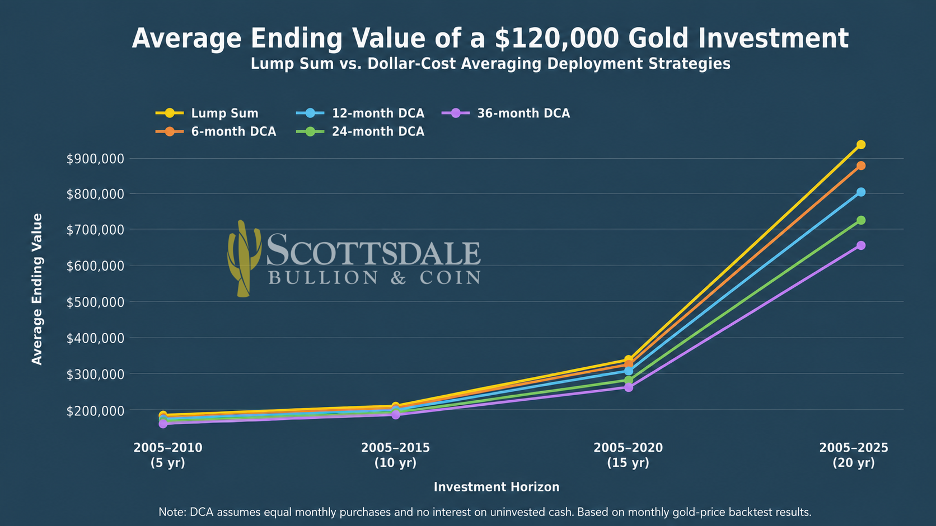
Methodology note: This analysis used monthly gold prices from 2005 through 2025 and averaged every eligible rolling 5-, 10-, 15-, and 20-year holding period. DCA assumes equal monthly purchases over the stated deployment period. Results exclude dealer premiums, taxes, transaction costs, storage costs, and interest on uninvested cash.
20-Year Historical Comparison (Lump Sum vs Dollar Cost Averaging)
| Strategy | Average Ending Value | Difference vs. Lump Sum |
|---|---|---|
| Lump Sum | $924,810 | — |
| 6-Month DCA | $870,290 | −5.9% |
| 12-Month DCA | $802,540 | −13.2% |
| 24-Month DCA | $724,570 | −21.7% |
| 36-Month DCA | $655,400 | −29.1% |
Three Key Takeaways
Lump Sum Produced the Highest Average Ending Value
Across every holding period, investing the full amount immediately produced the highest average ending value. The performance gap widened as the dollar cost averaging period became longer.
Longer Deployment Meant More Cash on the Sidelines
The results also highlight one of the primary tradeoffs of dollar cost averaging. Stretching purchases over one, two, or three years delayed exposure to gold’s long-term appreciation. While that reduced timing risk, it also created a larger opportunity cost as more capital remained uninvested.
Dollar Cost Averaging Still Accomplished Its Purpose
The results reinforce decades of research. When all of the capital is available, investing earlier has historically led to greater long-term wealth. Dollar cost averaging isn’t designed to maximize returns in that situation. It’s designed to help investors build a position consistently without having to perfectly time the market.
Historical results are only one part of the equation. Successfully applying dollar cost averaging also depends on choosing the right products, managing dealer premiums, and maintaining a consistent investment plan over time.
Choosing the Right Bullion Products for Dollar Cost Averaging
Once investors understand how dollar cost averaging works, the next logical question is what to buy. For precious metals investors, the answer usually depends on finding products that support steady, long-term accumulation.
Different bullion products offer different strengths in a dollar cost averaging strategy. Some provide greater recognition and liquidity, while others may offer lower premiums or make smaller recurring purchases more practical. The goal is to find products that fit the investor’s budget, buying schedule, and long-term precious metals goals. Bar sizing is one factor worth considering — see our guide to gold bar sizes from 1g to 400 oz for the wide range of sizes available.
| Product Type | Best Fit in a DCA Strategy |
|---|---|
| Sovereign coins | Recognition, liquidity, trust |
| Bars | Larger purchases, lower premiums |
| Silver rounds | Silver stacking, ounce accumulation |
| Fractional gold | Smaller recurring purchases |
| Modern collectible products | Usually not ideal for recurring bullion accumulation |
Focus on Bullion Value
Premiums matter in any precious metals purchase, but they become even more important when buying repeatedly. Paying unnecessarily high premiums month after month can reduce the total amount of gold or silver accumulated over time.
That does not mean investors always need the cheapest product available. The cleaner goal is to maximize metal ownership while sticking with products that are widely recognized and easy to sell.
Coins Offer Recognition and Liquidity
Government-minted bullion coins are often useful for investors who value trust, familiarity, and liquidity. American Gold Eagles and American Silver Eagles are among the most recognizable U.S. bullion coins, while Canadian Maple Leafs, Britannias, and Krugerrands are widely known international options.
These coins can make sense for investors who want products with strong market recognition. The tradeoff is that popular sovereign coins often carry higher premiums than bars or generic rounds. For some investors, that added cost is worthwhile for the confidence and liquidity they provide.
👉 Suggested Read: Silver Eagle vs. Maple Leaf: Which Coin Should You Buy?
Bars and Rounds Help Maximize Ounces
Gold bars, silver bars, and generic silver rounds are strong options for investors focused on accumulating more metal for each dollar invested. They are often available in a wide range of sizes, giving investors flexibility as their purchase amounts change over time. For a dollar cost averaging strategy, bars and rounds become especially useful as recurring purchases grow.
Their lower premiums allow more of each investment to go directly toward the underlying metal, helping investors steadily build ounces over time. This is especially relevant for silver stacking, where investors often focus on accumulating as many physical ounces as possible over the long run.
Fractional Products Can Make DCA More Practical
Not every investor wants to buy a full one-ounce gold coin every time they add to their position, especially as prices rise. Fortunately, fractional gold products—any bullion asset weighing less than an ounce—give investors more flexibility.
They make it possible to build a gold position in smaller increments while still staying committed to a long-term accumulation plan. It’s worth noting that these smaller products typically carry higher premiums relative to their gold content than full-ounce options. However, fractional gold can be a useful tool when it helps keep the plan realistic.
Avoid Overhyped Modern Collectible Products
Dollar cost averaging works best when each purchase is tied closely to the underlying value of the metal. That becomes harder when investors drift into special-label, modern-graded bullion coins, colorized releases, commemorative products, or limited-edition pieces whose value depends heavily on marketing appeal.
These products are often presented as being more valuable because of a label, holder, finish, theme, population count, or limited release. The problem is that those added features do not always translate into stronger resale value. In many cases, the investor may be paying for a story rather than substantially more gold or silver.
Ultimately, the best product is often the one that fits the investor’s budget, supports their long-term goals, and allows them to keep buying consistently. A straightforward plan followed over time will usually accomplish more than waiting for the perfect product or perfect entry point.
How Often Should You Dollar Cost Average Into Gold and Silver?
After choosing the right bullion products, the next decision is how often to buy. There is no universal schedule that works for every investor. The right cadence depends on budget, goals, cash flow, and the size of each planned purchase.
Common dollar cost averaging schedules include:
- Weekly purchases for investors who want the most gradual accumulation strategy, though smaller orders may come with higher relative costs.
- Monthly purchases for investors who want a practical schedule that aligns with paychecks, retirement income, business cash flow, or household budgeting.
- Quarterly purchases for investors who prefer fewer transactions and larger individual purchases.
- Annual purchases for investors using bonuses, distributions, tax refunds, or other once-a-year cash events to add to their precious metals position.
The best schedule is the one an investor can maintain through both rising and falling markets. Dollar cost averaging only works when the plan is realistic enough to follow.
Is Dollar Cost Averaging Right for You?
Dollar cost averaging gives investors a disciplined way to build a precious metals position over time. It can help reduce the pressure of trying to time the market, smooth purchases across different price environments, and make gold or silver accumulation more manageable.
Dollar cost averaging and lump sum investing should not be viewed as opposing strategies. Each has unique strengths depending on timing, available capital, risk tolerance, and the investor’s broader financial goals.
A lump sum approach may make sense when capital is already available and ready to deploy, while dollar cost averaging can be more practical when investors are building a position gradually or want a more measured way to enter the market. In many cases, investors use both strategies at different points in the same journey.
The right strategy depends on your goals, budget, timeline, and the types of precious metals you want to own. To determine which approach makes the most sense for your situation, speak with a Scottsdale Bullion & Coin precious metals advisor. They can help you compare your options and build a strategy aligned with your long-term financial goals.