

Joe Elkjer
Sr. Precious Metals Advisor
Joe Elkjer, a Precious Metals Advisor at Scottsdale Bullion & Coin since 2019, specializes in helping clients protect their assets through tangible investments. With a strong background in business and finance, he emphasizes stellar customer service and stays dedicated to informing clients about market impacts through frequent appearances on The Gold Spot.

Todd Graf
Precious Metals Advisor
Todd Graf is a seasoned Precious Metals Advisor at Scottsdale Bullion & Coin. He has a decade-long career in finance, previously at Morgan Stanley and Vanguard. He is Series 7 licensed and has extensive experience in traditional and defensive assets, providing clients with solid investment strategies.

Add SBC on Google as a preferred source to see more market related news like this when you search.

Congress just voted to block the creation of a digital dollar temporarily, experts are warning of a burst in the artificial intelligence bubble, and gold has fallen more than a quarter from its all-time high.
At first, these developments appear completely unrelated, but they underscore serious concerns facing investors right now. Simultaneously, Americans are facing a rapid decline in financial privacy, dramatic stock market concentration, and uncertainty over gold’s latest correction.
In this week’s The Gold Spot, Scottsdale Bullion & Coin’s Sr. Precious Metals Advisor Joe Elkjer and Precious Metals Advisor Todd Graf reveal how these seemingly disparate trends collide and why the importance of portfolio diversification is becoming increasingly hard to ignore.
Senate Bans Digital Dollar (CBDC)…For Now
Earlier this week, Congress passed bipartisan housing legislation aimed at curbing the affordability crisis in real estate. Buried beneath this headline purpose is a provision preventing the Federal Reserve from creating a central bank digital currency (CBDC).
Instead of snuffing out the possibility of the digital dollar entirely, policymakers only barred its development until 2030. Government officials in both Congress and the White House actively warn about the dangers of a CBDC, arguing that it could become a weapon for financial surveillance and control of transactions.
However, the decision to merely delay its creation, rather than instating a complete ban, has some investors worried about future privacy concerns. In four years, the question will be presented to an entirely new Congress and administration, opening up the possibility of its creation.
“Congress didn't kill the digital dollar. They set the ban to expire at the end of 2030. When 2031 rolls around, that protection lapses. All it takes is a new Congress or a new administration, and the door can swing right back open. This is a reprieve, not a repeal.”
Todd Graf
Precious Metals Advisor

Digital Currencies Thrive Overseas
The fears surrounding digital currencies aren’t relegated to science fiction narratives, with several prominent countries actively building or fully exercising CBDC frameworks. The European Central Bank is preparing a pilot digital euro in 2027, aiming for a full launch set for 2029.
China, an unsurprising forerunner in the space, has augmented the network of banks using its digital yuan this year. Beijing offers a sobering vantage point for how draconian and invasive digital currencies can become, controlling citizens’ behavior with a social credit system.
Gold is the Last Bulwark
As the hypercentralized and invasive digital currencies provide governments with easy access to track purchases, movement, and behavior, more investors are viewing gold as the last true financial safe-haven.
Even without a CBDC, the United States has a largely digital financial infrastructure that sacrifices privacy, security, and anonymity for convenience and speed. Physical gold, such as gold bars and coins, on the other hand, offers direct ownership and control without a digital trail.
Wall Street Goes All-In on AI
The average investor’s financial risk isn’t only rising due to the digitalization of money. Many experts are starting to raise the alarm over the extreme concentration of capital in artificial intelligence and the hazards that stem from market bubbles bursting.
Currently, companies linked to AI account for a staggering 45% of the S&P 500’s total market value. If you remove AI from the equation, the stock market’s record-setting surge in 2026 would flip into the red.

Beyond the stock market, AI generates a disproportionate share of economic output. One estimate found that AI-related spending accounted for 1.52 percentage points of recent economic growth. More specifically, this relatively new technology accounted for 76% of overall GDP and nearly 95% of inflation-adjusted spending across the economy.
Even if you’ve never purchased an AI stock, you may be more exposed to this potential bubble than you realize. Nearly half of the S&P 500 is riding on this wave of tech euphoria, and the overwhelming majority of 401(k)s, IRAs, and other retirement accounts are heavily invested in this index.
“Nearly half of the most popular index on earth is riding on one story. So if you're invested in stocks, especially your IRA, 401ks, you may be making a much bigger bet on AI than you even realize.”
Joe Elkjer
Sr. Precious Metals Advisor
Ray Dalio Views Gold as Protection

Bridgewater Associates Founder Ray Dalio recently cautioned about the impending pop of the AI balloon. More specifically, the billionaire hedge fund manager said the current stock market frenzy is roughly 80% as extreme as the speculative manias that preceded the 1929 crash and the dot-com collapse in 2000.
The gamble isn’t slowing down either, with Bridgewater estimating an influx of $650 billion into AI technology from Big Tech in 2026, up dramatically from prior years. What’s worse, these windfall investments aren’t producing meaningful output yet. An MIT study showed that 95% of generative AI programs have failed to turn a profit.
Far from a gold bug, Dalio still highlighted the importance of portfolio diversification in the midst of this AI euphoria, referring to the metal as the “best-performing major market” of 2025. He further underscored gold’s 47% outperformance of the stock market last year.
Critics See Warning Signs
Technology critic Ed Zitron echoes Dalio’s warnings, describing the AI industry as entering its “desperation phase.” Instead of independent investments with traceable yields, the sector is largely engaged in circular financing, in which a small group of tight-knit companies reinvests large sums in one another.

Author Scott Galloway placed a specific number on the potential fallout of the AI bubble, predicting that valuations of major companies could sink by 50% to 70% within two years. He fears that companies are severely overleveraged on AI, as most projects fail to provide a meaningful return.
Gold’s Pullback Tests the Long-Term Bull Case
As investors feel financially squeezed by the risks from digital money and a concentrated stock market, the importance of diversification is reaching a new level of salience. However, gold’s seemingly contradictory decline during a period of war and inflation has many people wondering about its status as a safe-haven asset.
The spot price of gold has been hovering around the $4,000/oz mark, leaving the metal down 27% from its all-time highs set in January 2026.
Why Conflict Is Pressuring Gold
Gold is traditionally viewed and historically affirmed as a defensive asset, with a tendency to keep pace with inflation and retain value against a falling economy. Thus, gold’s correction during economic challenges and the escalating geopolitical upheaval in Iran seem counterintuitive.
In reality, gold is stuck in a short-term quagmire of economic headwinds. The war’s resulting oil crisis has revived inflation concerns and forced the Federal Reserve’s interest rate policy into a higher-for-longer posture. Higher yields often pressure gold prices as the appeal of yielding assets increases. At the same time, a propped-up dollar makes bullion more expensive for foreign buyers.
Peter Schiff Sees Echoes of 2008…Gold to $11,400/oz?
Peter Schiff argues that traders are drawing the wrong long-term conclusion from the selloff. He recently warned that investors are being conditioned to see escalating war as bearish for gold, even though persistent inflation, debt, and monetary instability could eventually produce the opposite result.
Once again, gold is selling off as the war with Iran escalates. Traders are being conditioned to believe that war is now bearish for gold. Shorts will be in for a world of hurt when they are blindsided by the reality that the opposite is true. Conditions are set for a huge rally.
— Peter Schiff (@PeterSchiff) July 12, 2026
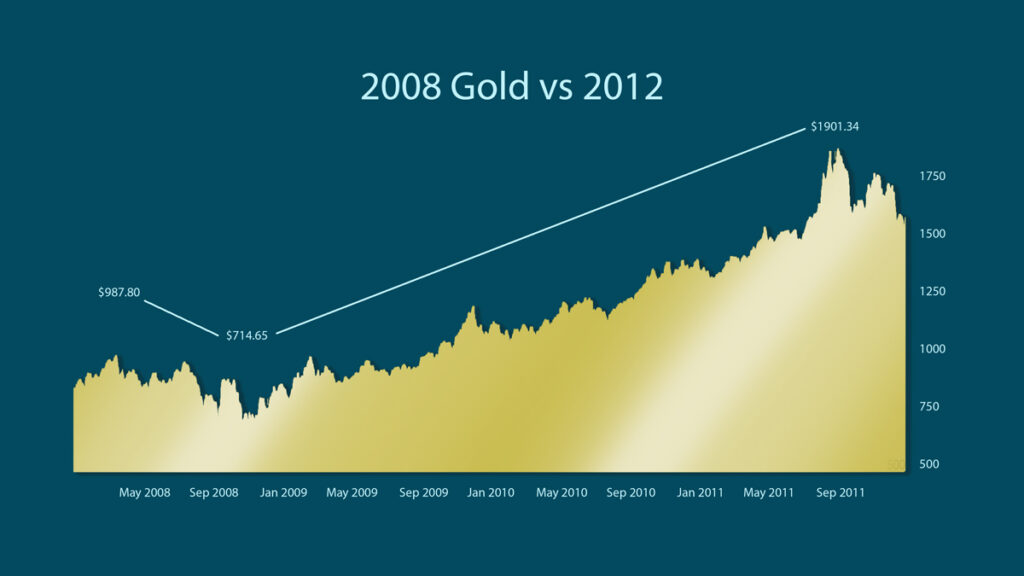
Schiff points to the 2008 financial crisis as a historical comparison. Gold fell roughly 32% during the panic before rising approximately 178% over the following three years. Applying the same rebound to today’s lows would place gold near $11,400/oz. This optimistic outlook comes as top banks say gold’s downside risk is running out of room
Gold’s Long-Term Drivers Remain
The fundamental pressures supporting gold have not disappeared. The national debt is approaching $40 trillion, federal deficits remain at historically elevated levels, and rising interest costs are placing greater strain on government finances.
Central banks are also continuing to diversify away from traditional reserve assets. They have purchased an average of roughly 1,000 metric tonnes of gold annually over the past four years, twice the pace recorded during the previous decade.
Although none of these bullish forces can predict whether gold will fall further in 2026, they reinforce the growing consensus on Wall Street that the metal remains a long-term hedge despite a short-term correction.
Don’t Wait to Buy Gold, Buy Gold and Wait
Financial privacy is shrinking, stock market risk is becoming more concentrated, and gold is moving through a sharp correction. None of these trends guarantees what gold prices will do next, but they reinforce the case for why many investors continue to view physical gold as a long-term hedge rather than a short-term trade.
The goal is not to chase every rally or panic over every pullback. It is to build a diversified portfolio before the next crisis makes protection more expensive.
Claim a FREE copy of our Precious Metals Investment Guide to learn how physical gold and silver may fit into your broader financial strategy.
Question or Comments?
If you have any questions about today’s topics or want to see us discuss something specific in a future The Gold Spot episode, please add them here.
Comment
Questions or Comments?
"*" indicates required fields