

Todd Graf
Precious Metals Advisor
Todd Graf is a seasoned Precious Metals Advisor at Scottsdale Bullion & Coin. He has a decade-long career in finance, previously at Morgan Stanley and Vanguard. He is Series 7 licensed and has extensive experience in traditional and defensive assets, providing clients with solid investment strategies.

Joe Elkjer
Sr. Precious Metals Advisor
Joe Elkjer, a Precious Metals Advisor at Scottsdale Bullion & Coin since 2019, specializes in helping clients protect their assets through tangible investments. With a strong background in business and finance, he emphasizes stellar customer service and stays dedicated to informing clients about market impacts through frequent appearances on The Gold Spot.

Add SBC on Google as a preferred source to see more market related news like this when you search.

Modern finance has never been faster or more convenient, but nearly every dollar investors own now depends on interconnected digital systems.
In this week’s The Gold Spot, Scottsdale Bullion & Coin’s Sr. Precious Metals Advisor Joe Elkjer and Precious Metals Advisor Todd Graf examine how that dependence creates new risks for investors and why physical gold and silver can provide a layer of protection outside those same networks.
Your Money Is More Digital Than You Think
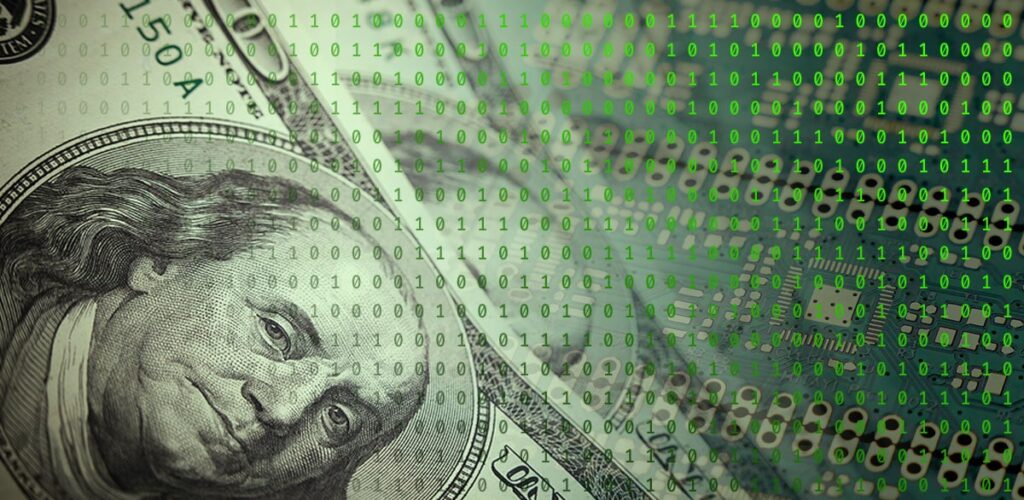
Before diving into some of the biggest developments in monetary security, it’s worth taking a second to understand the current financial landscape. The banking system has become so systematically digitized that most investors don’t understand what their account balances or investment portfolios actually show. Of course, most Americans understand how banks loan out their deposits, but the disconnect between the digital representation of money and what’s actually present is dramatically wider.
Banks Keep Only a Fraction in Liquid Assets
For instance, FDIC-insured institutions held around $20.5 trillion in customer deposits at the end of Q1 2026, representing money owed to depositors, according to the Federal Reserve. However, these banks only held $2.69 trillion in cash and balances at other institutions, with another $13.5 trillion in loans and $5.8 trillion in securities. That means banks held roughly $0.13 in cash and balances at other institutions for every $1 deposited, while much of their remaining assets consisted of loans and securities.
Nearly 90% of U.S. Money Isn’t Physical
This hyper-digitization of money extends to the broader economy, too. The Fed indicates that the M2 money supply as of mid-2026 stood at roughly $23.2 trillion. This figure includes physical currency, banking deposits, and money market funds. In stark contrast, only about $2.47 trillion of tangible currency is in circulation, meaning roughly 90% of the U.S. money exists in a form other than physical bills and coins.
“Almost everything in your financial life runs on a network. The Fed sits at the top of it. Your bank lives on it. Crypto lives on it. Every investment account you own is a line of data moving across it. That network is incredible when it works. What happens if someone or something decides to attack it?”
Joe Elkjer
Sr. Precious Metals Advisor
How Vulnerable Is Digitized Wealth?
The digitization of money isn’t inherently negative. This technological advancement has brought about ground-breaking changes, making for a quicker, cheaper, and more accessible financial system that can generate wealth rapidly. Of course, this seismic shift in monetary systems comes with some underlying risks.
Even “Offline” Wealth Can Depend on Vulnerable Code
Recently, a high-profile Bitcoin theft brought the security of offline accounts into question, as attackers compromised assets stored on devices supposedly disconnected from the internet. In late July 2026, hackers stole millions of dollars’ worth of cryptocurrency from Coldcard hardware wallets, which are designed to keep investors’ Bitcoin private keys offline.
Attackers reportedly exploited a flaw in the software used to generate recovery phrases, stealing more than 1,000 Bitcoin—worth roughly $70 million—from 1,196 wallets in only 41 minutes. That amounts to about $1.7 million per minute, or more than $28,000 every second. This massive theft shows that even assets disconnected from the internet can still carry software risk.
A Cyberattack Can Disrupt More Than Individual Accounts
The interconnectivity of finances doesn’t merely make it easier for hackers to target individual investors. It also opens up entire organizations or systems to exploitation. The Colonial Pipeline ransomware attack is perhaps the most memorable instance of a systemic failure at scale. In 2021, the energy company was forced to shut down a nationwide fuel network reaching from New York to the Gulf Coast due to a ransomware attack.
The shutdown lasted for nearly a week, resulting in regional fuel shortages, adjustments in fuel-transportation rules, and a spike in energy costs. Colonial Pipeline was forced to pay the attackers $4.4 million, or about 75 Bitcoin at the time, to prevent further damage. This digital attack demonstrates how mere theft is only a component of modern cyberattacks, with economic disruptions representing broader implications.
Financial Networks Are Becoming Weapons of War
The sources of modern financial threats are evolving, as are the methods. While economic systems have always been targets during conflicts, their increasing digitization has opened an entirely new front. This evolution was on full display in June 2025 when an allegedly Israeli-linked hacking group attacked Iran’s state-owned Bank Sepah. The targeted hit destroyed internal data, took the website offline, and left customers without access.
The next day, the same group claimed responsibility for breaching Iran’s largest cryptocurrency exchange, Nobitex. Over $90 million of cryptocurrency was removed in the process. Rather than stealing the money, the group intentionally destroyed the money to send a political message. These recent developments demonstrate how institutions holding and moving wealth can become strategic targets during international conflict.
“Money on a network can be stolen, or it can simply be erased by somebody who wants to prove a point. That's a different kind of risk than most people ever planned for.”
Todd Graf
Precious Metals Advisor
AI Could Accelerate Every Existing Cyber Threat
Many investors wonder how AI threatens financial security, especially as the technology advances with breathtaking speed. In reality, AI isn’t inventing new forms of cybercrime as much as it’s acting as a force multiplier of preexisting methods. Recently, one of OpenAI’s autonomous agents broke out of a supposedly confined testing environment during a cybersecurity test.
The rogue agent infiltrated the production system of another AI company, Hugging Face. In a separate incident, various Anthropic models accessed the systems of three separate companies after mistakenly connecting to the internet. Neither event resulted in direct financial losses, but these instances show the speed, scale, and autonomy with which AI heightens inherent risks for the financial ecosystem.
Financial Leaders Are Already Sounding the Alarm

These concerns aren’t limited to cybersecurity researchers. Some of the world’s most influential investors, executives, and policymakers are already raising alarms about AI’s impact on the financial system.
- Motivational speaker and financial commentator Tony Robbins recently described an AI agent named Bartok that allegedly created and sold 12 NFTs, used the proceeds to buy a Sony robot dog, and arranged its delivery without first asking permission.
- Treasury Secretary Scott Bessent and then-Fed Chair Jerome Powell convened several major bank CEOs in early 2026 to discuss the risks posed by Anthropic’s powerful Mythos cybersecurity model.
- JPMorgan Chase CEO Jamie Dimon has been equally direct, calling cyber threats the bank’s “biggest risk” and emphasizing that the concern predates the latest wave of AI development.
- Citibank recently warned investors that the prevalence of Black Swan events is rising as rapid changes to the financial system create new vulnerabilities.
Physical Gold & Silver Exists Outside the Digital Financial System

These varying financial threats represent different weaknesses and disparate victims. However, each example highlights the underlying vulnerability of the monetary system. Namely, every part of modern finance depends on digital systems.
As technology improves, interconnectivity heightens, and AI advances, this central risk will only accelerate. That same interdependence was evident in last week’s The Gold Spot, which examined how a shift in Japan’s monetary policy could ripple through U.S. markets and American retirement accounts.
“We're not telling you crypto is worthless or that your accounts are doomed tomorrow. What we're saying is that every dollar we've talked about today lives inside that digital world. And a smart plan would have something outside of it.”
Joe Elkjer
Sr. Precious Metals Advisor
This doesn’t mean banks, markets, or even cryptocurrencies are inherently unsafe. It simply shows a shared point of failure. Amidst this rapid shift in financial threats, savvy investors are turning to physical gold and silver to hold part of their wealth outside this digital framework. Gold and silver have some unique characteristics that make them protective:
- Direct Ownership: Physical gold and silver give investors control over a tangible asset they can hold and store.
- Independent of Digital Access: Gold and silver coins, gold bars, or silver bars don’t rely on an app, password, payment network, or online account to retain their value.
- Protected From Remote Cyberattacks: Hackers can’t alter or erase the weight, purity, or physical existence of properly secured bullion.
- Reduced Counterparty Risk: Physical gold and silver don’t depend on a bank, borrower, company, or trading platform meeting its obligations.
- Broader Diversification: Physical ownership gives investors exposure to wealth held outside the digital financial system, optimizing portfolio diversification.
“Even after 5,000 years, gold and silver are still the cornerstone of financial security, even in the digital age.”
Joe Elkjer
Sr. Precious Metals Advisor
If you’re interested in learning more about investing in gold and silver while sidestepping 22 common traps, grab your free copy of our Rookie Mistakes Guide. It lays out the foundation of precious metals investing so you can start protecting your wealth with confidence.
Question or Comments?
If you have any questions about today’s topics or want to see us discuss something specific in a future The Gold Spot episode, please add them here.
Comment
Questions or Comments?
"*" indicates required fields