

Eric Sepanek
SBC Founder
Eric Sepanek is the founder of Scottsdale Bullion & Coin, established in 2011. With extensive experience in the precious metals industry, he is dedicated to educating Americans on the wealth preservation power of gold and silver.

Add SBC on Google as a preferred source to see more market related news like this when you search.

 The U.S. economy barely remained above water in the fourth quarter of 2025 as the gross domestic product (GDP) reached its second-lowest point of the year. A delayed revision revealed the country’s sluggish output and raised concerns about 2026.
Beneath the headline figure lies a concerning mix of lingering inflation, fading consumer momentum, and government disruptions. Some analysts are warning about a looming stagflationary environment as a toxic trifecta of economic slowdown, stubborn inflation, and a soft job market worsens.
Q4 GDP Falls to 0.7% After Revision
On February 20, 2026, the Bureau of Economic Affairs (BEA) released its advance estimate of Q4 2025 GDP. The government agency assessed the country’s output at 1.4% for the final quarter of the year, representing a dramatic fall from Q3 growth of 4.4%.
While economists and administration officials were still grappling with these lower-than-anticipated figures, the BEA released a bombshell revision on March 13th, 2026. In the second estimate, Q4 2025 GDP was revised down to 0.7%, half of the original projection.
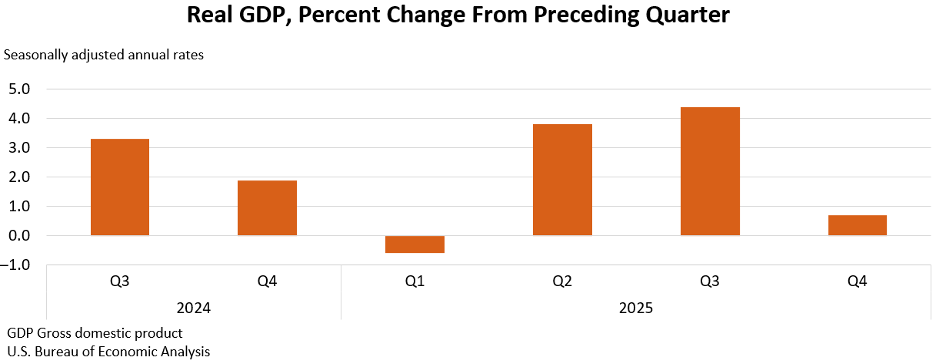
Source: https://www.bea.gov/news/2026/gdp-second-estimate-4th-quarter-and-year-2025
Even taking existing economic obstacles into account, this figure fell far below prior expectations. Between Q3 and Q4 2025, GDP tanked by 3.7%, raising concerns that the economy is entering a fragile phase rather than merely cooling down.
This sluggish growth is evident when zooming out to a longer timeframe, too. Last year’s total GDP came out to 2.1%, which is down 0.7% from 2024’s figure of 2.8%. Furthermore, 2024’s economic output had fallen from 2023’s GDP of 2.9%. In an interview with PBS, the CIO of Plante Moran Financial Advisors said that the economy “stumbled into the finish line.”
The Main Contributors to Weak Q4 Growth
GDP is calculated by combining four economic metrics: consumer spending, business investment, government spending, and net exports. Understanding each component of economic output can shed light on Q4’s weak performance.

Source: https://www.bea.gov/news/2026/gdp-second-estimate-4th-quarter-and-year-2025
Consumer Spending
Consumer spending grew 2% in Q4 after a downward revision, falling from 3.5% in Q3. The cumulative weight of rising costs, higher interest rates, and trade disruptions dampened consumer confidence and consumption habits.
Business Investment
Business investments posted an estimated growth between 2.2% and 3.3%, largely supported by the artificial intelligence frenzy. This piece of the GDP puzzle was also scaled back, limiting its ability to offset broader economic weakness.
Government Spending
The government experienced a shutdown for 43 days of Q4, precipitating a 16.7% annualized drop in federal spending. This wiped about 1% to 1.16% away from the GDP, making it one of the largest drags on the quarter’s output.
Trade and Exports
U.S. exports dropped by 3.3% in Q4, staging a major reversal from positive Q3 growth of 9.6%. This marked one of the steepest negative swings in the entire report. For their part, imports dipped less than anticipated, thereby minimizing their positive effect and resulting in trade as a counter to GDP.
Stubborn Inflation, Stagnant Rates, & Stagflation Fears
A lagging GDP isn’t the only alarming metric coming out of the economic data. At the same time, inflation remained stubbornly elevated. More specifically, core Personal Consumption Expenditures (PCE) hovered at 2.9% in December 2025 and remains high at 2.8% in early 2026. These figures remain far above the Federal Reserve’s 2% target.
The one-two punch of slowing growth and lofty inflation has pushed the Federal Reserve back into waiting mode. Interest rates are likely to remain stagnant until the economy makes a clear move in one direction. This dynamic has raised concerns about stagflation, a corrosive combination of limited growth, sticky inflation, and a poor job market.
The recent war in Iran is only ratcheting up the economic pain as spiking energy costs threaten to raise prices across the board.
National Debt Complicates the Financial Picture
In the background, the national debt continues growing unabated, recently crossing the $39 trillion mark. Economists argue that much of the economy’s moderate growth is fueled in large part by federal deficits, which are the principal drivers of debt growth. While this may help sustain short-term growth, it raises longer-term concerns about rising debt, higher borrowing costs, and the risk that fiscal policy becomes increasingly unsustainable.