

Eric Sepanek
SBC Founder
Eric Sepanek is the founder of Scottsdale Bullion & Coin, established in 2011. With extensive experience in the precious metals industry, he is dedicated to educating Americans on the wealth preservation power of gold and silver.
 In March 2026, China’s central bank notched its 17th consecutive month of positive gold accumulation, extending one of the most consistent buying sprees among major economies in recent years.
This steady trend of official demand has continued throughout gold market volatility, geopolitical uncertainty, and global economic destabilization. Instead of acting as obstacles, these financial disruptions have hastened Beijing’s rush into physical gold — a trend seen across fast-growing economies.
The PBOC’s Gold Reserves Reach Over 2,300 Tonnes
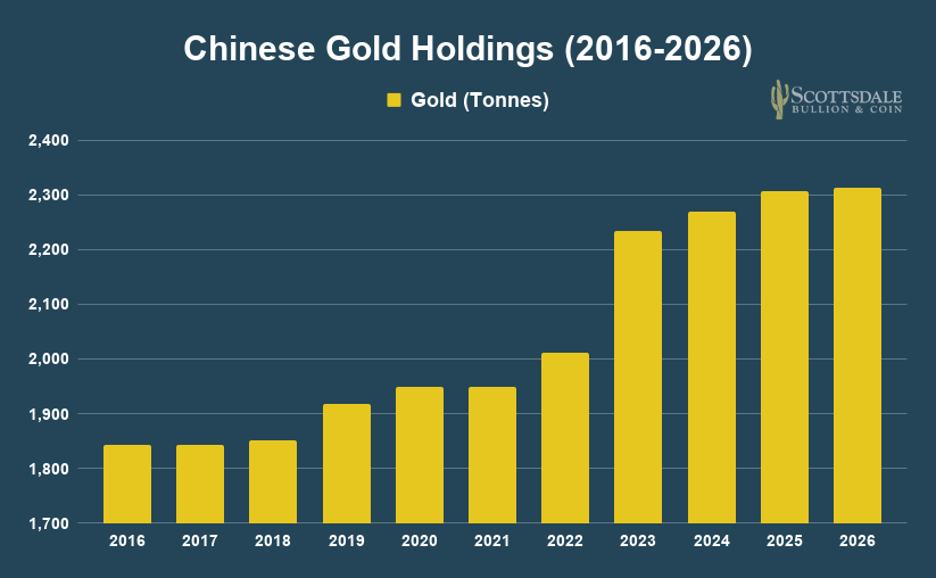
The People’s Bank of China (PBOC), the country’s central bank, added roughly five tonnes of gold in March, elevating its total holdings to around 2,313 tonnes, according to the World Gold Council (WGC). This marks the 17th consecutive month of positive gold inflows, reinforcing a steady, policy-driven approach to reserve accumulation.
The recent easing of gold prices over the past few months, following a record high near $5,600/oz, has actually reduced the total value of China’s gold reserves. Overall, Beijing’s physical holdings fell from $387 billion to $342 billion. What many experts view as a temporary dip in the gold market has presented a buying opportunity for central banks.
A Major Shift in Beijing’s Reserve Strategy
This sustained accumulation reflects a broader global trend. In recent years, central banks have sharply increased their gold demand, surpassing 1,000 tonnes annually between 2022 and 2024 and remaining elevated at 863 tonnes in 2025. Last year, this coincided with a record 5,000 tonnes of global gold demand.
China has been a key driver of this shift. After remaining largely stagnant between 2017 and 2021, the PBOC’s gold holdings began to rise again in late 2022, marking a clear turning point. Between 2022 and 2023, China increased its reserves by roughly 10%, with steady additions continuing through 2025 and Q1 2026.
Total holdings now stand at approximately 2,313 tonnes, up from about 1,842 tonnes in 2016, a roughly 26% increase in less than a decade, per the Chinese State Administration of Foreign Exchange.
Chinese Gold ETF Demand Breaks Records
While central banks continue to accumulate gold, retail investor flows are reinforcing the same trend at scale. Chinese gold exchange-traded funds (ETFs) recorded $8.5 billion in inflows during Q1, the strongest quarterly total on record.

Source: WGC
Over that same period, ETF holdings increased by 50 tonnes, bringing total holdings to 298 tonnes, while assets under management rose 26% to around $44 billion. In March alone, Chinese gold ETFs attracted about $1.7 billion in inflows, equivalent to an additional 8.4 tonnes of gold. This comes off the back of a record-setting early 2026 for ETF inflows.
Physical Demand Jumps 12% Year Over Year
In March, wholesale gold demand in China, which tracks physical gold entering the market, including gold bars and coins, reached 134 tonnes, up 57% month over month and 12% year over year. Seasonal restocking after the Chinese New Year and a higher number of working days contributed to the surge, while lower prices also encouraged opportunistic buying.
Physical demand started the year firm with net gold imports reaching 77 tonnes in January and 96 tonnes in February, both significantly higher than the prior year. Total Q1 wholesale demand totaled 345 tonnes, a 3% increase year over year.
China Sheds USD as Gold Reserves Jump
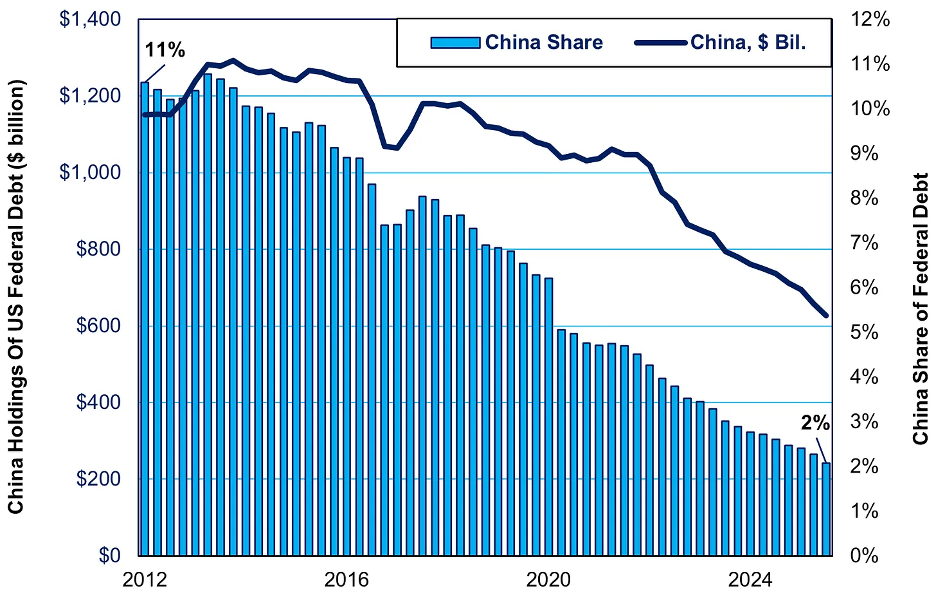
The flipside to China’s gold reserve buildup is a persistent, prolonged shedding of U.S. Treasuries. In 2013, PBOC’s holdings of American debt peaked at around $1.2 trillion, making it the single largest holder of foreign USD reserves in the world, as reported by Investing.com. In 2026, that figure sits just above $600 billion.
Source: Investing.com
That marks nearly a 50% drop in holdings within a little over a decade. Now, Beijing falls behind Japan and the United Kingdom as the largest holders of U.S. debt. Overall, China accounts for 2% of foreign federal debt, down from 11% to 12% between 2012 and 2013.
The transition by central banks from USD into gold is a reflection of a broader economic shift from the volatility of fickle fiat currency to tangible, inherently valuable assets. If you want to learn how physical gold can help protect your wealth, claim a FREE copy of our Precious Metal Investment Guide.