

Eric Sepanek
SBC Founder
Eric Sepanek is the founder of Scottsdale Bullion & Coin, established in 2011. With extensive experience in the precious metals industry, he is dedicated to educating Americans on the wealth preservation power of gold and silver.

Add SBC on Google as a preferred source to see more market related news like this when you search.

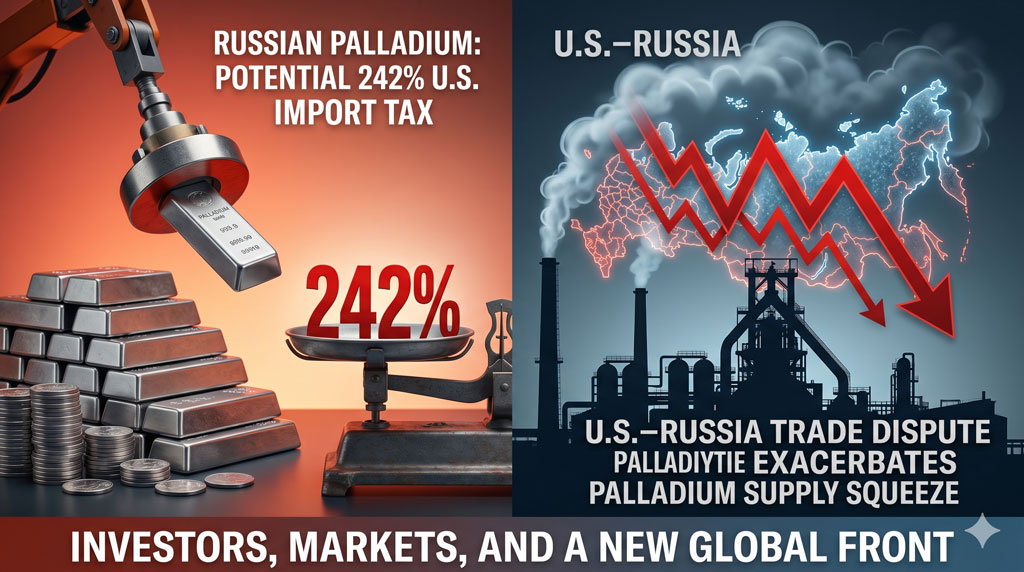 The United States is moving to impose punitive trade measures on palladium imports from Russia, one of the world’s largest producers of the precious metal. The justification for the prohibitive trade measures revolves around protecting prices in American markets.
These potential import tariffs reflect a growing trend of governments treating investment metals as a matter of national security, not only monetary value. Russia’s central role in the global palladium market could exacerbate the impacts of these import duties.
A New Front in the U.S.–Russia Trade Dispute
The U.S. Department of Commerce and the International Trade Commission are actively working toward placing various import taxes on Russian palladium, with the stated intention of increasing the cost of the metal’s cross-border trade.
The move comes as domestic interest groups, including Sibanye-Stillwater and United Steelworkers, complain about the comparatively affordable Russian imports undercutting American manufacturing and profits. These organizations claim that existing subsidies allow the Kremlin to sell palladium far below fair market prices.
The proposed penalties are a132.83% anti-dumping duty and 109.10% countervailing duty. Effectively, this would tax imports at a rate of 241.93%. For context, dumping is the practice of a foreign country flooding domestic markets with a good or commodity priced cheaper than market value. A countervailing duty simply aims to offset beneficial government subsidies.
What Happens Next?
Right now, the fate of these palladium duties hangs in the balance as the relevant U.S. authorities consider whether the claims made by the petitioning parties are legitimate. The fundamental question is whether Russian imports cause material injury to American producers. If the answer is yes, these duties will likely take effect immediately.
Why Does It Matter for Investors?
Import restrictions in one form or another are nothing new to the broader economy. Yet, the combination of palladium’s vital importance as a manufacturing and investment metal, along with Russia’s dominance in the market, makes this a development worth watching.
Palladium’s Strategic & Investment Importance
While silver’s dual role as a precious metal and industrial component steals the spotlight, palladium occupies a very similar space. Palladium is used in numerous applications of vital concern, such as catalytic converters, defense systems, electronics, chemical processing, and hydrogen technologies.
Beyond manufacturing processes, palladium is a pillar of the precious metals sector. Similar to gold and silver, investors diversify with palladium bars and coins due to their inherent value, direct ownership, and tendency to keep pace with inflation.
Russia’s Dominant Role
The possibility of import duties on palladium from most other countries wouldn’t be a newsworthy event, but Russia is a key pillar in the world’s palladium supply. In fact, the Kremlin accounts for around 49% of global palladium production, primarily through Nornickel. This extreme concentration makes the palladium market uniquely reactive to any kind of trade restriction from Russia.
The Impact on Palladium Prices
The combination of palladium’s essential role in industrial and investment spaces and Russia’s disproportionate influence over global output threatens to act as a force multiplier to the U.S. government’s potential import duties. These restrictions could provide a major boon to palladium prices for several reasons:
- Price Rebalance — If Russia’s sizable imports have been seriously undercutting domestic values, it stands to reason that a nearly 250% import tax would help to rebalance prices to their true value.
- Supply Squeeze — It’s no secret that hefty trade penalties reduce trade of the targeted product. The palladium market has already been dealing with a prolonged supply shortage. Additional inventory deficits, without a change in demand, are a tailwind for prices.
- Less Efficient Supply Chains — Russian palladium wouldn’t completely evaporate from U.S. markets. Instead, supply chain workarounds would replace streamlined trade. The increased friction and elevated transportation costs would be seen in higher charges.