

Steve Rand
General Manager / Sr. Precious Metals Advisor
Steve Rand is the General Manager and a Sr. Precious Metals Advisor at Scottsdale Bullion & Coin. He brings over 20 years of experience in the physical precious metals markets.

Michelle Ellis
Precious Metals Manager / IRA Liaison
Michelle Ellis is the IRA Liaison and manager at Scottsdale Bullion & Coin. She has over 8 years of experience helping investors set up or rollover their IRAs into physical gold and silver.

Add SBC on Google as a preferred source to see more market related news like this when you search.


The fourth quarter is when investors traditionally take stock of their retirement plans, but heading into 2027, the stakes feel unusually high.
In this week’s The Gold Spot, Scottsdale Bullion & Coin’s Sr. Precious Metals Advisor Steve Rand and IRA Liaison Michelle Ellis discuss whether retirement accounts are at greater risk under the AI boom, why Wall Street is embracing higher gold allocation recommendations, and how physical gold and silver can become part of a truly diversified retirement plan.
Millions of Americans Have More AI Exposure Than They Think
With the fourth quarter officially underway, many investors are taking a closer look at their retirement portfolios. Some market pressures suggest this year may require extra attention:
Stocks have continued to climb despite underlying fiscal concerns, often reaching elevated valuations. More specifically, artificial intelligence (AI) continues to account for a disproportionate share of both equity and economic growth.
While most investors recognize AI’s growing influence on the stock market, millions may not realize how much exposure their retirement portfolios already have to the technology.
AI’s Growing Grip on Retirement Savings
According to recent data:
- 97% of 401(k) participants own equities, while stocks account for roughly 75% of all 401(k) assets.
- AI-exposed stocks account for about 58% of the S&P 500.
- Technology has generated roughly 60% of the U.S. stock market’s gains so far in 2026.
- Semiconductors alone have contributed nearly one-third of the advance.
- Companies supplying the AI buildout could account for roughly half of S&P 500 earnings growth in 2026.
Notably, this hyperconcentration doesn’t mean the AI bubble will pop any time soon, or at all. Still, the stock market’s rapid reconsolidation means millions of Americans’ retirement portfolios increasingly rely on a relatively small group of companies and experimental technologies.
AI Spending Is Raising the Stakes
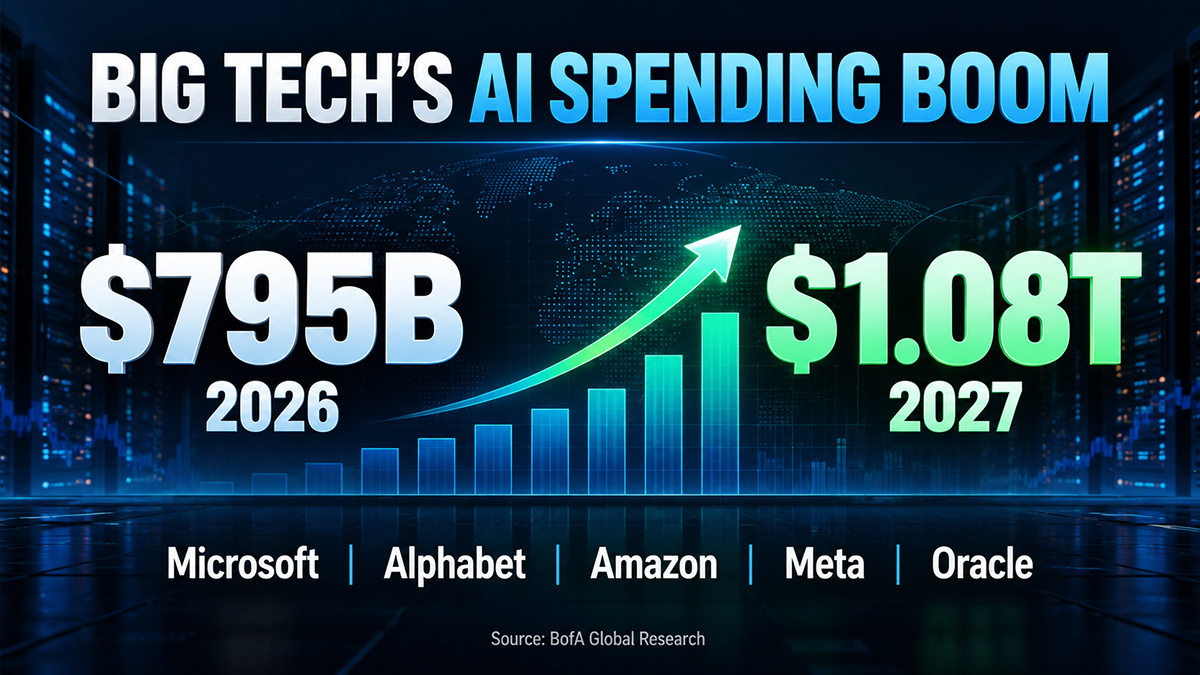
Recent spending trajectories suggest that this market dominance, and the resulting portfolio imbalances, are only increasing. Five major AI hyperscalers (Alphabet, Amazon, Meta, Microsoft, and Oracle) are projected to dedicate $795 billion in 2026, with estimates over $1 trillion in 2027.
Alarmingly, some estimates suggest hyperscalers may need to generate nearly 10 times their current AI-related revenue to earn returns comparable to their pre-AI businesses.
That concentration extends beyond the stock market itself. Bank accounts, brokerage accounts, retirement plans, and payment systems all rely heavily on digital infrastructure, raising a broader question about whether your wealth is too dependent on digital systems.
“These AI investments raise serious concerns and questions about valuations and what happens if those massive investments don't generate the returns that investors are expecting. Now, that doesn't mean that the AI bubble is guaranteed to burst. It does mean that it’s probably a good time to ask how dependent your retirement savings are on stocks continuing to perform the way that they have been.”
Steve Rand
General Manager / Sr. Precious Metals Advisor

Wall Street Is Making More Room for Gold
Over the past few years, the market has seen AI infrastructure expansion boost gold demand, as investors look to diversify their wealth amid rapid equity concentration. This broad-scale movement is reflected in shifting allocation recommendations from major financial institutions.
In the past, traditional investment wisdom suggested 5% or below for physical assets. Now, that traditional 60/40 split has given way to the 60/20/20 investment portfolio. Under this framework, investors are advised to hold 60% stocks, 20% bonds, and 20% gold, which effectively replaces half of the conventional bond allocation with physical gold bullion.

In a recent analysis of expert guidelines for precious metals allocation, Scottsdale Bullion & Coin tracked the widening range of recommendations. Some investors still favor modest exposure, but a growing number advocate for 10%, 15%, 20%, and more in gold.
That doesn’t mean every investor should jump to the highest allocation. Still, these figures show that gold is increasingly treated as a defined portfolio allocation rather than a small speculative side position.
“Gold is increasingly being discussed as a defined piece of a portfolio diversification. It comes down to what job you want gold to perform: diversification, protection against inflation, currency weakness, crisis insurance, or long-term wealth preservation.”
Steve Rand
General Manager / Sr. Precious Metals Advisor
What Role Does Gold Play in a Portfolio?

While the right gold allocation depends ultimately on an investor’s personal circumstances, gold can provide several broader retirement planning strategies in a portfolio, including:
- Portfolio diversification: Reducing dependence on stocks, bonds, or any single asset class.
- Inflation protection: Helping preserve purchasing power as prices rise.
- Currency protection: Providing an alternative store of value when the U.S. dollar weakens.
- Crisis protection: Offering a tangible asset during periods of financial, economic, or geopolitical stress.
- Long-term wealth preservation: Protecting accumulated wealth across market cycles and generations.
You Can Hold Physical Precious Metals Inside an IRA

Americans now hold more than $51 trillion in retirement assets, including nearly $20 trillion in IRAs alone, making portfolio concentration and diversification especially consequential. For investors looking to strengthen their retirement strategy, it may come as a welcome surprise that they can hold physical precious metals in certain retirement accounts.
Investors can hold gold in an IRA, opening their retirement plan to assets beyond the traditional mix of stocks, bonds, mutual funds, and cash equivalents. A Precious Metals IRA, which is technically a type of self-directed IRA, lets you hold certain forms of physical gold, silver, platinum, and palladium.
What Precious Metals Can a Self-Directed IRA Hold?
Not every form of precious metal qualifies for a retirement account. The IRS limits these accounts to certain IRA-eligible precious metals that meet minimum purity standards:
Some qualifying coins may also be eligible even if they fall outside the standard purity thresholds, so investors should verify individual products before purchasing them for an IRA. One notable exception is the American Gold Eagle, which is IRA-eligible despite falling below the standard 99.5% gold purity requirement.
Existing Retirement Savings May Qualify
Opening a precious metals IRA doesn’t necessarily require starting with new savings, either. Depending on the account and plan rules, assets from traditional and Roth IRAs, 401(k)s, 403(b)s, 457 plans, TSPs, and other eligible retirement accounts may be transferred or rolled over.
That can include a 401(k)-to-Gold-IRA rollover or other options for what to do with an old 401(k). Investors also may not need to move an entire account, allowing precious metals to make up only part of a broader retirement strategy.
“Because we're in Q4, this is a good time to review whether you've taken advantage of the IRA contribution opportunity available to you.”
Michelle Ellis
Precious Metals Manager / IRA Liaison
IRA Contribution Limits and Rollovers Are Different
For 2026, traditional and Roth IRA contributions are limited to $7,500, or $8,600 for investors age 50 and older. However, those annual gold IRA contribution limits apply to new contributions, not qualifying rollovers.
2026 IRA contributions limits:
| Under age 50 | Age 50+ (catch up contribution) |
|---|---|
| $7,500 | $8,600 |
That means existing eligible retirement assets may be transferred or rolled over separately from annual contribution limits. How much ultimately goes into precious metals depends on the investor’s broader strategy, available assets, and diversification goals. Investors can also review how much money is needed to start a Gold IRA before deciding whether the structure fits their plans.
Review Your Retirement Strategy Before Year-End

With Q4 2026 underway, now is a good time to review whether your retirement portfolio still aligns with your goals and is appropriately diversified heading into 2027.
If you have an IRA, 401(k), TSP, or another retirement account, Scottsdale Bullion & Coin’s advisors can help determine whether it may qualify for a Precious Metals IRA and explain your options. Contact us today by calling toll-free at Call Us: 1-888-812-9892 or using our live chat function.
You can also request our free Precious Metals Investment Guide to learn more.
Everything you need to know to get started in Precious Metals
Learn how precious metals can strengthen your portfolio, protect your assets and leverage inflation.
Request the Free Guide
Question or Comments?
If you have any questions about today’s topics or want to see us discuss something specific in a future The Gold Spot episode, please add them here.
Comment
Questions or Comments?
"*" indicates required fields