

Eric Sepanek
SBC Founder
Eric Sepanek is the founder of Scottsdale Bullion & Coin, established in 2011. With extensive experience in the precious metals industry, he is dedicated to educating Americans on the wealth preservation power of gold and silver.

Add SBC on Google as a preferred source to see more market related news like this when you search.


 Gold and silver have both posted jaw-dropping gains over the past few years. This unprecedented performance can be measured in their meteoric growth and their record highs. Gold shot far above $5,500/oz, and silver graced $90/oz. Since the beginning of 2025, the yellow metal has risen a remarkable 200%, yet it has still been beaten out by silver’s stunning 300% surge.
Although both metals have cooled somewhat since their all-time peaks, their robust price growth has made investors reconsider whether their investment portfolios are optimized to take full advantage of this performance.
This reassessment has been so widespread that the World Gold Council (WGC) released a report reexamining the long-standing differences between gold and silver, where these two precious metals stand in relation today, and how investors should consider portfolio balances.
Two Precious Metals, Two Very Different Investments
Gold and silver are the two most popular precious metals, with platinum and palladium not seeing as much investment exposure historically. Yet, that’s about where the similarities between gold and silver end.
As the WGC points out, these assets vary dramatically in virtually all categories that matter for investors, such as:
Value
Gold and silver have always maintained disparate evaluations, with the former consistently outpacing the latter. Beyond mere pricing, this value gap has many practical implications:
- Silver is generally more accessible to acquire due to its lower price point.
- Gold makes it easier to store higher values in physical form.
- Silver often yields higher percentage returns during a precious metals rally.
- Gold’s value is usually more stable because of its greater spot price
Supply
The gold supply is generally more stable than its shiny cousin. While the yellow metal is mined as a primary product, meaning it’s the primary resource being extracted, between 70% to 80% of the silver supply comes as a byproduct of mining other metals.
Furthermore, gold is spread out expansively in various countries across the world, while most of the silver mines are concentrated in a handful of countries. Recycling, which measures how much previously used metal reenters the supply, is much higher for gold, helping increase available resources.
Demand
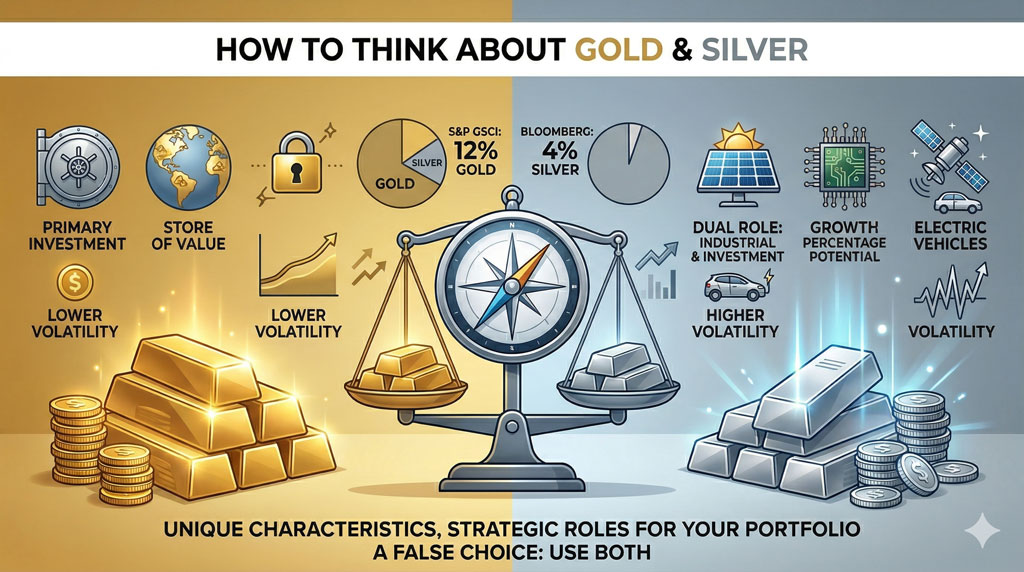
The demand landscape looks vastly different between gold and silver. The yellow metal is mainly an investment asset, with considerable purchases coming from central banks, financial institutions, and retail investors.
Gold jewelry is another source of demand, although some people treat these prices as investments. Similar to many financial assets, gold’s purchases are largely tied to macroeconomic conditions and fiscal policies.
Silver, on the other hand, has a dual role as an investment and industrial metal. Together, jewelry and investment comprise about half of the demand. The other half is dominated by industrial applications. More like an industrial metal, silver is sensitive to economic boom and bust cycles.
Market Size & Trading Activity
The gold market is multiple times larger than the silver market, valued at roughly $15 trillion. This elevated market scale comes with more frequent trading. Generally, gold traded between three and seven times more than silver, depending upon various factors.
Here’s how the trading volume breaks down by investment type, averaged out over the past five years:
| Market Type | Gold | Silver |
|---|---|---|
| ETFs | $2.3B/day | $0.7B/day |
| Futures | $55B/day | $11B/day |
| OTC | $97B/day | $13B/day |
Volatility
Silver’s lower price point and smaller market result in greater volatility. In other words, the silver price experiences more swings than its gold counterpart. WGC indicates that the silver market is about twice as volatile as gold’s.
Portfolio Allocation
The WGC points out that gold routinely outweighs silver in some of the largest commodity indices. For example, the S&P GSCI Index holds 12% gold to 1% silver. Also, the Bloomberg Commodity Index dedicates 15% to gold and 4% to silver. These splits fall in line with conventional precious metals investment advice, which recommends allocating more to gold than silver.
Gold vs Silver: A False Choice
That’s not to say that one is inherently better than the other. It’s merely to illustrate that gold and silver — despite often being held side by side in the same account — deserve different considerations due to their unique characteristics. Each metal has a specific role to play in your account.
If you’re interested in learning more about how gold and silver can fit into your portfolio, grab a FREE copy of our Precious Metals Investment Guide.