

Joe Elkjer
Sr. Precious Metals Advisor
Joe Elkjer, a Precious Metals Advisor at Scottsdale Bullion & Coin since 2019, specializes in helping clients protect their assets through tangible investments. With a strong background in business and finance, he emphasizes stellar customer service and stays dedicated to informing clients about market impacts through frequent appearances on The Gold Spot.

Brian Conneely
Sr. Precious Metals Advisor
Brian Conneely is a Precious Metals Advisor at Scottsdale Bullion & Coin. He's worked in the precious metals market since 2009, trading commodities and futures before moving into physical gold & silver investing.

Add SBC on Google as a preferred source to see more market related news like this when you search.

China has imported more than 1,000 tonnes of gold in just eight months despite being the world’s largest gold producer. At the same time, Beijing is steadily reducing its exposure to U.S. Treasuries as competition for global capital intensifies.
In this week’s The Gold Spot, Scottsdale Bullion & Coin’s Sr. Precious Metals Advisors Brian Conneely and Joe Elkjer break down China’s gold rush, its retreat from U.S. debt, and what these shifts could mean for gold.
China Is Buying Gold at a Historic Pace
Chinese gold imports are soaring in 2026, with the nation importing over 1,000 tonnes of gold between January and August. Within these eight months, Beijing brought around $158.8 billion of physical bullion onto its shores. These figures far exceed the 886 tonnes, worth roughly $96.5 billion, that were imported during all of 2025.
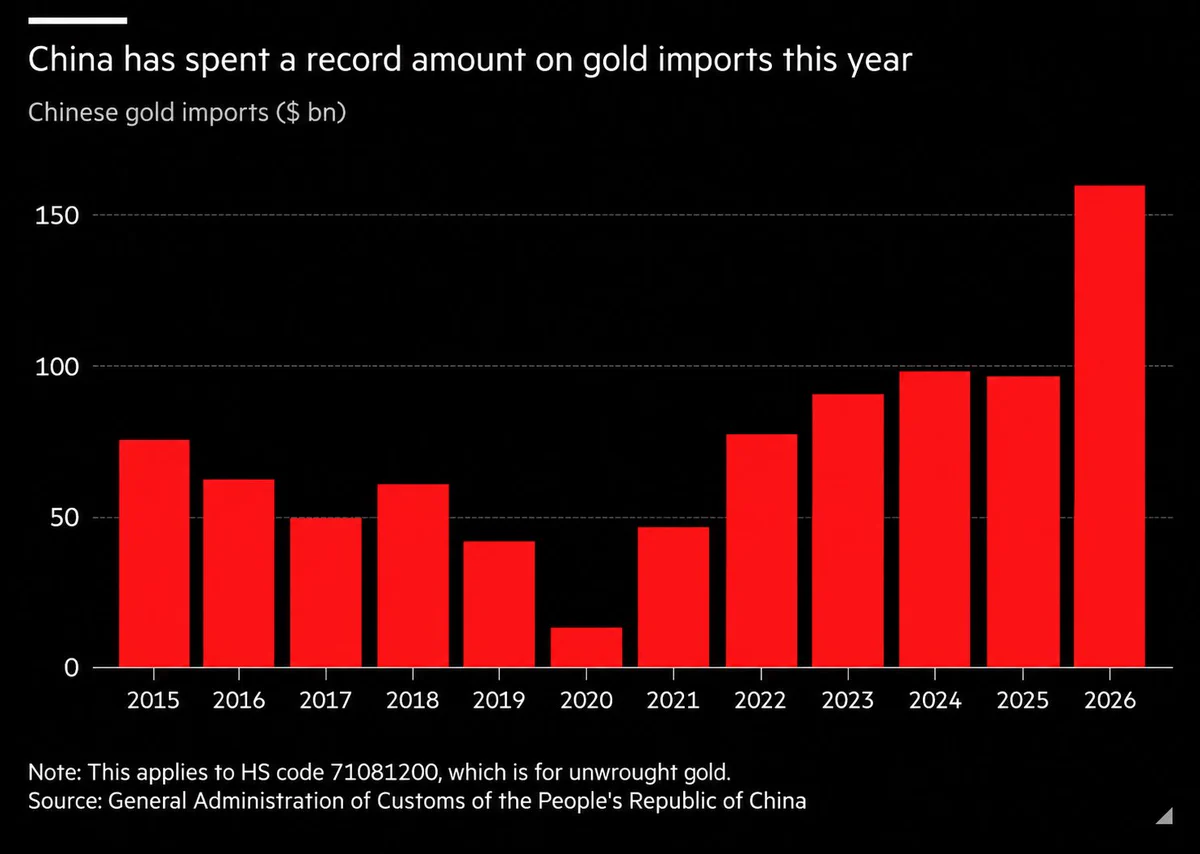
Put another way, the nation spent 65% more on gold imports in the first eight months of 2026 than in all of last year, showing remarkably resilient demand despite elevated gold prices, with buying accelerating during several price pullbacks.
More surprisingly, Beijing’s ravenous appetite for the physical metal has risen despite China’s role as the world’s largest gold producer—a position it’s held since 2007.
In 2025, Chinese mines produced around 392 tonnes of gold, which accounts for roughly 10% of global mine output. Since domestic consumption far exceeds domestic production, the country has had to compensate with imports. Since 2013, China has also been the globe’s largest gold consumer.
Crucially, the 1,000+ tonnes of imports stem from China at large, including private and institutional investors, not merely the central bank.
Still, the impact of the People’s Bank of China (PBOC) shouldn’t be understated, with the institution adding to its gold reserves for 22 months in a row through August.
Why Chinese Investors Are Turning to Gold
In 2016, China established a yuan backed by gold. A paper currency that would be convertible to gold on the Shanghai and Hong Kong exchanges.[/caption]
A series of structural domestic economic challenges are increasingly driving Chinese investors, both at the individual and institutional level, away from traditional assets and toward physical gold.
- With around 70% of Chinese household wealth tied to housing, real-estate development investment plunged 9% year-over-year through August 2026, while new construction starts fell 24.8% and new-home sales by floor area dropped 12.1%.
- The CSI 300, China’s benchmark stock index, remains 20% below its 2021 peak, leaving investors who bought near the top waiting years to merely recover their original investments.
- Beijing’s 10-year government bond yield has fallen below 1.7%, offering investors little incentive to invest in government debt due to the extremely limited returns.
Gold’s rapidly expanding appeal among Chinese investors is partly driven by weakness in traditional assets, but it also reflects a broader debasement trade aimed at limiting counterparty risk. Unlike housing, stocks, or government bonds, physical gold bars and coins aren’t dependent upon another party’s financial performance, solvency, or promise to pay.
“A stock depends on a company. A bond depends on a borrower. Money in a bank depends on a bank. Gold doesn’t require someone else to make good on a promise.”
Joe Elkjer
Sr. Precious Metals Advisor

As Lisa Liu of Gold Mountains Asset Management explains, “Both the central bank and private investors are diversifying their reserves and savings towards an asset with no counterparty risk, as part of a broader long-term wealth preservation strategy.” China’s shift reflects a broader trend among institutional and private investors increasingly seeking greater control over their physical gold.
China Is Diversifying Away From U.S. Treasuries
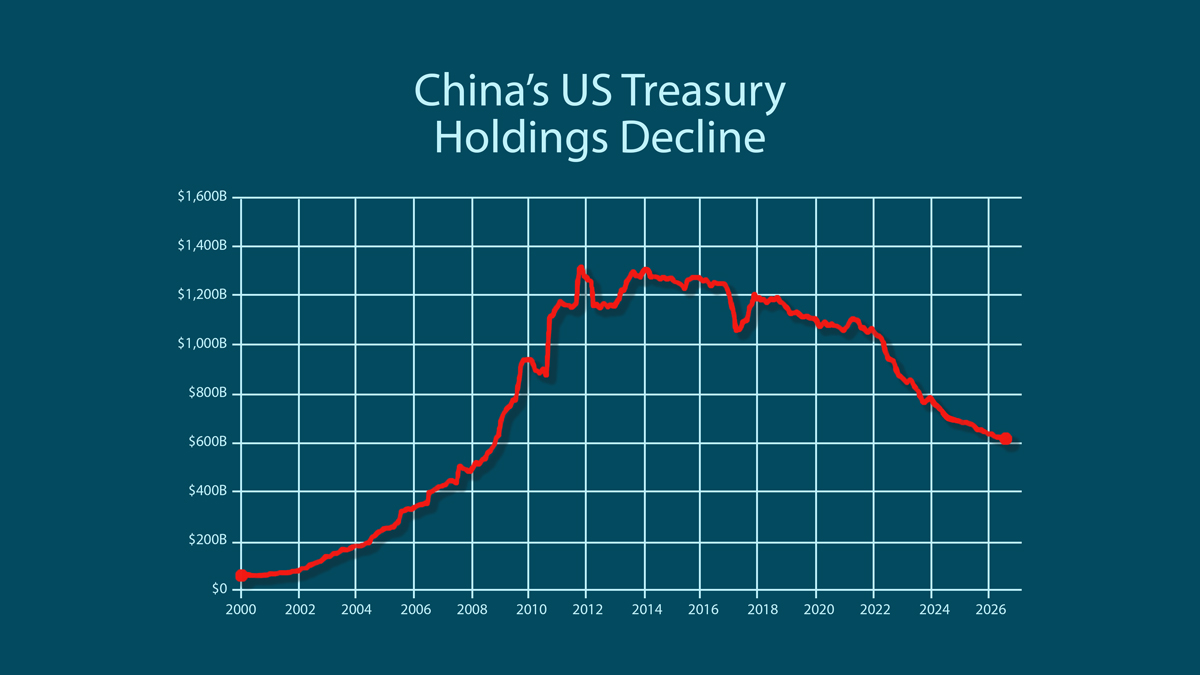
China’s rising demand for gold coincides with a decades-long retreat from U.S. government securities. In July 2026, Beijing’s reported Treasury holdings dropped to around $618 billion, hitting their lowest point since August 2008. Furthermore, these investments are down more than half from their peak of $1.3 trillion in 2013.
In 2009, China was the largest foreign holder of U.S. Treasuries. Of the countries that own American debt, Beijing has fallen to third, behind Japan and the United Kingdom. Throughout this period, China’s share of foreign-held Treasuries collapsed from 30% to 8%. Between July 2025 and July 2026 alone, China shed another $78 billion in U.S. Treasuries, underscoring the accelerating drawdown.
Uncovering Beijing’s Shadow Gold Purchases
As mentioned before, while the PBOC focuses on the de-dollarization of its reserves, it has been purchasing physical gold for nearly two years straight. Between November 2024 and August 2026, the PBOC bought 122 tonnes of gold. However, those officially reported stats almost certainly don’t tell the full story. The notoriously secretive country is often speculated to accumulate more gold than official records suggest.
For instance, Goldman Sachs recently estimated that the Chinese central bank bought 35 tonnes in July, despite officially reporting just 20 tonnes—a 75% discrepancy. More revealingly, between 2003 and 2015, the PBOC secretly accumulated 1,058 tonnes of gold that only came to light years later.
Everyone Is Competing for Capital
China’s reserve diversification, heavily favoring gold while steadily offloading U.S. Treasuries, is unfolding against a backdrop of acute capital competition. Beijing’s historical role as one of America’s largest creditors makes that shift especially consequential at a time when Washington’s financing needs are rapidly expanding.
The U.S. national debt exceeding $40 trillion partially explains why China and other major foreign reserve holders are actively minimizing their Treasury holdings. As Washington’s need for capital spikes, Big Tech is drawing colossal sums of capital from the market to fuel the artificial intelligence boom and the accompanying infrastructure.
This intensifying debt tug-of-war is playing out as major borrowers compete for an increasingly contested pool of investor capital. For perspective, the U.S. Treasury borrowed $577 billion in Q1 and $190 billion in Q2, and projects borrowing to reach $739 billion in Q3 and $628 billion in Q4. This would put privately held net marketable borrowing at roughly $2.13 trillion in 2026 alone.
At the same time, JPMorgan CEO Jamie Dimon estimates AI-related spending in the private sector, specifically among major cloud and technology companies, will reach $700 billion in 2026, up from roughly $300 billion last year. Furthermore, he projects these investments could approach $1 trillion in 2027—more than tripling in just two years.

While none of this establishes a direct correlation between U.S. debt or AI expansion and Chinese gold demand, it certainly demonstrates the competitive capital landscape in which global reserve diversification is occurring.
Gold Demand Is Defying Higher Rates
Amid this capital free-for-all, gold purchases remain remarkably resilient. In China, gold bullion bar and coin demand reached 314 tonnes in H1 2026, the strongest first-half total to date. However, the buying frenzy extends beyond Beijing. Global gold exchange-traded funds attracted $18 billion in August, marking the second-largest monthly inflow on record.
More notably, this persistence in demand is occurring against a macroeconomic backdrop that has historically been unfavorable to gold. The Federal Reserve recently unanimously raised interest rates by 25 basis points, with policymakers signaling further tightening ahead.
Despite interest-bearing assets offering increasingly competitive yields, gold demand remains strong, and gold price forecasts remain bullish. Fidelity recently projected gold at roughly $5,067/oz, while Goldman Sachs reiterated its $5,400/oz end-of-2027 forecast even after the rate hike.
Buy Gold & Wait, Don’t Wait to Buy Gold

While gold prices often steal the headlines, the more bullish signal is flashing in the background. China’s record-setting bullion imports and steady retreat from U.S. debt, along with a global rise in gold demand, point to a broader shift toward greater financial control.
“The biggest takeaway isn’t whether gold reaches $5,000 or $5,400. It’s that some of the largest pools of money in the world are increasingly asking the same question: What do I own that doesn’t depend on somebody else’s promise?”
Brian Conneely
Sr. Precious Metals Advisor
Some of the world’s largest pools of capital are placing a greater emphasis on direct ownership. As a tangible, safe-haven asset, gold has become a flashpoint in this global diversification.
If you’re eager to learn more about how gold can play a role in your portfolio, grab a FREE copy of our Precious Metals Investment Guide.
Everything you need to know to get started in Precious Metals
Learn how precious metals can strengthen your portfolio, protect your assets and leverage inflation.
Request the Free Guide
Question or Comments?
If you have any questions about today’s topics or want to see us discuss something specific in a future The Gold Spot episode, please add them here.
Comment
Questions or Comments?
"*" indicates required fields