

Steve Rand
General Manager / Sr. Precious Metals Advisor
Steve Rand is the General Manager and a Sr. Precious Metals Advisor at Scottsdale Bullion & Coin. He brings over 20 years of experience in the physical precious metals markets.

Michelle Ellis
Precious Metals Manager / IRA Liaison
Michelle Ellis is the IRA Liaison and manager at Scottsdale Bullion & Coin. She has over 8 years of experience helping investors set up or rollover their IRAs into physical gold and silver.

Add SBC on Google as a preferred source to see more market related news like this when you search.

As the U.S. fiscal outlook grows more strained, gold continues to respond in real time. The real question is whether your retirement strategy is positioned for what these trends are pointing toward.
In this week’s The Gold Spot, Scottsdale Bullion & Coin’s Sr. Precious Metals Advisor Steve Rand and IRA Liaison Michelle Ellis examine what happens to gold prices when federal spending doubles within a decade. They also discuss Congress’s grim forecast for the U.S. fiscal situation and how investors can take action today to protect their wealth from the fallout.
The “Unsustainable” Federal Trajectory
Persistent Deficits
In its most recent annual report, the Congressional Budget Office (CBO) — a nonpartisan agency that tracks the financial and economic health of the U.S. — called the country’s fiscal trajectory “unsustainable.” One of the most persistent drivers of the U.S. deteriorating balance sheet is a relentless and rapidly expanding annual federal deficit.

The last time the federal government maintained a balanced budget was 2001. Ever since, the deficit has steadily ballooned to $1.8 trillion in 2025. Looking back only 10 years, this figure stood at $665 billion, nearly a third of where it sits today. The CBO expects the deficit to reach $1.9 trillion in 2026 and spiral to $3.1 trillion by 2036.
Overspending Accelerates
This two-and-a-half-decade run of federal deficits is really a symptom of a much larger issue: federal spending. In 2017, total U.S. spending was about $4 trillion. By 2025, that figure had surged to roughly $7 trillion. Despite the warnings from federal watchdogs, the CBO projects federal outlays will reach about $7.8 trillion by 2027. In other words, federal spending is on track to nearly double within a single decade.
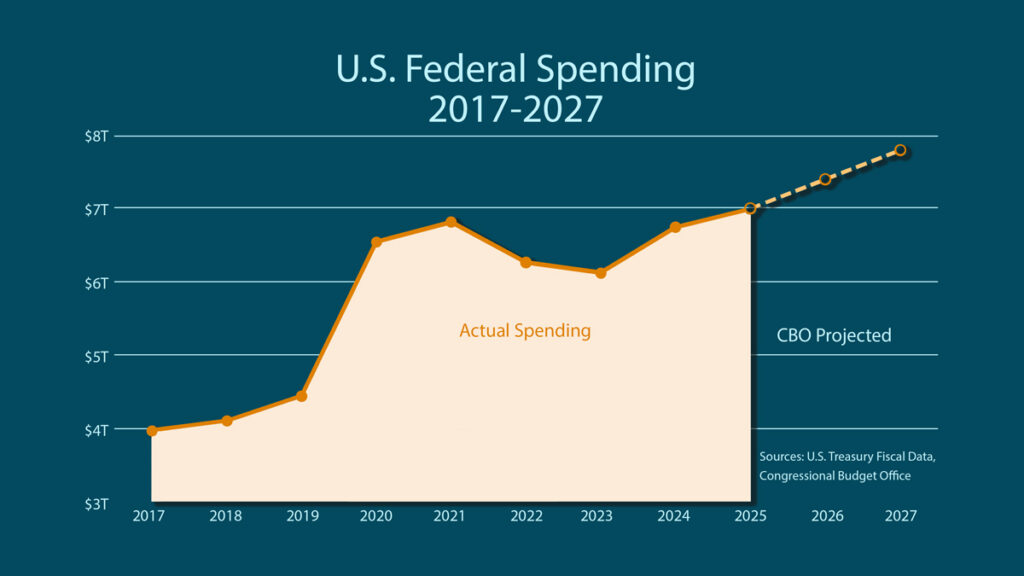
The combination of overspending and ongoing deficits has helped push the national debt to more than $39 trillion, a figure expected to reach $50 trillion by 2030.
Mandatory Items Drive Federal Overspending and Deficits
The CBO Office identifies three major categories of mandatory spending as the primary drivers behind persistent deficits and their rapid growth. Unlike discretionary spending, these obligations are set by law and must be funded each year, leaving little room for adjustment.
Social Security
Social Security remains the single largest line item in the federal budget and one of the fastest-growing. In 2025, it accounted for roughly 22% of all federal outlays. As the Baby Boomer generation continues to retire and cost-of-living adjustments compound, spending is projected to rise from 5.2% of gross domestic product (GDP) today to 5.9% by 2036. According to the CBO, this program alone will account for roughly 28% of total spending growth over the next decade.
At the same time, the system is approaching a critical inflection point. The Social Security trust fund is currently projected to be depleted by 2032, just six years away. Without legislative action, that would trigger an automatic reduction in benefits of about 21%, highlighting the structural strain already embedded in the program.
Medicare
Federal healthcare spending represents another major and accelerating pressure on the budget. Medicare alone made up about 15% of federal expenditures in 2025. Medicare outlays are expected to increase from 4% of GDP to 5.2% by 2036. When combined with Medicaid, Affordable Care Act subsidies, and the Children’s Health Insurance Program (CHIP), total federal health spending is projected to climb from 5.8% to 6.7% of GDP.
This is not just a spending issue. It is also a demographic one. The U.S. is entering a period where a growing share of the population is drawing benefits, while a relatively smaller working-age population supports the system. As a result, healthcare costs are proving exceptionally difficult to contain, with long-term upward pressure already locked in under current trends.
Debt Interest
The third major driver is interest on the national debt, an expense that is growing rapidly and compounding over time. In 2025, net interest payments represented about 14% of government spending. Interest costs have already surpassed national defense spending, reaching approximately $970 billion annually. By 2036, that figure is projected to more than double to $2.1 trillion.
The CBO further warns that after 2027, net interest costs will exceed their historical share of GDP at any point since at least 1940. What makes this category particularly concerning is its self-reinforcing nature. As debt levels rise, so do interest costs. In turn, higher interest payments contribute to even larger deficits and additional borrowing. Under current law, there is no natural constraint on this cycle, allowing it to accelerate over time.
“It's a self-reinforcing spiral. More debt creates higher interest costs. Higher interest costs create more debt. And there's no natural ceiling under the current law.”
Steve Rand
General Manager / Sr. Precious Metals Advisor


 SUGGESTED READING
Gold’s Rise Overtakes Federal Spending
Gold has a centuries-long track record of keeping pace with inflation, rising steadily during economic downturns to help offset losses in the broader market. However, the yellow metal’s performance is also closely tied to government spending. This connection is especially evident in the past 10 years of fiscal mismanagement. While the annual federal budget and deficit have both doubled in the last decade, gold has more than kept pace.
In 2017, gold prices were at $1,150/oz, down from a peak of around $1,800/oz in 2012. Today, the yellow metal comfortably sits above $4,700/oz. That’s a staggering surge of more than 300% in less than a decade. The increase is even higher when measured to gold’s recent all-time high of $5,589/oz in January 2026.

“Gold is up 300% in 10 years. Why? It has everything to do with out-of-control spending, which requires borrowing money, printing more money, which creates inflation, and gold rises.”
Steve Rand
General Manager / Sr. Precious Metals Advisor
Gold’s Role in Retirement Planning
With spending on the rise, deficits expanding, and the long-term outlook being called “unsustainable,” savvy investors are repositioning their investment portfolios to withstand the incoming economic pain. As gold’s performance over the past decade has moved right alongside those trends, diversifying into precious metals is becoming a central pillar of long-term investing.
With Tax Day approaching, there is still a short window to take action for the 2025 tax year. IRA contributions can still be made and allocated into a Precious Metals IRA, allowing you to take advantage of both tax benefits and long-term asset protection.
2025 and 2026 IRA Contribution Limits:
| 2025 IRA Contribution Limits | 2026 IRA Contribution Limits | |
|---|---|---|
| Under age 50 | $7,000 | $7,500 |
| Age 50+ (catch up contribution) | $8,000 | $8,600 |
Many investors are also unaware of how much flexibility they already have. Existing retirement accounts can often be repositioned into a gold IRA, including:
- Traditional IRAs and Roth IRAs
- SEP IRAs
- Employer plans like 401(k)s and 403(b)s
- Thrift Savings Plans
Depending on the account, contributions may be tax-deductible, or growth may occur tax-deferred or tax-free. Either way, your money compounds without the drag of immediate taxation. In an environment defined by inflation, rising debt, and uncertainty around the U.S. dollar, a Gold IRA allows you to pair those tax advantages with physical assets built for long-term stability.

Protect Against What Comes Next
In an environment defined by inflation, rising debt, and uncertainty around the dollar, a Gold backed IRA allows you to pair those tax advantages with physical assets built for long-term stability.
- 👉 To learn how gold can help protect your nest egg while lowering your tax burden, watch our in-depth video on How a Precious Metals IRA Works.
- 👉 To learn more about investing in precious metals, grab a FREE copy of our Precious Metals Investor Guide.
Question or Comments?
If you have any questions about today’s topics or want to see us discuss something specific in a future The Gold Spot episode, please add them here.
Comment
Questions or Comments?
"*" indicates required fields