

Steve Rand
General Manager / Sr. Precious Metals Advisor
Steve Rand is the General Manager and a Sr. Precious Metals Advisor at Scottsdale Bullion & Coin. He brings over 20 years of experience in the physical precious metals markets.

Michelle Ellis
Precious Metals Manager / IRA Liaison
Michelle Ellis is the IRA Liaison and manager at Scottsdale Bullion & Coin. She has over 8 years of experience helping investors set up or rollover their IRAs into physical gold and silver.

Add SBC on Google as a preferred source to see more market related news like this when you search.


Gold’s rally may only be getting started. Institutional money is still underallocated, IRA deadlines are days away, and Wall Street is quietly rewriting the traditional portfolio model.
In this week’s The Gold Spot, Scottsdale Bullion & Coin’s Sr. Precious Metals Advisor Steve Rand and IRA Liaison Michelle Ellis discuss which investors could fuel the next surge in gold prices, how you can optimize your investments through a gold IRA, and why the traditional portfolio model is being reconsidered, even by leading financial institutions.
Institutional Investors Set to Spark Next Leg of Gold Rally

Thus far, the multi-year gold rally has been primarily driven by a combination of sustained central bank gold demand and unprecedented retail interest. Just last year, total gold purchases reached an all-time high of over 5,000 metric tons. Official buyers scooped up over 1,000 tonnes between 2022 and 2024, and picked up another 834 tonnes in 2025. Additionally, retail physical demand notched a 12-year high in 2025, totaling 1,374 tonnes.
Although institutional demand, in the form of private banks, hedge funds, and investment firms, has warmed up to gold over the past few years, this significant portion of potential buyers has yet to fully enter the market. However, that might be about to change. Sprott Inc.’s Senior Managing Partner, Ryan McIntyre, believes institutional buyers will drive the next major influx of investment into the gold market.
“As the economic uncertainty grows, that shift into gold could spark the next rally to all-time highs.”
Steve Rand
General Manager / Sr. Precious Metals Advisor


Why are institutional investors waiting to buy?
With gold rising reliably over the past few years and strong inflows coming from official and retail sectors, the obvious question is, why have institutional investors dragged their feet for so long? To this question, Sprott’s McIntyre sees two primary obstacles:
- Limited Institutional Expertise: Since 2015, major financial institutions have largely gutted their commodities sectors, preferring to focus on more mainstream assets. This lack of expertise left many organizations disengaged from the gold market.
- Strong Performance of Familiar Assets: A compounding reason for the relative inactivity of institutions in gold buying is the relative success of more mainstream asset classes. For instance, since 2015, the S&P500 has more than tripled. In the past few years, the leading equities index has consistently set fresh records.
Banks Remain Bullish on Gold Despite Low Allocations
The institutional sector may remain underallocated to gold relative to central banks and retail investors, but their projections for the yellow metal remain optimistic. Many 2026 gold price predictions from leading banks and investment firms expect gold to hit $6,000 an ounce or above by the end of the year.
Rising Geopolitical Risk Threatens to Delay Institutional Gold Spree
Typically, geopolitical unrest drives investors toward precious metals and other safe-haven assets to hedge against inflation and to de-risk amid shaky markets. However, the current war in Iran is creating a more nuanced investment landscape. Right now, gold faces a few headwinds, delaying the potential institutional investment wave and prolonging the sideways trading. McIntyre highlights a few main obstacles:
- 📈 Rising Treasury Yields: The Federal Reserve has taken a more cautious stance on rate cuts amid rising economic uncertainty. These higher yields increase the opportunity cost of holding gold.
- 💵 Strong Dollar: The U.S. Dollar has seen a short-term boost in value following a long drought as investors around the world seek economic shelter in a familiar asset.
- 🌐 Macroeconomic Uncertainty: The slowdown in global trade, especially in the energy sector, and the subsequent spike in gas prices have stalled the global economy. This pause creates hesitation among investors.
It’s crucial to note that many economists and financial commentators view the calm in the gold markets to be temporary. In fact, Schiff Gold founder Peter Schiff highlights how gold fell before it soared in 2008, drawing a parallel to the current situation. He believes prices could experience a similar rebound, up to new peaks.
In the early months of the 2008 GFC, gold crashed 32%, about 40% of its prior bull-market gain. After gold bottomed, it surged 178% over the next three years. Gold nearly hit $4,100 today, down 27%, about 40% of its gain since $2K. A 178% surge from that low puts gold at $11,400.
— Peter Schiff (@PeterSchiff) March 23, 2026

The window to make your 2025 contributions to your precious metals IRA is closing quickly. Investors have until April 15, 2026, to make investments that count toward the 2025 tax year. At the same time, you can get a head start on your 2026 contributions to minimize your tax burden and take advantage of calmer gold and silver prices.
For 2025, the IRS contribution limits are:
| 2025 IRA Contribution Limits | 2026 IRA Contribution Limits | |
|---|---|---|
| Under age 50 | $7,000 | $7,500 |
| Age 50+ (catch up contribution) | $8,000 | $8,600 |
“Don't wait until the last minute. We're seeing a high volume of contributions this year, especially with the recent pullback in gold and silver. So it's critical to try and get started now.”
Michelle Ellis
Precious Metals Manager / IRA Liaison

Rethinking the 60-40 Portfolio: Why Investors Are Turning to Gold
Historically, the final stretch leading into April 15 sees a surge in IRA contributions, and early April 2026 is already showing elevated activity, so don’t wait until the last minute! Getting started now ensures your contribution is completed on time and allows for a more deliberate, strategic allocation into precious metals.
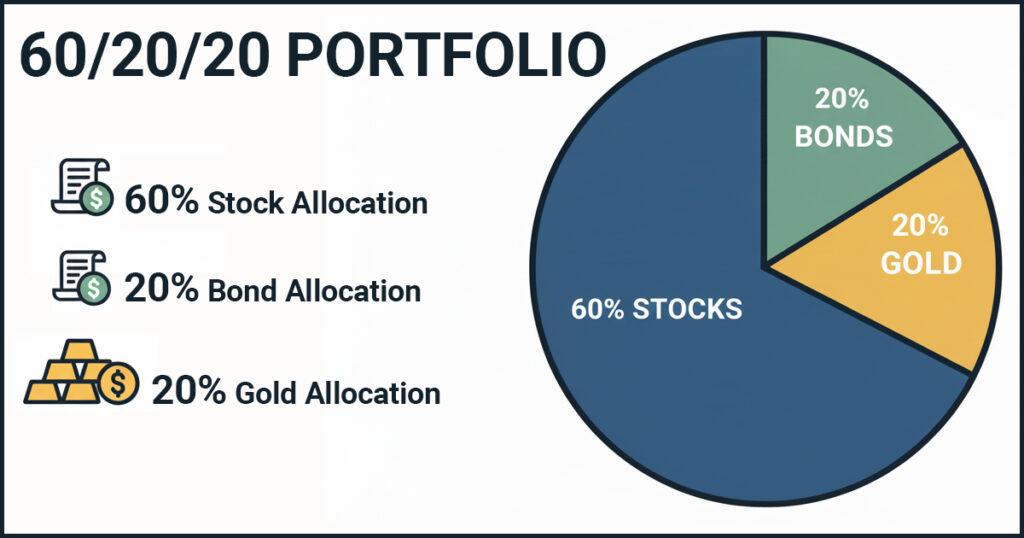
For decades, conventional investment wisdom championed the 60/40 portfolio model: 60% allocated to stocks for growth and 40% to bonds for stability. Unfortunately, this foundation of long-term investing was grounded in an economic landscape that’s been shifting rapidly. A combination of active de-dollarization across the globe, domestic fiscal mismanagement, and shifting investment behavior has forced a market reckoning with this traditional portfolio.
“Bonds are no longer providing the same level of protection that they once did.”
Steve Rand
General Manager / Sr. Precious Metals Advisor
Now, some of the largest financial institutions and well-known investors are recommending a 60/20/20 portfolio rule, where the traditional 40% aimed at stability is split between bonds and gold. In today’s environment of persistent inflation, rising debt levels, and increased market volatility, bonds are simply no longer delivering the same level of downside protection investors once relied on.
Put This Strategy Into Action
As more institutions move toward real assets and away from traditional portfolio models, the opportunity for individual investors is clear: get positioned early, not late.
If you’re looking to incorporate gold into your portfolio using tax-advantaged dollars, here are the next steps:
👉 Watch our in-depth video explaining how a Precious Metals IRA works.
👉 Learn how gold can protect your portfolio with a FREE copy of our Precious Metals Investment Guide.
Question or Comments?
If you have any questions about today’s topics or want to see us discuss something specific in a future The Gold Spot episode, please add them here.
Comment
Questions or Comments?
"*" indicates required fields