

Steve Rand
General Manager / Sr. Precious Metals Advisor
Steve Rand is the General Manager and a Sr. Precious Metals Advisor at Scottsdale Bullion & Coin. He brings over 20 years of experience in the physical precious metals markets.

Brian Conneely
Sr. Precious Metals Advisor
Brian Conneely is a Precious Metals Advisor at Scottsdale Bullion & Coin. He's worked in the precious metals market since 2009, trading commodities and futures before moving into physical gold & silver investing.

Add SBC on Google as a preferred source to see more market related news like this when you search.

How much of your portfolio should be in gold and silver: 5%, 10%, 20%, or more?
It’s one of the most common questions precious metals investors ask, yet even leading financial professionals offer widely different answers. As some argue for larger gold allocations, understanding the reasoning behind those percentages matters as much as the numbers themselves.
In this The Gold Spot episode, Scottsdale Bullion & Coin’s Sr. Precious Metals Advisor Steve Rand and Sr. Precious Metals Advisor Brian Conneely discuss the roles gold can play in your portfolio, why expert allocation recommendations differ, and how your financial circumstances shape the right balance of gold and silver.
The 3 P’s of Precious Metals Investing
Before focusing on a fixed allocation percentage, precious metals investors are encouraged to ask a more fundamental question:
“What job do I want gold to perform in my portfolio?”
Gold can serve several different functions, such as keeping pace with inflation, preserving wealth, hedging against financial instability, protecting privacy, and gaining independence from digital systems.
Gold can fulfill several or even all of these roles at once, with certain objectives taking priority as economic conditions change. Investors also shape how precious metals serve their goals through how much they own, the products they choose, and how they hold them.
Scottsdale Bullion & Coin breaks down gold’s numerous roles into three P’s: privacy through physical ownership, profit through potential price appreciation, and protection through diversification and wealth preservation.
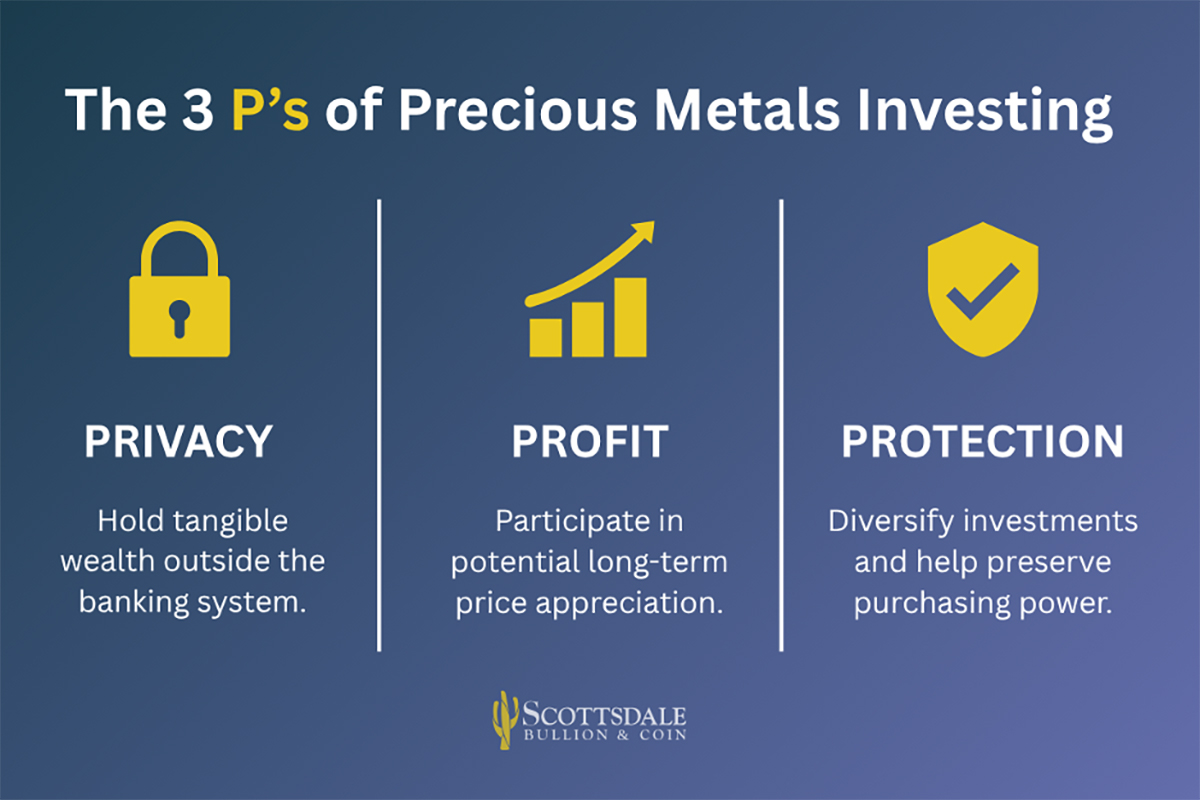
These goals often overlap. Identifying which matters most helps you decide how much to allocate and which metals and products fit your priorities.
Why Do Expert Gold Allocation Recommendations Vary?
According to the World Gold Council (WGC), gold is one of the most widely traded and liquid assets in the world, only trailing behind currency trading and global equities. With a wide spectrum of investors active in the market, gold allocation recommendations can vary widely, as financial professionals place different emphasis on gold’s role in a portfolio. For example:
- A portfolio manager may emphasize diversification alongside stocks and bonds.
- An investor concerned about inflation or currency weakness might give gold a larger role.
- A precious metals specialist may focus on physical ownership and exposure to risks within the financial system.
Scottsdale Bullion & Coin’s recent analysis of dozens of professional gold allocation recommendations from leading financial institutions and analysts found a broad range between 2% and 75%. However, the overwhelming majority of experts fell within the 10% to 25% range. The average recommendation came out to 18%.
These recommendations reflect differing investment goals, market outlooks, risk assessments, and time horizons, making them useful starting points rather than fixed rules for every portfolio.
The Rise of the 60/20/20 Portfolio

For decades, conventional investment wisdom recommended investors split their portfolio between 60% stocks and 40% bonds, with a minimal percentage of the latter category sometimes dedicated to precious metals.
Over the past few years, the traditional 60/40 framework has come under scrutiny, with many prominent financial experts arguing that the diversification is insufficient. Most notably, Morgan Stanley championed the 60/20/20 portfolio: 60% stocks, 20% bonds, and 20% gold.
“Gold isn't necessarily being viewed as just a small alternative investment anymore. It's increasingly being discussed as a meaningful component of a diversified portfolio.”
Steve Rand
General Manager / Sr. Precious Metals Advisor

Again, precious metals allocation should be built around an individual’s financial goals, risk tolerance, and time horizon. Still, this foundational shift in mainstream investment advice reflects the metal’s increasingly prominent role.
Key Factors That Shape Your Precious Metals Allocation
As with any investment, how much you allocate to gold should reflect your financial objectives and personal circumstances.
Gold’s core strengths in wealth preservation and diversification can serve a range of goals, while a tailored allocation acts like a lens, focusing those strengths on your financial priorities.
In fact, two investors with an identical net worth can invest in gold for different purposes. For example, a person approaching retirement may focus more on preserving accumulated wealth while maintaining liquidity for potential living costs. On the other hand, a younger investor might aim for long-term price appreciation, with a broader investment horizon allowing for greater risk tolerance.
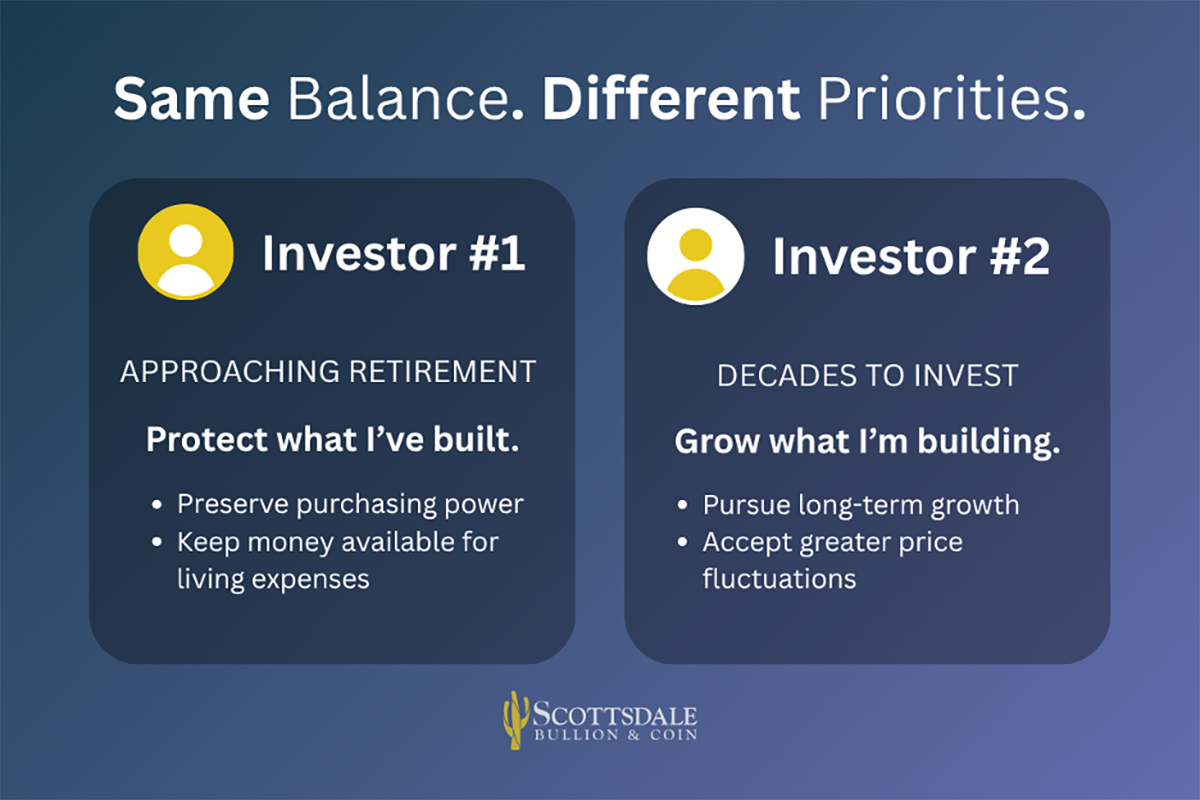
The same amount of wealth can call for different allocations, depending on each investor’s stage of life and plans for the future.
“The goal shouldn't be to blindly follow a percentage recommended by someone on Wall Street, or even a well-known investor.”
Steve Rand
General Manager / Sr. Precious Metals Advisor
A Practical Checklist for Your Precious Metals Allocation
Choosing an allocation involves weighing your investment goals against your financial commitments and preferences.
Before deciding how much of your portfolio to dedicate to gold and silver, consider the following:
- Your primary objectives, including wealth preservation, growth, or leaving a financial legacy.
- Your investment horizon and retirement plans.
- Your income, budget, and available funds for building your holdings.
- The cash you need for emergencies and upcoming expenses.
- Your existing exposure to stocks, bonds, and other assets.
- Your comfort with price fluctuations.
- The importance you place on financial privacy, physical ownership, and control over your holdings.
- Your outlook on inflation, currency depreciation, and broader economic conditions.
Gold & Silver: Choosing the Right Mix for Your Portfolio

The precious metals spotlight often shines brighter on gold, but investors shouldn’t underestimate the role silver can play in a well-diversified portfolio. Like gold, silver has a long history as a store of wealth and means of exchange. Its distinctive physical properties also make it valuable in a wide range of manufacturing applications.
“After deciding how much of your portfolio should be in precious metals, you still need to consider how much should be gold and how much should be silver.”
Brian Conneely
Sr. Precious Metals Advisor
This combination of investment and industrial demand provides an additional source of demand that can support silver prices alongside investment buying. In fact, silver’s functional uses are so core that it was recently added to the U.S. Critical Minerals List, officially recognizing it as a metal of national security and economic interest.
Gold and silver share many investment benefits, but differences in pricing, market size, and demand sources influence how each responds to economic conditions. When deciding how to divide your precious metals allocation, it’s important to understand how silver tends to differ from gold, including:
- Affordability: Silver’s lower price per ounce makes full-ounce purchases more accessible.
- Flexibility: Its lower cost per ounce makes it easier to build physical holdings through regular purchases.
- Industrial demand: Manufacturing accounts for a larger share of silver demand than gold demand.
- Technology applications: Silver is used in electronics, batteries, and solar panels.
- Growth potential: Silver can outperform gold during strong precious metals rallies.
- Volatility: Its smaller market contributes to larger price swings than gold.
- Economic sensitivity: Silver’s industrial demand responds to changes in business activity.
- Storage: The same dollar investment in silver weighs more and takes up more space than gold.
Those differences between gold and silver matter when choosing your mix. Investors emphasizing wealth preservation may approach the balance differently from those willing to accept larger price swings.
“I always encourage people to focus on their long-term objectives rather than trying to find one magic percentage.”
Steve Rand
General Manager / Sr. Precious Metals Advisor
Build an Allocation Around Your Goals
The right precious metals allocation starts with understanding what you want gold and silver to accomplish. Expert recommendations offer useful perspective, while your financial circumstances and priorities help determine the percentage, mix of precious metals, and products that fit your investment portfolio.
For a closer look at the approaches discussed by leading financial institutions and prominent investors, check out our expert precious metals allocation report.
For personalized recommendations and expert advice, our precious metals advisors are around to answer your questions and explore different options for physical gold and silver.
Contact us today by calling toll-free at 1-888-812-9892 or using our live chat function. As always, it costs nothing to consult.