

Eric Sepanek
SBC Founder
Eric Sepanek is the founder of Scottsdale Bullion & Coin, established in 2011. With extensive experience in the precious metals industry, he is dedicated to educating Americans on the wealth preservation power of gold and silver.

Add SBC on Google as a preferred source to see more market related news like this when you search.


Global gold exchange-traded funds (ETFs) recorded positive inflows through September, pushing total holdings to a fresh record.
Investors showed a strong appetite for gold even as prices declined during the month. This September rush pushed third-quarter inflows to historic highs, reflecting growing investor concerns over inflationary pressures, government borrowing, and economic stability.
With traditional headwinds such as higher interest rates and a stronger dollar failing to deter gold buyers, are the forces driving gold demand fundamentally changing?
September Gold Rush Caps Record $31 Billion Quarter
According to the World Gold Council (WGC), investors poured $10 billion into physically backed gold ETFs in September, adding 67 tonnes. This represents the third-strongest month of 2026 and extends a three-month streak of positive inflows. Together, August and September accounted for roughly 90% of Q3’s total ETF purchases.
At the end of Q3, global gold-backed ETFs stood at an all-time high of 4,256 tonnes, with 211 tonnes added in this quarter alone. This milestone marks a 10.4% increase in holdings from September 2025.

Chart data source: World Gold Council
Western investors drove much of the buying spree, with European gold ETFs attracting a record $13.6 billion in Q3, outpacing North America’s $11.7 billion. At the same time, Asian funds added $4.9 billion. The resurgence of Western gold ETF demand reflects growing concerns over government debt, currency instability, and dollar debasement, building off August’s momentum.
ETF Holdings Rose as Values Fell
Sometimes, rising gold prices can inflate ETF asset values without a corresponding increase in physical holdings. The opposite happened in September as demand rose despite gold prices retreating through the month.
As the metal’s value declined, global ETF assets under management—representing the dollar value of fund holdings—dropped from $615.16 billion in August to $574.23 billion in September. Despite the 6.7% decline in asset values, physical gold holdings increased 1.6%, reaching an all-time high of 4,256 tonnes.
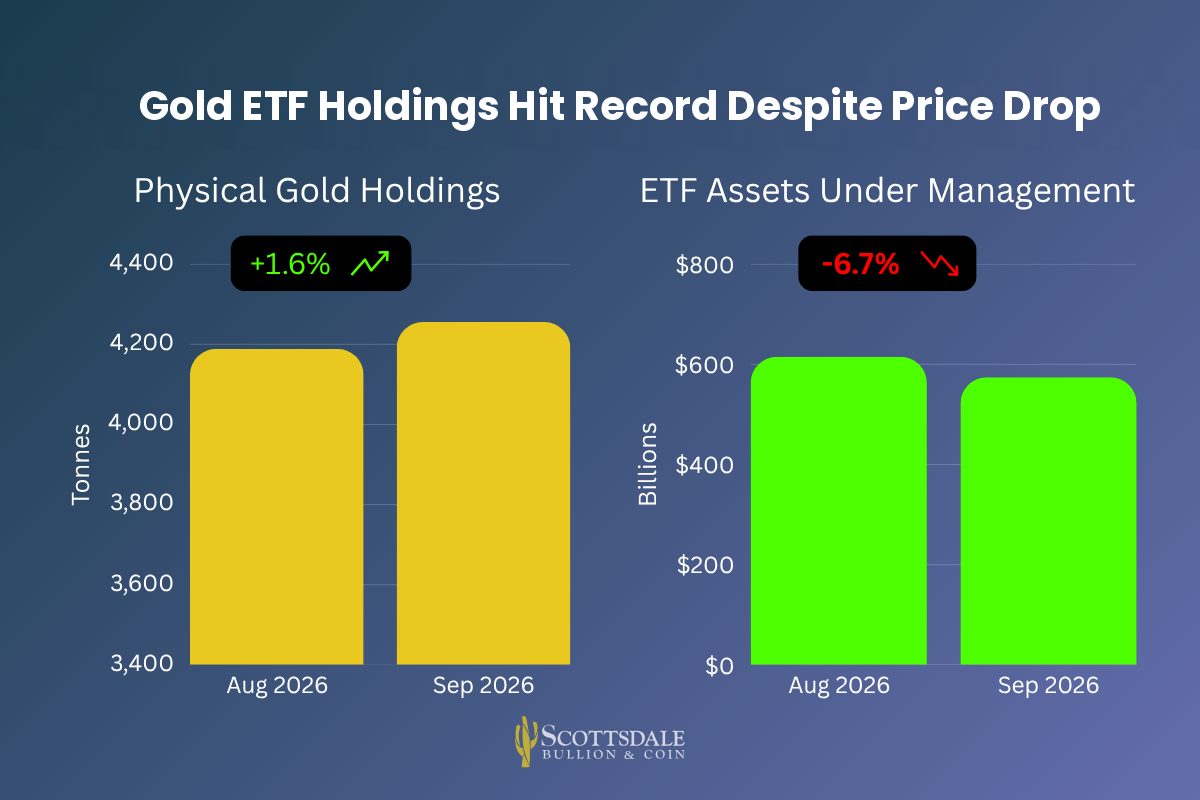
Chart data source: World Gold Council
Rather than deterring investors, September’s gold price slump coincided with continued ETF accumulation, suggesting that buyers remain confident in gold’s longer-term prospects or view the correction as a buying opportunity.

Gold ETF Demand Defies Traditional Headwinds
The broader macroeconomic environment makes the sustained surge in global gold ETF demand even more noteworthy.
Traditionally, higher Treasury yields and a stronger U.S. dollar have weighed on gold prices. Rising yields make non-yielding assets less attractive relative to interest-bearing investments, while a stronger dollar makes the metal more expensive for foreign buyers.
However, gold demand remains elevated as Treasury yields soar and the dollar strengthens. In September, the 10-year U.S. Treasury yield jumped 53 basis points to 5.3%, while the U.S. Dollar Index gained 2%. Recent research suggests that gold’s relationship with interest rates has become less predictable.
J.P. Morgan Asset Management found that 10-year real Treasury yields explained 85% of gold price variation between 1990 and 2021, compared with just 16% since 2022. Similarly, Reuters reported in April 2026 that gold’s traditionally inverse relationship with the U.S. dollar had weakened by roughly 53% compared with its five-year average.
Will Gold ETF Demand Remain Strong in Q4 2026?
Early fourth-quarter data suggest investors are maintaining their gold positions despite continued price volatility. By October 8, Bloomberg-tracked gold ETF holdings reached a 2026 high of 101.3 million troy ounces, representing a 5.3% increase from July’s low of 96.2 million ounces. These holdings held steady even as gold prices slumped below September levels.
Furthermore, BMO reported in October that gold ETF holdings are exceeding levels suggested by their historical relationship with gold prices. The firm believes concerns about government finances, inflation, and bond-market volatility could support sustained investment demand. Similarly, Invesco and Sucden Financial expect continued ETF buying to help support gold prices through Q4.
Together, Q3’s record-breaking investment demand and continued accumulation into October suggest that investors are increasingly looking beyond short-term price fluctuations, focusing on gold’s longer-term role amid rising economic uncertainty.