

Joe Elkjer
Sr. Precious Metals Advisor
Joe Elkjer, a Precious Metals Advisor at Scottsdale Bullion & Coin since 2019, specializes in helping clients protect their assets through tangible investments. With a strong background in business and finance, he emphasizes stellar customer service and stays dedicated to informing clients about market impacts through frequent appearances on The Gold Spot.

Todd Graf
Precious Metals Advisor
Todd Graf is a seasoned Precious Metals Advisor at Scottsdale Bullion & Coin. He has a decade-long career in finance, previously at Morgan Stanley and Vanguard. He is Series 7 licensed and has extensive experience in traditional and defensive assets, providing clients with solid investment strategies.

Add SBC on Google as a preferred source to see more market related news like this when you search.

Recently, the Federal Reserve felt the need to officially address viral claims that gold bullion has overtaken United States Treasuries as the world’s premier reserve asset. Yet, within its own argument, the central bank highlighted the global trend of official investors increasing their gold reserves as geopolitical and economic uncertainty mounts.
In this week’s The Gold Spot, Scottsdale Bullion & Coin’s Sr. Precious Metals Advisor Joe Elkjer and Precious Metals Advisor Todd Graf break down the Fed’s argument, the institutional shift driving physical gold demand, and why some of the world’s largest investors continue treating gold bars and coins as financial insurance.
Did Gold Really Overtake U.S. Treasuries?

Over the past few months, headlines have swirled about gold overtaking the U.S. dollar and euro in global reserves, leading some to assume bullion had usurped the dollar as the primary reserve asset. On September 3, the Fed published a research note directly addressing this conjecture.
In reality, gold surpassed U.S. Treasuries and the euro as a share of global reserves, not the U.S. dollar overall. At the end of 2025, global gold reserves had a market value of roughly $5.1 trillion, exceeding the $3.9 trillion in U.S. Treasuries owned by foreign official institutions. Even after removing America’s gold holdings, the remaining reserves were worth approximately $4 trillion.
Most of these gains stemmed from gold’s skyrocketing prices throughout 2025, reaching an all-time high in January 2026. Although central bank demand has risen considerably in the past few years, many established countries built up their reserves decades ago.
When you look at how much gold central banks actually hold, many leading countries—the U.S., Germany, Italy, and France—have maintained relatively stagnant gold reserves. Together, these four countries, along with the International Monetary Fund, hold around 52% of the world’s gold reserves.
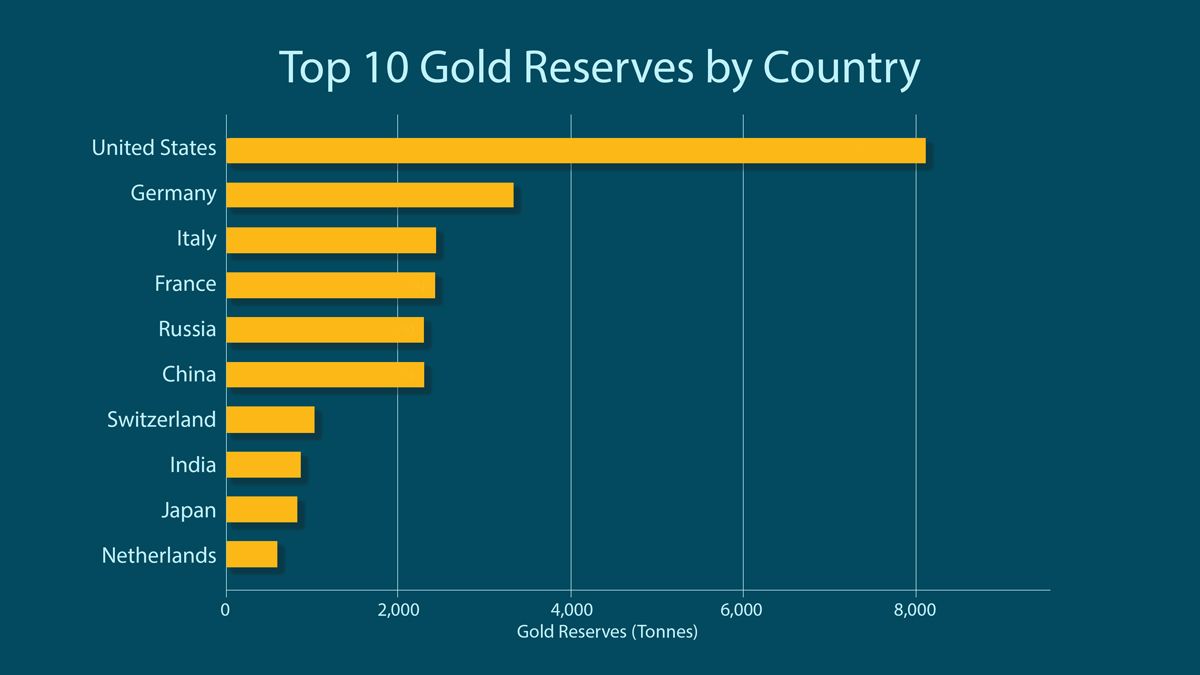
These legacy holdings can obscure what central banks are buying today. Excluding the major legacy holders, U.S. Treasuries still exceed gold in total reserve value. In June 2026, Treasuries led by roughly $1 trillion, or about $600 billion when including estimated unreported gold purchases.
Put plainly, the Fed has a reasonable argument for why gold hasn’t simply “replaced” Treasuries. Still, the more pressing development is how reserve managers have been treating gold recently.
“We don't need to argue that the Fed's math is wrong. The Fed can be winning the statistical argument and still miss the bigger trend.”
Todd Graf
Precious Metals Advisor

Central Banks Have Dramatically Increased Gold Buying
While not directly challenging the math behind some reserve-asset comparisons, the Fed still acknowledges a seismic shift in official gold demand and the macroeconomic and geopolitical catalysts behind it.
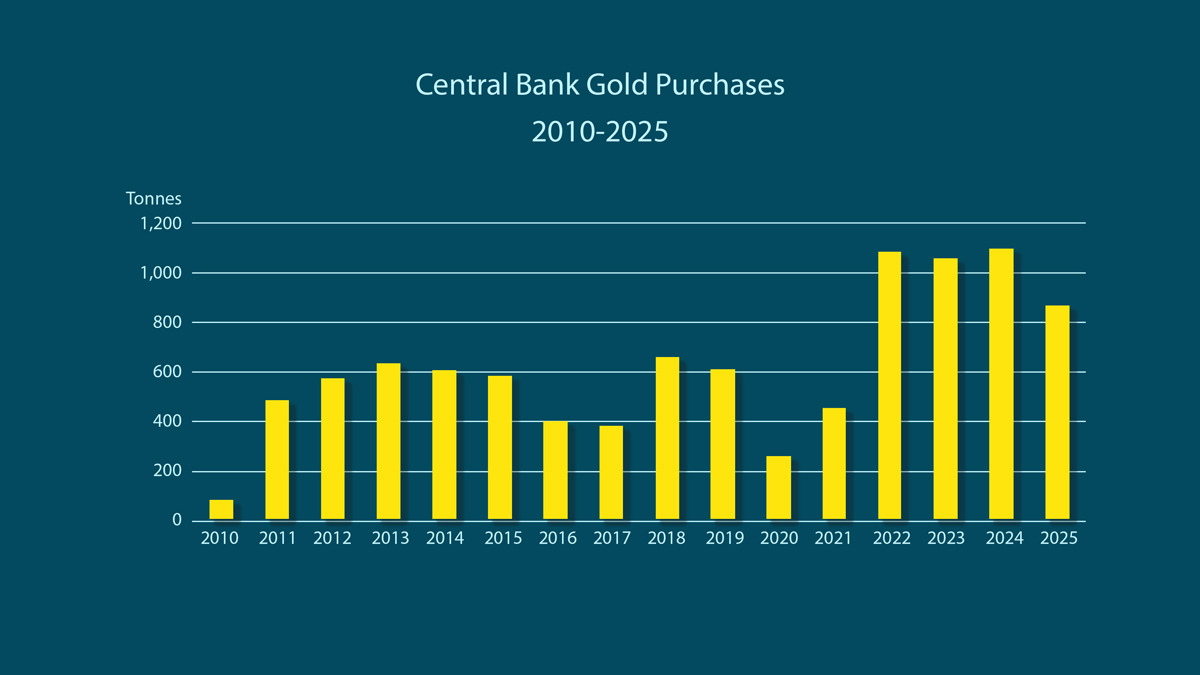
Following decades of net-selling, central banks have been net buyers of physical bullion since 2008. The pace rose dramatically in 2022 in the aftermath of Russia’s invasion of Ukraine, when the weaponization of the dollar and international sanctions kickstarted a modern-day gold rush.
World Gold Council data puts the magnitude of this change into perspective. Central banks purchased more than 1,000 tonnes annually between 2022 and 2024, roughly doubling the average pace seen during the preceding decade. Buying dipped to 863 tonnes in 2025, but remained far above the 2010–2021 annual average of just 473 tonnes.
China provides one of the latest examples. In August, the People’s Bank of China officially added another 20.2 tonnes, marking its largest monthly purchase since October 2023. The move extended the central bank’s buying streak to 22 consecutive months and brought its reported 2026 purchases through August to approximately 80 tonnes.

The trend appears poised to continue. A record 45% of central banks expect to increase their own gold reserves over the next year, marking the most bullish reading since the survey began in 2018. At the same time, 89% expect global official gold holdings to rise, suggesting central bank demand could remain a powerful force in the market well beyond the current buying cycle.
“Gold may not have officially replaced Treasuries, but central banks clearly want more of it than they used to. That is arguably the more important story for investors.”
Joe Elkjer
Sr. Precious Metals Advisor
The World’s Largest Money Managers Are Rebuilding Gold Positions
This institutional shift is no longer confined to central banks. Bloomberg recently interviewed more than a dozen major asset managers overseeing a combined $27 trillion. Every firm had either recently increased its gold exposure or maintained a bullish allocation.
Several managers used gold’s recent correction as a buying opportunity:
- Amundi: Europe’s largest asset manager purchased bullion and expects gold to return to around $5,000/oz by year-end.
- Pictet Asset Management: Rebuilt gold exposure after trimming positions earlier in 2026.
- Fidelity International: Also added back exposure it had previously reduced.
- Robeco: Returned to gold as central bank demand accelerated, with portfolio manager Arnout van Rijn calling gold “part and parcel” of a normal portfolio.
- BNP Paribas Asset Management: Rebuilt exposure as gold’s correlation with stocks and other risk assets weakened, strengthening its usefulness as a hedge.
Rather than abandoning gold after its steep retreat from January’s highs, some of the world’s largest money managers used lower prices to rebuild exposure. Timing matters, since many top banks say gold’s downside risk is running out of room. With private institutional portfolios dwarfing the physical gold market, even a modest increase in allocations could create a substantial new source of demand.
“Central banks aren’t just holding gold and hoping the price goes up. They're treating it like an asset, like insurance that they may need to use in the future.”
Todd Graf
Precious Metals Advisor
Major Investors Are Rethinking Government Debt
Just as institutional investors are increasing their gold exposure, some of the world’s largest pools of capital are reconsidering government debt.
Norway’s $2.3 trillion Government Pension Fund Global, the world’s largest sovereign wealth fund, recently proposed reducing government bonds from 70% to 50% of its fixed-income benchmark. U.S. Treasuries would experience the largest individual decline, potentially cutting nearly $80 billion from the fund’s roughly $215 billion position.
The move isn’t a direct rotation from Treasuries into gold, but the proposal is notable. For generations, sovereign bonds have formed the defensive foundation of major institutional portfolios, with the dollar’s role as the uncontested world reserve currency propping up U.S. Treasuries.
To make matters worse, rising deficits, inflation, and debt burdens are putting increased pressure on bond markets. Just recently, Treasury buybacks revived the debasement trade and gold demand.
Central Banks Are Preparing to Use Their Gold
Central banks aren’t simply buying more gold bars. Increasingly, they’re making strategic decisions about where they store their physical reserves and how readily they can access them. For example, Germany’s repatriation efforts highlight the growing emphasis on maintaining greater control over physical reserves. Meanwhile, France has also taken steps to reduce its reliance on U.S.-based gold custody.
The most recent example comes from the Netherlands. Between March and August 2026, De Nederlandsche Bank (DNB) repositioned roughly 86 tonnes of gold from reserves held in the United States and Canada to increase the amount readily available through London. Its total gold reserve remained unchanged at 612.4 tonnes.
Instead, the reshuffling was designed to improve liquidity, tradability, geographic diversification, and access during a severe crisis. London’s share of Dutch gold reserves jumped from 18.1% to 32.1%, while New York’s allocation fell from 31.3% to 18.5%.
What This Means for Individual Investors

Gold may not have officially replaced U.S. Treasuries, but that misses the bigger trend. Central banks are buying more physical gold, major money managers are rebuilding positions, and some institutions are reducing their dependence on government debt.
For individual investors, the lesson isn’t to abandon stocks and bonds. It’s to consider why some of the world’s most sophisticated investors continue treating physical gold as financial insurance.
To learn how physical gold bars and coins can serve a similar role in your portfolio, claim a FREE copy of our Rookie Mistakes Guide. It can help you avoid common pitfalls and build a precious metals strategy on a stronger footing.
Everything you need to know to get started in Precious Metals
Learn how precious metals can strengthen your portfolio, protect your assets and leverage inflation.
Request the Free Guide
Question or Comments?
If you have any questions about today’s topics or want to see us discuss something specific in a future The Gold Spot episode, please add them here.
Comment
Questions or Comments?
"*" indicates required fields